Bourdain Handed Over the Microphone. Kaleb Cooper Is Who Was Holding It.
There is a plastic stool in Hanoi photographed more often than some cathedrals, and ten years after Bourdain sat down, the pilgrimage still runs to timetable.
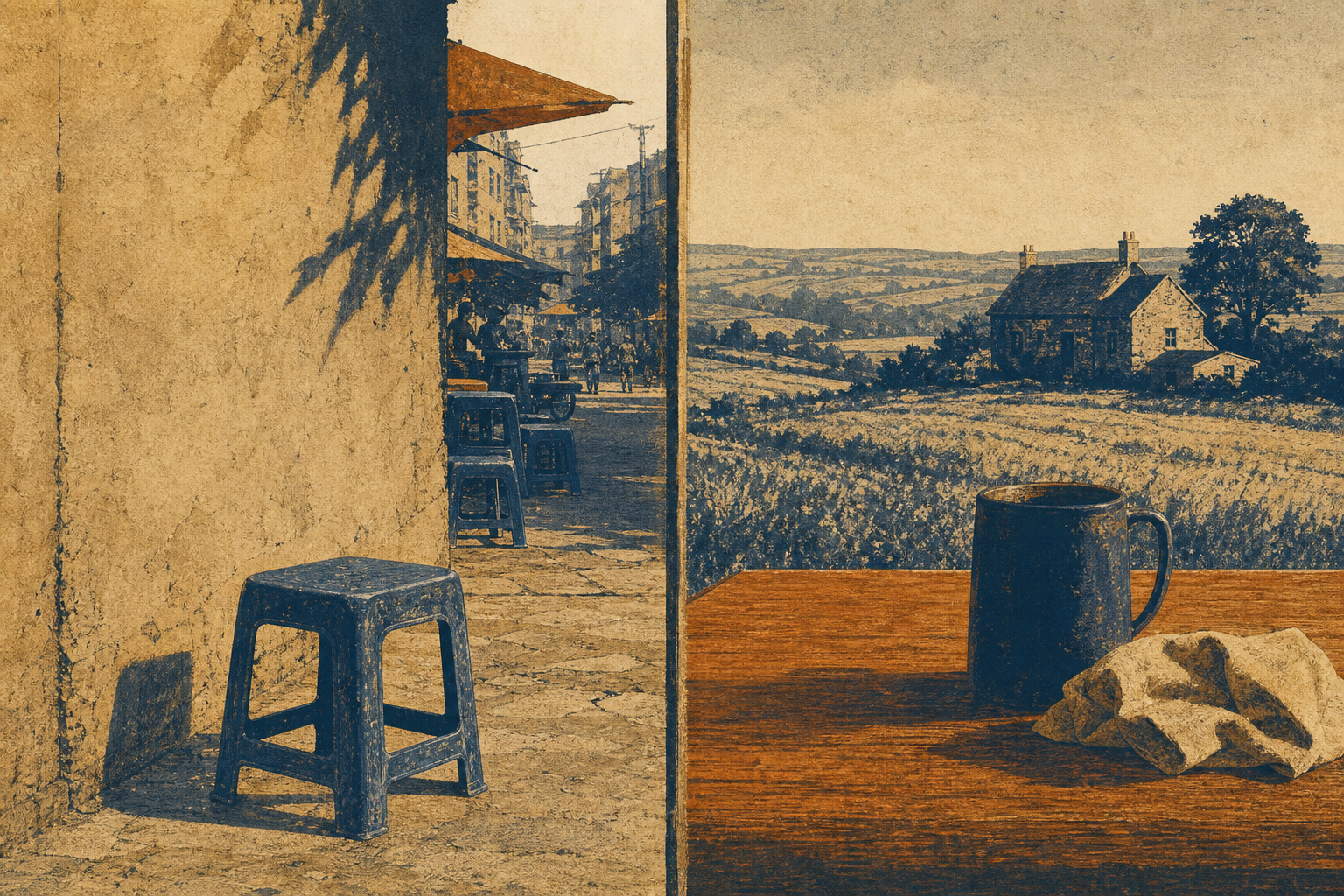
There is a plastic stool in Hanoi photographed more often than some cathedrals. Bourdain sat on one like it in 2016, ate bún chả with a sitting president, and ten years on the pilgrimage still runs to timetable: flight, noodles, photo, caption lifted from a paperback. A recent magazine piece argued that the devotion has soured into something cultlike, and that the faithful may have misread the man they quote. Two hundred miles from any of that, on rented ground in the Cotswolds, a young farm contractor named Kaleb Cooper was asked whether he fancied seeing New York and could not find one reason to go, given the shortage of tractors there. He meant it, flatly and without a glance at the camera. The book he built out of that certainty is stranger and more useful than its gift-table packaging suggests.
Most coverage of the Bourdain estate treats him as a supplier of aphorisms about being brave with food. That is the noise: the tote bag, the tattoo, the itinerary assembled from episodes. The signal is quieter work. His method was deference. He turned up somewhere, found the person who actually knew the ground, shut up, and let them talk about the thing they did every day. Travel was logistics; attention was the job. A fandom organized around booking the same restaurants has inverted that stance, converting a habit of listening into a checklist of addresses. The test of whether you absorbed the method or only the merchandise is simple. Sit with somebody who has no interest at all in your world.
Cooper's book is assembled the way a working day is: short discrete jobs, finished, left behind. Pieces run a page or two, and some run a single line. There is a patient, unhurried explanation of the difference between straw and hay, delivered by a man who has clearly been asked by one townie too many. Sheep are dismissed as "suicidal morons," a verdict he defends with field evidence. Goats get their own reckoning. Farming is declared the best job in the world, a claim he does not so much argue as repeat until resistance starts to feel rude.
Underneath the jokes runs one consistent test: does the thing do work? A tractor passes. A hedge passes, though it takes a decade to prove it. A city with no agricultural function fails on the spot, and so do most of the objects and ambitions attached to it. This is a philosophy of use, and it hangs together better than plenty of positions that get called worldviews on television. It also explains the deadpan. If your single criterion is whether something earns its keep on land you farm, most of modern life can be settled in a sentence, which is funny and faintly alarming in the same breath.
The format has a ceiling and the book walks straight into it. Quickfire opinions are wonderful for forty pages and thinner by the third run of them, because a one-liner can only repeat itself at a fresh angle. Filed under humor and agriculture, it earns the first shelf and rents space on the second. It is also, plainly, a Christmas object, engineered for the stocking and the tie-in table, and pretending otherwise would be silly. The farming here is texture. Anyone hoping for the arithmetic of a dairy operation gets gestures where the numbers should be.
The one figure that would explain almost everything, the price a supermarket actually pays for a litre of milk, never arrives, and neither do contract rates or the debt attached to a combine. That omission costs the book real weight, because money is where rural life turns political, and Cooper is exactly the person who knows those sums by heart. And yet the parochialism is the part worth taking seriously. Cooper has assessed the wider world and found it largely irrelevant to the fields he works, a position almost nobody with a book deal will hold in public.
He has total command of one square patch of England and no anxiety whatsoever about the parts he has not seen. Every travel-writing virtue, the unfamiliar meal, the humbling border crossing, the long bus ride toward discomfort, sits outside his interest entirely, and he sleeps fine.
The argument worth having is what following Bourdain would actually require. Copying his route costs an airfare and a week of annual leave. Copying his attention means handing an hour to somebody whose expertise has no glamour attached and no bearing on your life, then letting them be the authority in the room. Cooper's book is a low-stakes place to practise: funny enough to finish in two sittings, stubborn enough to keep refusing the terms you brought to it. Whether farming is truly the best job in the world is his business. Holding that opinion without needing you to share it is the rarer skill, and the harder one to fake.
Why this book
That is where the two stories touch. The people making pilgrimages to Bourdain's noodle stalls are traveling in order to sit near someone very like Cooper: a person with unglamorous mastery of one specific place, who describes it without polish. Bourdain's contribution was handing that person the microphone and keeping himself out of the frame. His fandom kept the destination and dropped the humility, which is how a man who mocked authenticity shopping ended up as the patron saint of a tour route. The irony curls back on Cooper too. His plainness reaches you through a television format co-produced by Jeremy Clarkson, a broadcaster who bought a farm, then a pub, and turned both into content about the difficulty of running a farm and a pub. The market for unvarnished rural life is enormous, professionally managed, and now includes this book. Cooper sits inside that trade as one of its most bankable assets. What stops the whole arrangement from collapsing into pure product is that his indifference to being interesting reads as constitutional rather than strategic, and strategy is usually the easiest thing to spot.
Bridges by email
A news story and the book that goes with it, whenever we publish one.