Whales Are Moving Into Greenland's Waters. The Ice Sheet Is the Bigger Story.
A whale surfacing where whales did not used to surface is a small event with a long shadow.
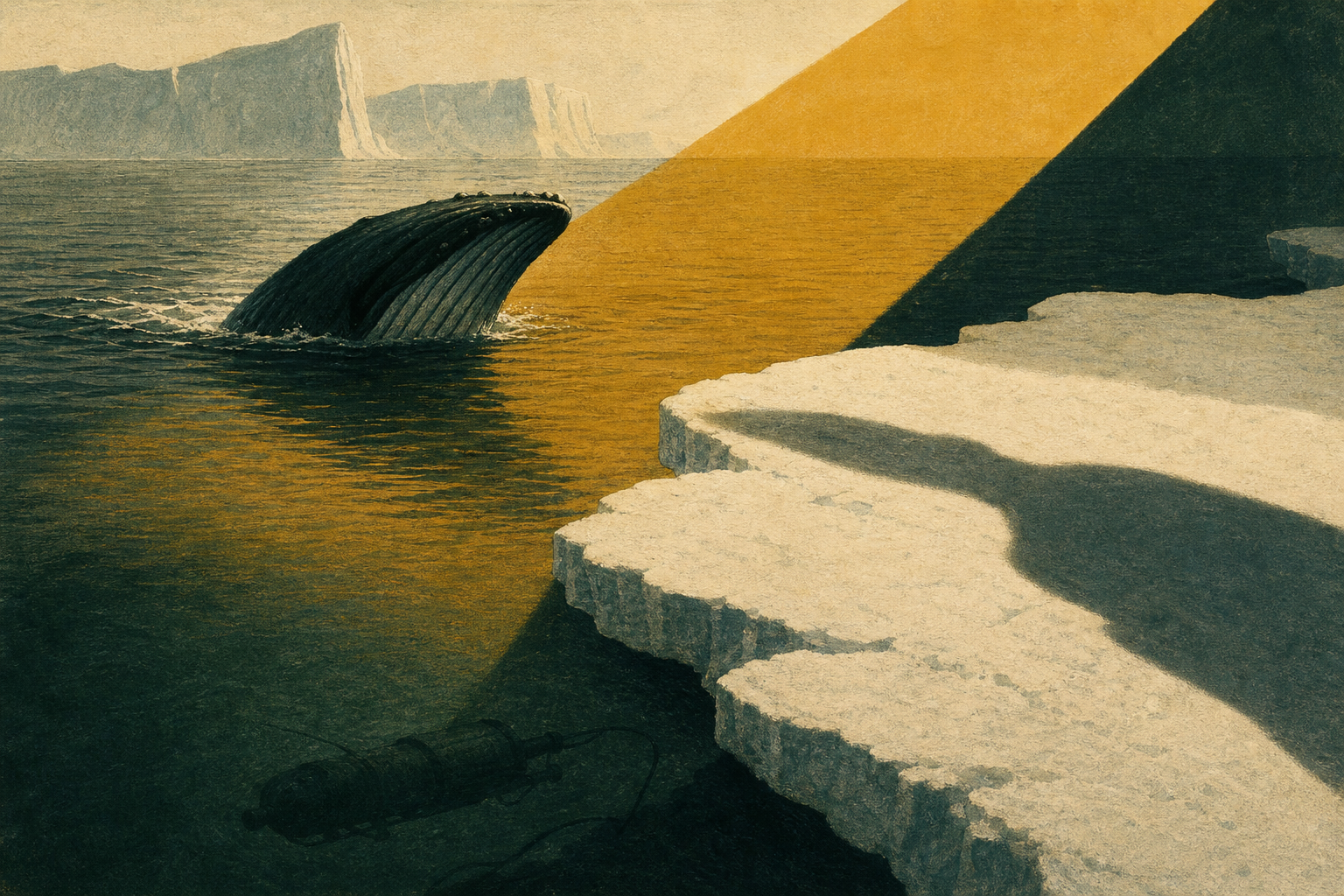
A whale surfacing where whales did not used to surface is a small event with a long shadow. Off East Greenland, water that spent most of the year sealed under sea ice now opens up, and fin, minke and humpback whales have been recorded feeding along fjords and coastal stretches that were closed to them within living memory. The finding comes out of a study run over decades, which is the unglamorous part: someone kept watching and filming, season after season, until absence turned into presence. For the families along that coast, the change arrives as arithmetic. Hunting and fishing calendars bend to match animals their grandparents never tracked, and boat traffic follows the whales, along with visitors holding cameras. These are large mammals doing something sensible with newly available water, and their arrival is the cheerful face on a process that is grinding along underneath it.
Coverage of the whales usually stops at the pleasant part, which puts the emphasis in the wrong place. Sea ice is a thin skin floating on the ocean. Its loss rewrites habitat, opens shipping routes, and darkens a surface that used to throw sunlight back into space, which warms the region further. The sea rises along Florida or Bangladesh for a different reason: the ice sitting on land. Greenland holds enough frozen freshwater to lift global sea level by roughly seven meters, and its runoff is already changing the salinity and density of the North Atlantic, the machinery that moves heat around the planet. So the question underneath the whale story is how fast the island is shedding mass, and what all that fresh water does to currents everyone downstream depends on.
Jon Gertner's "The Ice at the End of the World" answers that question and takes the long way there on purpose. It opens with the explorers who walked out onto the ice sheet when nobody knew how thick it was or whether crossing it would kill them, then hands off to the mid-century scientists who drilled into it, hauling coring gear to outposts where a resupply flight counted as an event on the calendar. The early chapters are full of frostbite, bad rations, and men doing sums about how many dogs they can afford to lose.
The ice cores are where the book earns its ambition. Gertner explains in plain language how layered snow becomes a physical record: trapped air bubbles, volcanic dust, isotope ratios, one band per year, running back through warm spells and abrupt freezes. Drill deep enough and you are reading the weather of centuries that left no written account, sample by sample, in a trailer at the edge of nowhere. The cores' hardest news concerned speed. They recorded a climate capable of turning inside a single human lifetime, a pace the textbook millennia had no room for, and that changed the question of what a warming atmosphere might plausibly do next.
From there the narrative moves to the modern measuring effort: satellites weighing the ice sheet from orbit, aircraft flying the glacier fronts, instruments lowered into fjords to find out whether warm ocean water is working at the ice from below. Gertner is good on the texture of that labor, the waiting, the equipment that seizes at the worst moment, the researcher who hands a whole career to one variable and calls it a fair trade. He writes about instruments the way other people write about characters. The structure costs him something. The exploration chapters run long, and the polar-hero tradition they belong to has a documented habit of treating Greenland as an empty stage.
Greenlandic people appear, but the book's attention stays with the visitors who came to measure and the institutions that wrote the checks. The islanders who have watched this ice their whole lives get less narrative room than one German meteorologist's doomed traverse, and that imbalance is the weakest seam in an otherwise sturdy book. What pulls it back to human scale is Gertner's insistence on following the water. Meltwater leaves the ice in summer rivers, pours into fjords, freshens the surface of the North Atlantic, and turns up decades later as centimeters against a seawall in a city that has never heard of Jakobshavn. The whales off East Greenland run on the same physics, one link closer to the surface.
The next Greenland item worth your attention is likely a number: gigatons lost, meters of potential rise, salinity at a given depth. Gertner gets you fluent enough in that vocabulary for the figures to stop reading as noise and start reading as a forecast for whatever coast you happen to live on. The human version sits right beside the physics, in the people who dragged drills across an ice sheet to learn how fast a climate can turn. The whales off East Greenland are real, they are worth watching, and they are the smallest thing happening in that water.
Why this book
The practical use of a book like this is that it changes what you look for in the next Greenland story. When a headline announces a new species in a fjord, a record melt day, or a slab of floating ice breaking free, you have somewhere to file it. In August 2026, Copernicus Sentinel-1 imagery caught a 76-square-kilometre section of Petermann Glacier's floating tongue drifting off, the glacier's largest such loss since 2012. Knowing whether a given event involves seasonal sea ice or the land-based ice sheet tells you which consequences to expect, and the coverage regularly blurs the two. The charismatic-animal story does more harm than good to public understanding, because it codes warming as rearrangement: whales gain a fjord, the ledger appears to settle, and nothing seems to have been subtracted. The ledger does not settle. The same open water that lets a fin whale into a new bay lets warmer ocean water reach glacier fronts that have sat grounded for centuries. Read only the animal version and you come away picturing an Arctic that is merely reshuffling itself. Gertner's account of the cores and the satellites makes that comfortable picture hard to hold.
Bridges by email
A news story and the book that goes with it, whenever we publish one.