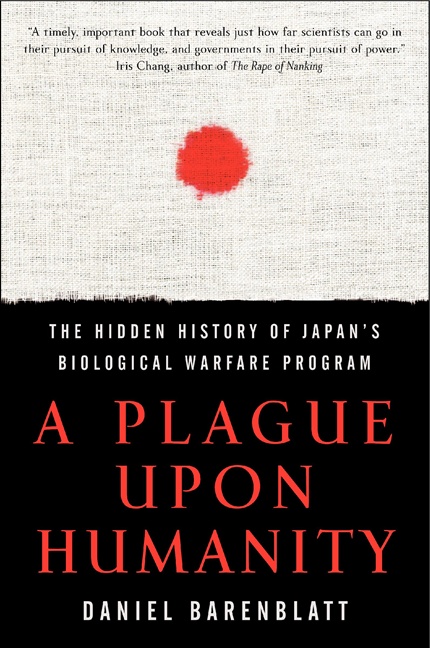
A Plague Upon Humanity
The Hidden History of Japan's Biological Warfare Program
HarperCollins · Print & ebook · January 4, 2005
From 1932 to 1945, in a headlong quest to develop germ warfare capability for the military of Imperial Japan, hundreds of Japanese doctors, nurses and research scientists willingly participated in what was referred to at the time as 'the secret of secrets' – horrifying experiments conducted on live human beings, in this case innocent Chinese men, women, and children.
We earn from qualifying purchases.
- Who it’s for
- A compact, unsettling history of biology used as a weapon.
- Genres
- Chemical & Biological Warfare, WWII Pacific Theater, Japanese History
- Published
- HarperCollins, January 4, 2005
Nearest books
Matched by what the books are about, then ordered by what their readers also loved. Most of these share its genre: Chemical & Biological Warfare.
 The Demon in the FreezerPaul Boehmer, Richard Preston59% match
 The Rape of NankingIris Chang, Anna Fields59% matchAlso shares WWII Pacific Theater and Japanese History
 Japan's Infamous Unit 731Hal Gold, Yuma Totani84% matchAlso shares WWII Pacific Theater and Japanese History
 Factories of DeathSheldon H. Harris81% match
 The United States and Biological WarfareStephen Endicott, Edward Hagerman71% match
 Plague MakersWendy Barnaby, Wendy Bamaby63% match
 BiohazardKen Alibek, Stephen Handelman63% match
For younger readers: When Plague Strikes, When Can We Go Back to America?, Days of Infamy: How a Century of Bigotry Led to Japanese American Internment (scholastic Focus)
Start with three books, and this one can be the first.
Members get a new edition every morning: a route out from their books to essays, research and talks, with the reason for each.
Start with this bookAbout this book
From 1932 to 1945, in a headlong quest to develop germ warfare capability for the military of Imperial Japan, hundreds of Japanese doctors, nurses and research scientists willingly participated in what was referred to at the time as 'the secret of secrets' – horrifying experiments conducted on live human beings, in this case innocent Chinese men, women, and children.
Continue reading
This was the work of an elite group known as Unit 731, led by Japan's answer to Joseph Mengele, Dr Shiro Ishii. Under their initiative, thousands of individuals were held captive and infected with virulent strains of anthrax, plague, cholera, and other epidemic and viral diseases. Soon entire Chinese villages were being hit with biological bombs. Even American POWs were targeted. All told, more than 250,000 people were infected, and the vast majority died. Yet, after the war, US occupation forces under General Douglas MacArthur struck a deal with these doctors that shielded them from accountability. Provocative, alarming and utterly compelling, A Plague Upon Humanity draws on important original research to expose one of the most shameful chapters in human history.
Hidden History
A compact, unsettling history of biology used as a weapon.
Come here for
- hidden-history framing
- warfare-and-disease overlap
Expect
- institutional, classroom-friendly angle
- clear explanatory structure
Where it sits
| Chemical & Biological Warfare | 79% |
|---|---|
| WWII Pacific Theater | 56% |
| Japanese History | 43% |
Percentages are BookFrontier’s reading of the book.
Publisher categories
- Art History
- Ancient History
- Chinese History
- European History
Show all 8 publisher categories
- Japanese History
- Chemical & Biological Warfare
- World War II History
- Medical History
- Authors
- Daniel Barenblatt
- Publisher
- HarperCollins
- Published
- January 4, 2005
- Format
- Print & ebook
- Reading lane
- Art History