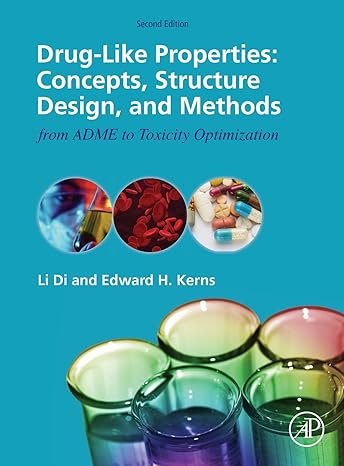
Drug-like Properties
Concepts, Structure Design and Methods From ADME to Toxicity Optimization
Elsevier Science · Print & ebook · January 27, 2016
Of the thousands of novel compounds that a drug discovery project team invents and that bind to the therapeutic target, only a fraction have sufficient ADME (absorption, distribution, metabolism, elimination) properties, and acceptable toxicology properties, to become a drug product that will successfully complete human Phase I clinical trials.
We earn from qualifying purchases.
- Who it’s for
- Explore how ADME and toxicity properties are assessed and optimized in drug discovery.
- Genres
- Pharmacology, Toxicology, Pharmaceutical Technology
- Published
- Elsevier Science, January 27, 2016
Nearest books
Matched by what the books are about, then ordered by what their readers also loved.
 Basic Principles of Drug Discovery and DevelopmentBenjamin E. Blass, Benjamin Blass69% matchShares Pharmacology and Pharmaceutical Technology
 A Comprehensive Guide to Toxicology in Nonclinical Drug DevelopmentAli S. Faqi DVM PhD DABT ATS, Ali S. Faqi66% matchShares Pharmacology and Pharmaceutical Technology
 A Practical Guide to Toxicology and Human Health Risk AssessmentLaura Robinson63% match
 Environmental ToxicologyMohd. Salim Reshi, Darakhshan Javaid61% matchShares Toxicology
 Characterizing BiotherapeuticsJennie R. Lill, Wendy Sandoval61% matchShares Pharmaceutical Technology
 Principles of ToxicologyStephen M. Roberts, Robert C. James60% match
 Practical Process Research and Development – a Guide for Organic ChemistsNeal G. Anderson60% matchShares Pharmaceutical Technology
 Chemometrics and Cheminformatics in Aquatic ToxicologyKunal Roy58% matchShares Toxicology
Start with three books, and this one can be the first.
Members get a new edition every morning: a route out from their books to essays, research and talks, with the reason for each.
Start with this bookAbout this book
Of the thousands of novel compounds that a drug discovery project team invents and that bind to the therapeutic target, only a fraction have sufficient ADME (absorption, distribution, metabolism, elimination) properties, and acceptable toxicology properties, to become a drug product that will successfully complete human Phase I clinical trials.
Continue reading
Drug-Like Properties: Concepts, Structure Design and Methods from ADME to Toxicity Optimization, Second Edition, provides scientists and students the background and tools to understand, discover, and develop optimal clinical candidates. This valuable resource explores physiochemical properties, including solubility and permeability, before exploring how compounds are absorbed, distributed, and metabolized safely and stably. Review chapters provide context and underscore the importance of key concepts such as pharmacokinetics, toxicity, the blood-brain barrier, diagnosing drug limitations, prodrugs, and formulation. Building on those foundations, this thoroughly updated revision covers a wide variety of current methods for the screening (high throughput), diagnosis (medium throughput) and in-depth (low throughput) analysis of drug properties for process and product improvement. From conducting key assays for interpretation and structural analysis, the reader learns to implement modification methods and improve each ADME property. Through valuable case studies, structure-property relationship descriptions, and structure modification strategies, Drug-Like Properties, Second Edition, offers tools and methods for ADME/Tox scientists through all aspects of drug research, discovery, design, development, and optimization. - Provides a comprehensive and valuable working handbook for scientists and students in medicinal chemistry - Includes expanded coverage of pharmacokinetics fundamentals and effects - Contains updates throughout, including the authors’ recent work in the importance of solubility in drug development; new and currently used property methods, with a reduction of seldom-used methods; and exploration of computational modeling methods
ADME Optimization
Explore how ADME and toxicity properties are assessed and optimized in drug discovery.
Come here for
- Solubility, permeability, pharmacokinetics, toxicity, and the blood-brain barrier
- Case studies, structure-property relationships, and methods for analyzing drug properties
Expect
- Coverage of screening, diagnostic, and in-depth analysis methods
- A second edition with expanded pharmacokinetics and computational modeling
Where it sits
| Pharmacology | 50% |
|---|---|
| Pharmaceutical Technology | 44% |
| Toxicology | 38% |
Percentages are BookFrontier’s reading of the book.
Publisher categories
- Pharmacology
- Authors
- Li Di, Edward H Kerns, Edward Kerns
- Publisher
- Elsevier Science
- Published
- January 27, 2016
- Format
- Print & ebook
- Reading lane
- Pharmacology