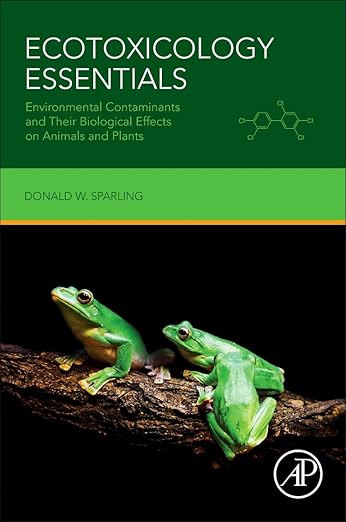
Ecotoxicology Essentials
Environmental Contaminants and Their Biological Effects on Animals and Plants
Elsevier Science · Print & ebook · May 3, 2016
We earn from qualifying purchases.
- Who it’s for
- Connect contaminant chemistry with animal behavior, ecosystem dynamics, and wildlife risk assessment.
- Genres
- Environmental Science, Toxicology, Ecology
- Published
- Elsevier Science, May 3, 2016
Nearest books
Matched by what the books are about, then ordered by what their readers also loved. Most of these share its genres: Environmental Science and Toxicology.
 Environmental Toxicology and ChemistryDonald G. Crosby73% match
 Environmental ToxicologyMohd. Salim Reshi, Darakhshan Javaid73% match
 Environmental ToxicologyKaiden Higgins71% match
 Principles of ToxicologyStephen M. Roberts, Robert C. James70% match
 EcotoxicologyElisabeth Gross, Jeanne Garric70% matchAlso shares Ecology
 Environmental and Biochemical ToxicologyJürgen Gailer, Raymond J. Turner69% match
 Effect-directed Analysis of Complex Environmental ContaminationWerner Brack69% match
 A Practical Guide to Toxicology and Human Health Risk AssessmentLaura Robinson67% match
For younger readers: Eyes Wide Open: Going Behind the Environmental Headlines, The Wondrous Workings of Planet Earth, The Wildlife Detectives
Start with three books, and this one can be the first.
Members get a new edition every morning: a route out from their books to essays, research and talks, with the reason for each.
Start with this bookAbout this book
Ecotoxicology Essentials: Environmental Contaminants and Their Biological Effects on Animals and Plants provides a fundamental understanding of this area for students and professionals in ecotoxicology, ecology, conservation, chemistry, public health, wildlife management, fisheries, and many other disciplines.
Continue reading
Although new chemicals and potential problems are developed every year, a basic education is essential to address these new challenges, and this work gives such training. Written with the regulatory framework in mind, the material guides readers on modelling, how to conduct assessments, and human and wildlife risk, focusing on effects on animals rather than transport of chemicals. Simple discussions of chemistry are complemented by coverage on the behavior of the animal, dynamics of the ecosystem, real-life situations like drought, and predators in the system – i.e., the natural system versus the lab setting. The book’s first section contains chapters on the principles of contaminant toxicology including a brief history of the science of ecotoxicology, basic principles of the science, testing methods, and ways of determining if animals have been exposed to either acute or chronic concentrations of contaminants. The second section deals with the primary classes of contaminants including their chemical characteristics, sources, uses, and effects on organisms. The third section focuses on more complex issues such as the regulation of pollution, population and community effects, risk assessment and modelling. - Uses examples from both aquatic and terrestrial environments and species - Includes a Terms to Know section and a list of study questions in each chapter, fostering a greater understanding of the issues - Focuses on the effects of contaminants on wildlife while providing enough chemistry to allow a detailed understanding of the various contaminant groups - Emphasizes natural examples and 'real' species, rather than laboratory studies on only a handful of organisms - Features case histories, detailing actual events that include aspects of how the contamination occurred and its effects on wildlife - Provides material from a wide variety of international sources
Wildlife Contaminants
Connect contaminant chemistry with animal behavior, ecosystem dynamics, and wildlife risk assessment.
Come here for
- Wildlife effects across aquatic and terrestrial environments
- Case histories of contamination and its effects on wildlife
Expect
- Coverage of contaminant toxicology, testing, and exposure
- Study questions and terms to know in each chapter
Where it sits
| Ecology | 71% |
|---|---|
| Environmental Science | 51% |
| Toxicology | 34% |
Percentages are BookFrontier’s reading of the book.
Publisher categories
- Environmental Science
- Authors
- Donald W. Sparling PhD, Donald W Sparling
- Publisher
- Elsevier Science
- Published
- May 3, 2016
- Format
- Print & ebook
- Reading lane
- Environmental Science