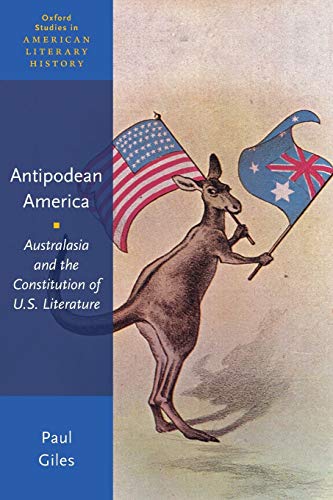
Antipodean America
Australasia and the Constitution of U. S. Literature
Oxford University Press · Print & ebook · October 15, 2016
Although North America and Australasia occupy opposite ends of the earth, they have never been that far from each other conceptually.
We earn from qualifying purchases.
- Who it’s for
- Paul Giles traces how Australia and New Zealand helped shape U.S. literature across three centuries.
- Genres
- Comparative Literature, Australian & Pacific Lit Crit, American Lit Crit
- Published
- Oxford University Press, October 15, 2016
Nearest books
Matched by what the books are about, then ordered by what their readers also loved.
 Islands, Identity and the Literary ImaginationElizabeth McMahon62% matchShares Australian & Pacific Lit Crit
 Transpacific ImaginationsYunte Huang62% matchShares Comparative Literature
 Beyond Hostile IslandsDaniel McKay, Patrick Porter58% match
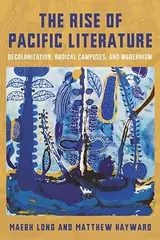 The Rise of Pacific LiteratureMatthew Hayward, Maebh Long57% matchShares Comparative Literature and Australian & Pacific Lit Crit
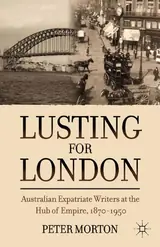 Lusting for LondonP. Morton, Peter Morton55% matchShares Australian & Pacific Lit Crit
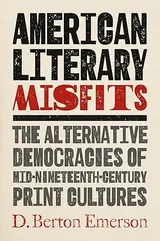 American Literary MisfitsD. Berton Emerson55% matchShares American Lit Crit
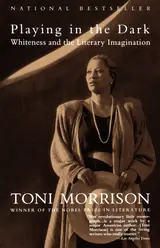 Playing in the DarkToni Morrison55% matchShares American Lit Crit
 The World, the Text, and the IndianScott Richard Lyons54% matchShares Comparative Literature
For younger readers: Tales of the Enchanted Islands of the Atlantic, America Redux: Visual Stories From Our Dynamic History, Coming to America: the Story of Immigration
Start with three books, and this one can be the first.
Members get a new edition every morning: a route out from their books to essays, research and talks, with the reason for each.
Start with this bookAbout this book
Although North America and Australasia occupy opposite ends of the earth, they have never been that far from each other conceptually. The United States and Australia both began as British colonies and mutual entanglements continue today, when contemporary cultures of globalization have brought them more closely into juxtaposition.
Continue reading
Taking this transpacific kinship as his focus, Paul Giles presents a sweeping study that spans two continents and over three hundred years of literary history to consider the impact of Australia and New Zealand on the formation of U.S. literature. Early American writers such as Benjamin Franklin, Thomas Jefferson, Joel Barlow and Charles Brockden Brown found the idea of antipodes to be a creative resource, but also an alarming reminder of Great Britain's increasing sway in the Pacific. The southern seas served as inspiration for narratives by Washington Irving, Edgar Allan Poe, and Herman Melville. For African Americans such as Harriet Jacobs, Australia represented a haven from slavery during the gold rush era, while for E.D.E.N. Southworth its convict legacy offered an alternative perspective on the British class system. In the 1890s, Henry Adams and Mark Twain both came to Australasia to address questions of imperial rivalry and aesthetic topsy-turvyness. The second half of this study considers how Australia's political unification through Federation in 1901 significantly altered its relationship to the United States. New modes of transport and communication drew American visitors, including novelist Jack London. At the same time, Americans associated Australia and New Zealand with various kinds of utopian social reform, particularly in relation to gender politics, a theme Giles explores in William Dean Howells, Charlotte Perkins Gilman, and Miles Franklin. He also considers how American modernism in New York was inflected by the Australasian perspectives of Lola Ridge and Christina Stead, and how Australian modernism was in turn shaped by American styles of iconoclasm. After World War II, Giles examines how the poetry of Karl Shapiro, Louis Simpson, Yusef Komunyakaa, and others was influenced by their direct experience of Australia. He then shifts to post-1945 fiction, where the focus extends from Irish-American cultural politics (Raymond Chandler, Thomas Keneally) to the paradoxes of exile (Shirley Hazzard, Peter Carey) and the structural inversions of postmodernism and posthumanism (Salman Rushdie, Donna Haraway). Ranging from figures like John Ledyard to John Ashbery, from Emily Dickinson to Patricia Piccinini and J. M. Coetzee, Antipodean America is a truly epic work of transnational literary history.
Antipodean Literary Crossings
Paul Giles traces how Australia and New Zealand helped shape U.S. literature across three centuries.
Come here for
- The antipodes as a creative resource and a political concern
- Literary crossings from early American writing to postwar fiction
Expect
- Separate readings of writers including Franklin, Melville, Gilman, and Coetzee
- Attention to empire, gender politics, exile, and modernism
Where it sits
| Comparative Literature | 83% |
|---|---|
| Australian & Pacific Lit Crit | 71% |
| American Lit Crit | 50% |
Percentages are BookFrontier’s reading of the book.
Publisher categories
- American Lit Crit
- Authors
- Paul Giles
- Publisher
- Oxford University Press
- Published
- October 15, 2016
- Format
- Print & ebook
- Reading lane
- American Lit Crit