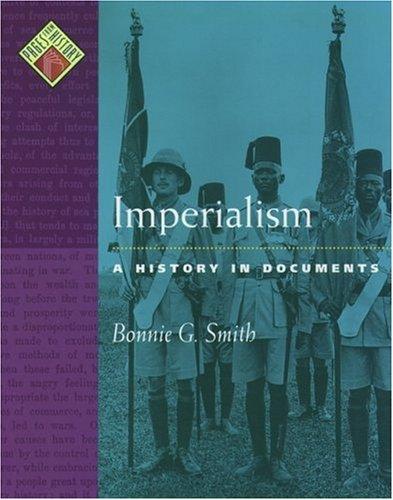
Imperialism
A History in Documents
Oxford University Press · Print & ebook · September 15, 2000
We talk about living in a global era, but the groundwork for it was laid more than a century ago.
We earn from qualifying purchases.
- Who it’s for
- Documents and commentary trace how imperial expansion reshaped societies, education, and environments around the world.
- Genres
- History
- Published
- Oxford University Press, September 15, 2000
Nearest books
Matched by what the books are about, then ordered by what their readers also loved.
 1493 for Young PeopleCharles Mann59% match
 Story of the World, Vol. 4 Revised EditionSusan Wise Bauer59% matchShares History
 The Industrial Revolution for KidsCheryl Mullenbach53% match
 The Kingfisher Atlas of the Modern WorldSimon Adams53% match
 The Silk RouteJohn S. Major52% match
 What the World EatsFaith D'Aluisio51% match
 The New AmericansBetsy Maestro51% match
 Timelines of World HistoryJane Chisholm51% matchShares History
For older readers: The Industrial Revolution, 1616, The Age of Revolutions in Global Context, C. 1760-1840
Start with three books, and this one can be the first.
Members get a new edition every morning: a route out from their books to essays, research and talks, with the reason for each.
Start with this bookAbout this book
We talk about living in a global era, but the groundwork for it was laid more than a century ago. By the late 19th century, Europe, Japan, and the United States had taken control of most of the world. Travel and trade between home countries and colonies sent goods and technology to even the most remote corners of the globe.
Continue reading
An English lady's letter home on smallpox inoculations in Turkey, an American missionary's account of the forcible collection of rubber in Belgian Congo, and a Chinese official's regulations for European merchants are among the primary sources that Bonnie Smith has assembled to demonstrate the advantages and drawbacks of the new economy. Society, education, and the environment also underwent massive changes, as witnessed by the selection of excerpts from an exam in a German missionary school in Togo and British reports on the devastation of entire forests in Burma. Imperial growth did not come without a price. A Japanese document outlining governance in Korea and U.S. President Benjamin Harrison's defense of the annexation of Hawaii illustrate the militant nationalism, religious intolerance, and pseudo-scientific racist theories used to justify the brute force of colonial rule. The colonized nations fought back-a popular Chinese poem in praise of the Boxers' opposition to foreign rule attests to this rebellious spirit, and a Moroccan's shock at "barbaric" European mores illustrates the conquered's view of the conquerors. A picture essay, "Mixture," showcases the amalgamation of global cultures through photographs of buildings, furniture, advertisements, sporting events, and sculpture. Bonnie Smith vividly captures the booming expansion of a flawed political system and expertly links the documentary evidence with informed commentary and prefatory essays to each chapter.
Empire in Documents
Documents and commentary trace how imperial expansion reshaped societies, education, and environments around the world.
Come here for
- Primary sources on travel, trade, colonial rule, and resistance
- A picture essay on global cultural mixture
Expect
- Letters, regulations, reports, and political defenses
- Chapter-opening essays alongside documentary excerpts
Where it sits
| History | 68% |
|---|
Percentages are BookFrontier’s reading of the book.
Publisher categories
- History
- Authors
- Bonnie G. Smith
- Publisher
- Oxford University Press
- Published
- September 15, 2000
- Format
- Print & ebook
- Reading lane
- History