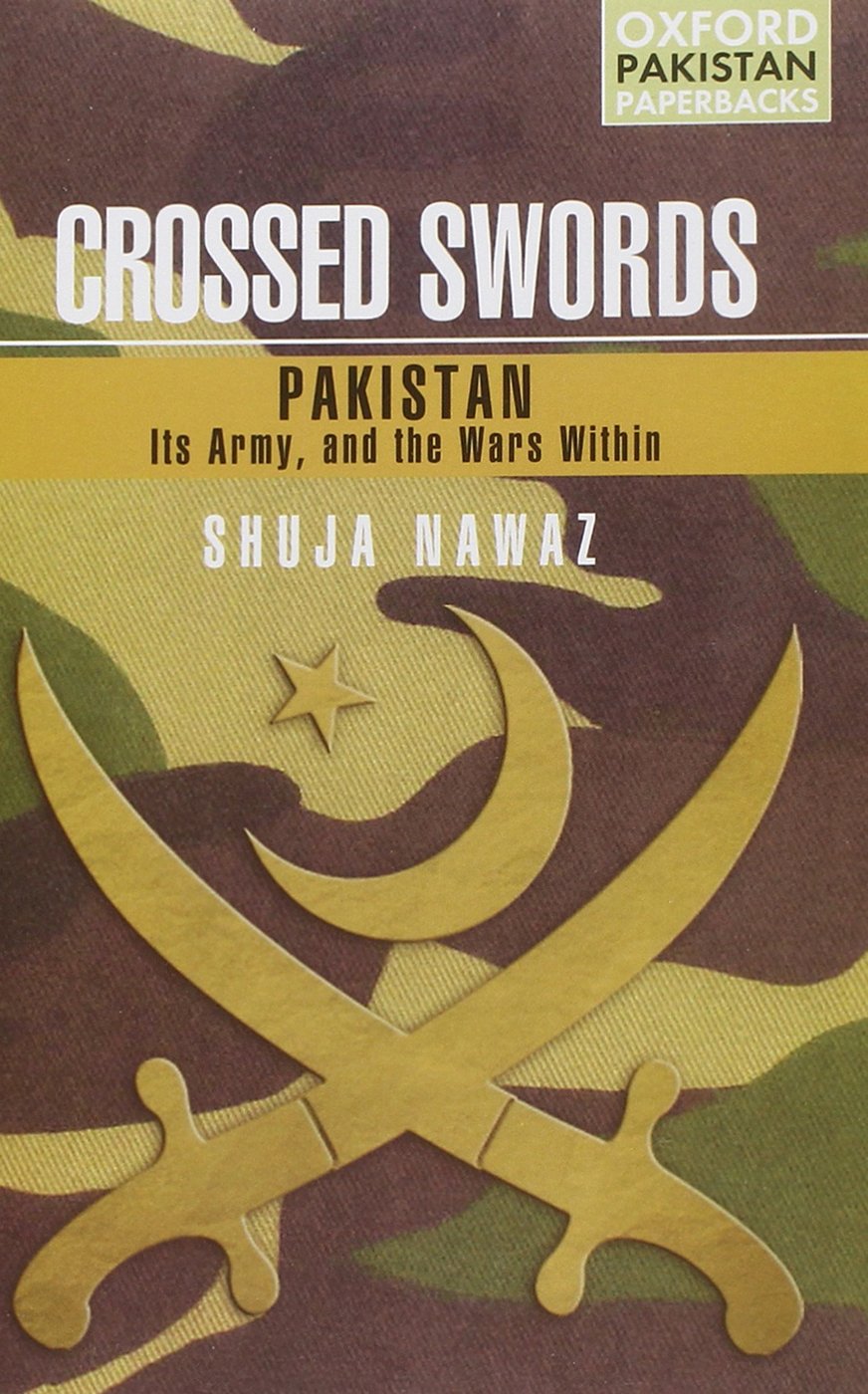
Crossed Swords
Pakistan, Its Army, and the Wars Within
Oxford University Press · Print & ebook · October 11, 2009
Pakistan and its army are inseparable entities.
We earn from qualifying purchases.
- Genres
- Middle Eastern Politics, Terrorism & Counterterrorism, Afghan War (2001-)
- Published
- Oxford University Press, October 11, 2009
Nearest books
Matched by what the books are about, then ordered by what their readers also loved. Most of these share its genre: Afghan War (2001-).
 The Wrong EnemyCarlotta Gall58% matchAlso shares Terrorism & Counterterrorism
 Understanding the War in AfghanistanJoseph J. Collins54% match
 The Long WarDavid Loyn52% matchAlso shares Terrorism & Counterterrorism
 ConflictDavid Petraeus, Andrew Roberts51% match
 House of WarJames Carroll51% match
 In My Father's CountrySAIMA WAHAB50% match
 No Good Men Among the LivingAnand Gopal50% matchAlso shares Middle Eastern Politics and Terrorism & Counterterrorism
For younger readers: War in Afghanistan
Start with three books, and this one can be the first.
Members get a new edition every morning: a route out from their books to essays, research and talks, with the reason for each.
Start with this bookAbout this book
Pakistan and its army are inseparable entities. For most of its life as an independent state, Pakistan has been under direct or indirect army rule, while pursuing an elusive quest for nationhood. Pakistan has also been an important ally of the United States, during the Cold War, the Afghan War against the Soviet Union, and more recently, after the 9/11 terrorist attacks on the United States of 2001, in the 'War on Terror'.
Continue reading
The US-Pakistan relationship is a long one and often filled with mutual distrust on both sides. It has also provoked much street unrest within Pakistan, a country facing a hostile larger neighbour, India, and wracked by internal wars and insurrections, pitting linguistic, ethnic, and religious groups against each other and the state. Yet, Pakistan remains a key to the future stability and growth of Central Asia, South Asia, and the Gulf region, as a major Muslim country, armed with nuclear weapons, and with a growing and predominantly youthful population of some 160 million. Recently, it has seen the emergence of heavily armed Jihadi groups, bent upon imposing their own view of Islamic Law on a Pakistani population that is largely moderate but silent. These uprisings have pitted the Jihadis and their Al Qaeda associates against the army, breaking a relationship between the Mullahs and the Military that was born during the regime of General Ziaul Haq in the 1980s and sustained by Pakistan's support of the Kashmiri uprising against India through the army's Jihadi surrogates. Pakistan has also witnessed proxy wars between Shia and Sunni extremists, financed by local and foreign sources. Many fear that an undemocratic Pakistan fighting its many internal wars may become a 'failed state', with dire consequences for the volatile and strategic region of the world in which it resides. The Pakistan army is at the centre of this maelstrom, with President Pervez Musharraf, who has been ruling since 1999 after a coup d'etat against an elected prime minister, still wearing his uniform as the Chief of Army Staff. Regardless of whether he stays or goes, the role and nature of the Pakistan army remains key to Pakistan's future. Will it continue to intrude into national politics? Or will a democratic system emerge and be sustained by the politicians, many of whom have been too keen in the past to bring in the army into managing the state. Will the conflict between the constitutional authority of the state and the coercive power of the military ever end? Or will an eventually unstable and Islamist-controlled army contribute to the collapse of the current Pakistani state and change its relationship with the West? Based on 30 years of research and analysis, Shuja Nawaz, who has ancient military ties and whose brother, General Asif Nawaz, was army chief over 1991-93, delves into these and other questions. This book is a profound, multi-layered, and historical analysis of the nature and role of the Pakistan army in the country's polity as well as its turbulent relationship with the United States. Nawaz examines the army and Pakistan in both peace and war. Using many hitherto unpublished materials from the archives of the United States, the United Kingdom, and the General Headquarters of the Pakistan army, as well as interviews with key military and political figures in Pakistan and the United States, he sheds light not only on the Pakistan army and its US connections but also on Pakistan as a key Muslim country in one of the world's toughest neighbourhoods. In doing so, he lays bare key facts about Pakistan's numerous wars with India and its many rounds of political musical chairs, as well as the Kargil conflict of 1998. He then draws lessons from this history that may help Pakistan end its wars within and create a stabler political entity. This book takes you behind the headlines.
Inside Power
Come here for
- strategic power and military politics
- a sustained, inside-view account
Expect
- insight over spectacle
- serious, steady narrative pace
Where it sits
| Terrorism & Counterterrorism | 32% |
|---|---|
| Afghan War (2001-) | 30% |
| Middle Eastern Politics | 26% |
Percentages are BookFrontier’s reading of the book.
Publisher categories
- Military History
- Authors
- Shuja Nawaz
- Publisher
- Oxford University Press
- Published
- October 11, 2009
- Format
- Print & ebook
- Reading lane
- Military History