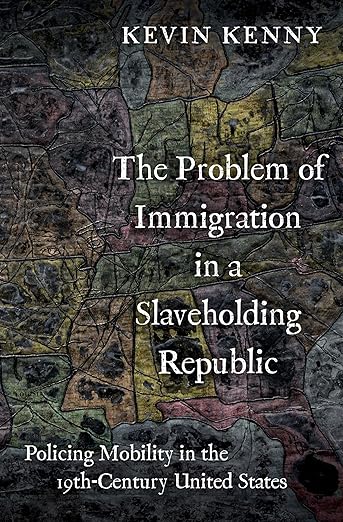
The Problem of Immigration in a Slaveholding Republic
Policing Mobility in the Nineteenth-century United States
Oxford University Press · Print & ebook · April 26, 2023
A powerful analysis of how regulation of the movement of enslaved and free black people produced a national immigration policy in the period between the American Revolution and the end of Reconstruction.
We earn from qualifying purchases.
- Who it’s for
- Trace how slavery and state control of movement shaped the emergence of national immigration policy.
- Genres
- Immigration & Emigration Law, 19th-Century America, Immigration Policy
- Published
- Oxford University Press, April 26, 2023
Nearest books
Matched by what the books are about, then ordered by what their readers also loved.
 No God But GainStephen Chambers60% matchShares 19th-Century America
 The Monroe DoctrineJay Sexton55% matchShares 19th-Century America
 Brought Forth on This ContinentHarold Holzer64% match
 Shaping Our NationMichael Barone62% matchShares Immigration Policy
 BannedShoba Sivaprasad Wadhia62% matchShares Immigration & Emigration Law and Immigration Policy
 American VisionsEdward L. Ayers60% matchShares 19th-Century America
 Immigration Detention Inc.Nancy Hiemstra, Deirdre Conlon59% matchShares Immigration & Emigration Law and Immigration Policy
For younger readers: Coming to America: the Story of Immigration, Days of Infamy: How a Century of Bigotry Led to Japanese American Internment (scholastic Focus), Exclusion and the Chinese American Story
Start with three books, and this one can be the first.
Members get a new edition every morning: a route out from their books to essays, research and talks, with the reason for each.
Start with this bookAbout this book
A powerful analysis of how regulation of the movement of enslaved and free black people produced a national immigration policy in the period between the American Revolution and the end of Reconstruction. Today the United States considers immigration a federal matter. Yet, despite America's reputation as a "nation of immigrants," the Constitution is silent on the admission, exclusion, and expulsion of foreigners.
Continue reading
Before the Civil War, the federal government played virtually no role in regulating immigration, and states set their own terms for regulating the movement of immigrants, free blacks, and enslaved people. Insisting that it was their right and their obligation to protect the public health and safety, states passed their own laws prohibiting the arrival of foreign convicts, requiring shipmasters to post bonds or pay taxes for passengers who might become public charges, ordering the deportation of immigrant paupers, quarantining passengers who carried contagious diseases, excluding or expelling free blacks, and imprisoning black sailors. To the extent that these laws affected foreigners, they comprised the immigration policy of the United States. Offering an original interpretation of nineteenth-century America, The Problem of Immigration in a Slaveholding Republic argues that the existence, abolition, and legacies of slavery were central to the emergence of a national immigration policy. In the century after the American Revolution, states controlled mobility within and across their borders and set their own rules for community membership. Throughout the antebellum era, defenders of slavery feared that, if Congress gained control over immigration, it could also regulate the movement of free black people and the interstate slave trade. The Civil War and the abolition of slavery removed the political and constitutional obstacles to a national immigration policy, which was first directed at Chinese immigrants. Admission remained the norm for Europeans, but Chinese laborers were excluded through techniques of registration, punishment, and deportation first used against free black people in the antebellum South. To justify these measures, the Supreme Court ruled that immigration authority was inherent in national sovereignty and required no constitutional justification. The federal government continues to control admissions and exclusions today, while some states monitor and punish immigrants, and others offer sanctuary and refuse to act as agents of federal law enforcement. By revealing the tangled origins of border control, incarceration, and deportation, distinguished historian Kevin Kenny sheds light on the history of race and belonging in America, as well as the ongoing tensions between state and federal authority over immigration.
Policing Mobility
Trace how slavery and state control of movement shaped the emergence of national immigration policy.
Come here for
- State laws governing immigrant, free Black, and enslaved people’s movement
- Slavery’s role in the rise of federal immigration policy
Expect
- Antebellum rules on exclusion, quarantine, deportation, and imprisonment
- A history connecting Chinese exclusion to earlier controls on free Black people
Where it sits
| 19th-Century America | 59% |
|---|---|
| Immigration & Emigration Law | 35% |
| Immigration Policy | 22% |
Percentages are BookFrontier’s reading of the book.
Publisher categories
- 19th-Century America
- Authors
- Kevin Kenny
- Publisher
- Oxford University Press
- Published
- April 26, 2023
- Format
- Print & ebook
- Reading lane
- 19th-Century America