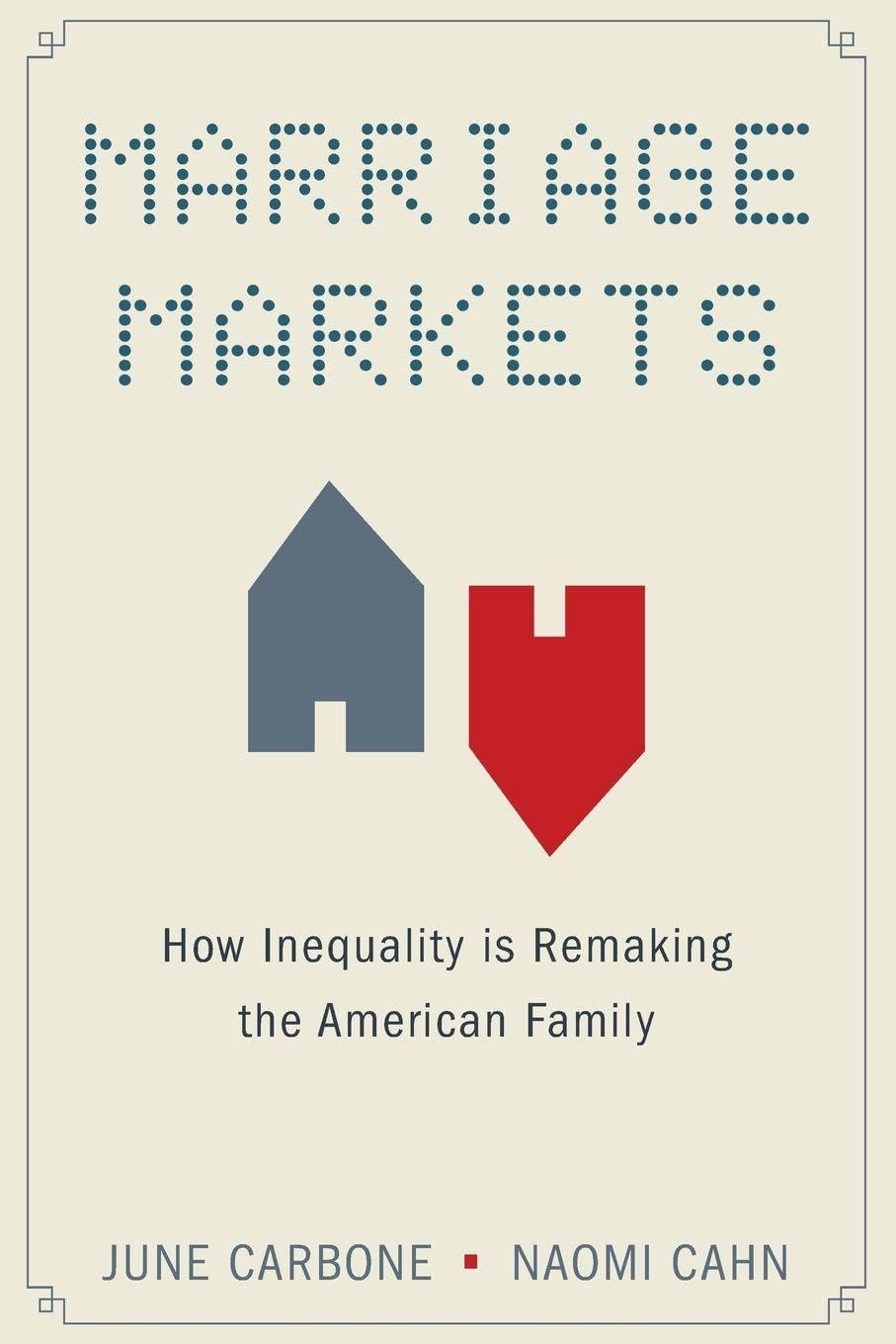
Marriage Markets
How Inequality Is Remaking the American Family
Oxford University Press · Print & ebook · April 8, 2014
There was a time when the phrase "American family" conjured up a single, specific image: a breadwinner dad, a homemaker mom, and their 2.5 kids living comfortable lives in a middle-class suburb.
We earn from qualifying purchases.
- Genres
- Marriage & Family, Social Class, Population & Demographics
- Published
- Oxford University Press, April 8, 2014
Nearest books
Matched by what the books are about, then ordered by what their readers also loved.
 Shaping Our NationMichael Barone53% matchShares Population & Demographics
 The DivideJason Hickel, Jonathan Cowley51% matchShares Social Class
 The Marriage and Family ExperienceBryan Strong, Theodore Cohen64% matchShares Marriage & Family
 All the Single LadiesRebecca Traister60% match
 Of Boys and MenRichard V. Reeves59% match
 Coming ApartCharles Murray59% matchShares Social Class and Population & Demographics
For younger readers: What the World Eats
Start with three books, and this one can be the first.
Members get a new edition every morning: a route out from their books to essays, research and talks, with the reason for each.
Start with this bookAbout this book
There was a time when the phrase "American family" conjured up a single, specific image: a breadwinner dad, a homemaker mom, and their 2.5 kids living comfortable lives in a middle-class suburb. Today, that image has been shattered, due in part to skyrocketing divorce rates, single parenthood, and increased out-of-wedlock births.
Continue reading
But whether it is conservatives bewailing the wages of moral decline and women's liberation, or progressives celebrating the result of women's greater freedom and changing sexual mores, most Americans fail to identify the root factor driving the changes: economic inequality that is remaking the American family along class lines. In Marriage Markets, June Carbone and Naomi Cahn, co-authors of the acclaimed Red Families v. Blue Families, examine how macroeconomic forces are transforming our most intimate and important spheres, and how working class and lower income families have paid the highest price. Just like health, education, and seemingly every other advantage in life, a stable two-parent home has become a luxury that only the well-off can afford. The best educated and most prosperous have the most stable families, while working class families have seen the greatest increase in relationship instability. Why is this so? This book offers a new answer: it is due to the economics of marriage markets, and of how men and women match up when they search for a life partner. For instance, when eligible (i.e., desirable and marriageable) men outnumber eligible women, the marriage and marital stability rates are significantly higher than when the reverse situation occurs - the exact situation we have in America today. The failure to see marriage as a market affected by supply and demand has obscured any meaningful analysis of the way that societal changes influence culture. Only policies that redress the balance between men and women through greater access to education, stable employment, and opportunities for social mobility can a culture that encourages commitment and investment in family life. A rigorous and enlightening account of why American families have changed so much in recent decades, Marriage Markets cuts through the ideological and moralistic rhetoric that drives our current debate and offers real insight into - and solutions for - a problem that will haunt America for generations to come.
Where it sits
| Marriage & Family | 84% |
|---|---|
| Social Class | 84% |
| Population & Demographics | 33% |
Percentages are BookFrontier’s reading of the book.
Publisher categories
- Gender & the Law
- Authors
- June Carbone, Naomi Cahn, Naomi R. Cahn
- Publisher
- Oxford University Press
- Published
- April 8, 2014
- Format
- Print & ebook
- Reading lane
- Gender & the Law