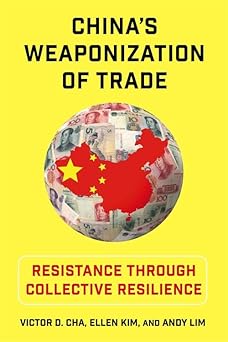
China's Weaponization of Trade
Resistance Through Collective Resilience
Columbia University Press · Print & ebook · January 20, 2026
In recent years, China and the United States have each turned economic interdependence into an instrument of coercion, using their dominant positions in international trade to push states and firms to comply with their political goals.
We earn from qualifying purchases.
- Who it’s for
- An examination of China’s trade pressure and strategies for collective resistance.
- Genres
- Trade & Tariffs, Political Economy, Security Studies
- Published
- Columbia University Press, January 20, 2026
Nearest books
Matched by what the books are about, then ordered by what their readers also loved.
 Chinese Statecraft in a Changing WorldJean Dong64% match
 ChokepointsEdward Fishman62% matchShares Political Economy and Security Studies
 War Without RulesDavid Bryson, Brett Boles61% matchShares Security Studies
 Confessions of an Economic Hit Man, 3rd EditionJohn Perkins60% matchShares Political Economy
 ChinaHelmut Wagner60% match
 Has China Won?Kishore Mahbubani59% match
 Danger ZoneHal Brands, Michael Beckley59% matchShares Security Studies
 Confessions of an OutsourcerTimothy Brantingham58% matchShares Trade & Tariffs
Start with three books, and this one can be the first.
Members get a new edition every morning: a route out from their books to essays, research and talks, with the reason for each.
Start with this bookAbout this book
In recent years, China and the United States have each turned economic interdependence into an instrument of coercion, using their dominant positions in international trade to push states and firms to comply with their political goals. What is distinctive about this form of economic pressure, and how can other countries fight back?
Continue reading
This groundbreaking book explores the weaponization of economic interdependence and its implications for the international order through a wealth of new and original data on China’s economic statecraft. Victor D. Cha, Ellen Kim, and Andy Lim examine how and in what ways the United States and China have deployed economic coercion, focusing on China’s extensive use of this tactic over the past three decades. They analyze a vast data set that includes more than 600 cases of China’s economic bullying of states, companies, and individuals in North America, Asia, and Europe. Cha, Kim, and Lim propose a multilateral strategy of “collective resilience” to counter intimidation, showing how targeted states can band together, leverage trading relationships, and threaten retaliation. Synthesizing new insights from unique trade data with international security expertise, this timely book sheds new light on how China exercises economic power—and it provides a playbook to deter bullies and rebalance the global order.
Economic Coercion
An examination of China’s trade pressure and strategies for collective resistance.
Come here for
- China’s economic coercion across states, companies, and individuals
- A proposed multilateral strategy of collective resilience
Expect
- Analysis of China and U.S. uses of economic coercion
- Cases spanning North America, Asia, and Europe
Where it sits
| Trade & Tariffs | 84% |
|---|---|
| Security Studies | 40% |
| Political Economy | 28% |
Percentages are BookFrontier’s reading of the book.
Publisher categories
- International Economics
- International Relations
- Trade & Tariffs
- Asian Politics
- Authors
- Victor Cha, Ellen Kim, Andy Lim
- Publisher
- Columbia University Press
- Published
- January 20, 2026
- Format
- Print & ebook
- Reading lane
- International Economics