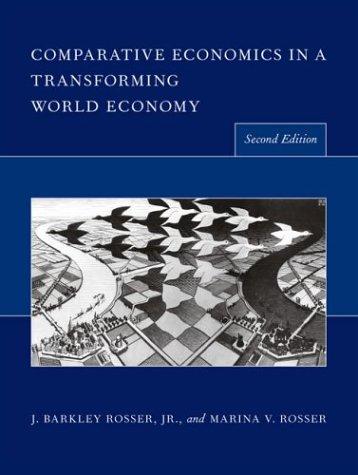
Comparative Economics in a Transforming World Economy
2nd Edition
The MIT Press · Print & ebook · December 23, 2003
The second edition of an innovative undergraduate textbook in Comparative Economic Systems that goes beyond the traditional dichotomies.
We earn from qualifying purchases.
- Who it’s for
- A comparative map of mixed systems, transitions, and country-level economic paths.
- Themes
- Comparative economic systems, Economic transitions, Developing economies
- Genres
- Comparative Economics, Economic Development, Political Economy
Nearest books
Matched by what the books are about, then ordered by what their readers also loved. Most of these share its genre: Political Economy.
 Negotiating the World EconomyJohn S. Odell61% match
 Rethinking EconomicsJ. Christopher Proctor, Liliann Fischer59% match
 The Worldly PhilosophersRobert L. Heilbroner58% match
 Economic Facts and FallaciesThomas Sowell57% match
 Unequal ExchangeArghiri Emmanuel, Charles Bettelheim57% match
 Capitalism, AloneBranko Milanovic, Branko Milanović57% match
 The Little Book of EconomicsGreg Ip57% match
 ChoiceRobert P. Murphy, Donald J. Boudreaux56% match
For younger readers: Big Money
Start with three books, and this one can be the first.
Members get a new edition every morning: a route out from their books to essays, research and talks, with the reason for each.
Start with this bookAbout this book
The second edition of an innovative undergraduate textbook in Comparative Economic Systems that goes beyond the traditional dichotomies. This second edition of an innovative undergraduate text offers an approach to understanding different economic systems that reflects both recent transformations in the world economy and recent changes in the field of Comparative Economic Systems.
Continue reading
The traditional way of teaching comparative economics, with its reliance on relatively simple dichotomies (private vs. state, planning vs. market) does not take into consideration the many variants and mixtures of economic systems that exist in the real world. The Rossers' introduction in the first edition of the concept of the "new traditional economy"—the effort by a developing country to embed a modern economic system into a traditional culture, usually religious—presented a new way to look at developing economies. Their innovative examination of Iran and its effort to develop a "revolutionary Islamic economy" as an alternative to market capitalism illustrates the use of this new tool in comparative economics. After a four-chapter theoretical and historical overview, the book focuses on fifteen country studies, organized by economic system. The chapters on advanced market capitalism examine the economies of the United States (a chapter new to this edition) Japan, France, Sweden, and Germany. The chapters examining transition in former socialist economies discuss Russia, the former Soviet Republics, Poland, Hungary, Yugoslavia (including expanded treatment of the most successful transition economy, that of Slovenia), and China. The chapters in the final section of the book discuss "alternative paths" taken by the developing economies of Iran, India (its complex mix of socialism, capitalism, and tradition is examined in a chapter new to this edition), Mexico, and South and North Korea. The book concludes with a look at future trends that will continue to transform the world economy.
Mixed Economic Systems
A comparative map of mixed systems, transitions, and country-level economic paths.
Come here for
- A theoretical and historical overview
- Country studies organized by economic system
Expect
- Comparisons beyond market-versus-state and planning-versus-market dichotomies
- A final look at trends reshaping the world economy
Where it sits
| Comparative Economics | 100% |
|---|---|
| Political Economy | 30% |
| Economic Development | 29% |
Percentages are BookFrontier’s reading of the book.
Publisher categories
- Comparative Economics
- Authors
- J. Barkley Rosser Jr., Marina V. Rosser
- Publisher
- The MIT Press
- Published
- December 23, 2003
- Format
- Print & ebook
- Theme
- Comparative economic systems · Economic transitions · Developing economies
- Reading lane
- Comparative Economics