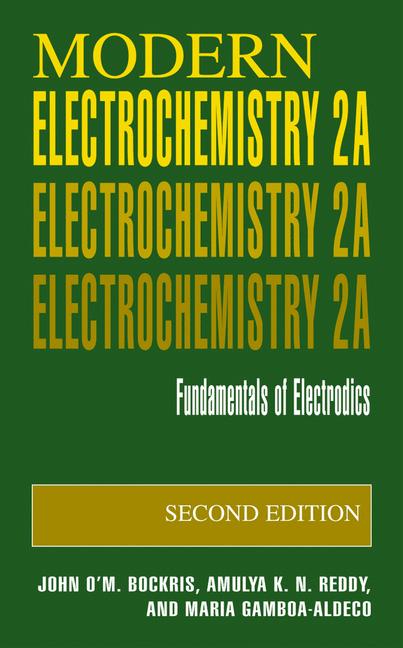
Modern Electrochemistry 2a
Fundamentals of Electrodics
Kluwer Boston Incorporated · Print & ebook · January 31, 2001
This book had its nucleus in some lectures given by one of us (J.
We earn from qualifying purchases.
- Who it’s for
- An accessible introduction connects electrochemistry with energy conversion, industry, and biology.
- Themes
- Electrochemical energy conversion, Industrial electrochemistry, Biological electrochemistry
- Genres
- Electrochemistry, Electrical Power
Nearest books
Matched by what the books are about, then ordered by what their readers also loved. Most of these share its genre: Electrochemistry.
 Electrochemical EngineeringThomas F. Fuller, John N. Harb73% match
 Physical ElectrochemistryNoam Eliaz, Eliezer Gileadi72% match
 ElectrochemistryCarl H. Hamann, Andrew Hamnett68% match
 Electrochemical MethodsAllen J. Bard, Larry R. Faulkner67% match
 A First Course in Electrode ProcessesDerek Pletcher66% match
 Electroanalytical ChemistryGary A. Mabbott65% match
 Electrochemical SystemsJohn Newman, Nitash P. Balsara63% match
 Analytical ElectrochemistryJoseph Wang60% match
For younger readers: Science Comics: Electricity, Oscar and the Bird, Easy Electronics
Start with three books, and this one can be the first.
Members get a new edition every morning: a route out from their books to essays, research and talks, with the reason for each.
Start with this bookAbout this book
This book had its nucleus in some lectures given by one of us (J. O'M. B. ) in a course on electrochemistry to students of energy conversion at the University of Pennsyl- nia. It was there that he met a number of people trained in chemistry, physics, biology, metallurgy, and materials science, all of whom wanted to know something about electrochemistry.
Continue reading
The concept of writing a book about electrochemistry which could be understood by people with very varied backgrounds was thereby engendered. The lectures were recorded and written up by Dr. Klaus Muller as a 293-page manuscript. At a later stage, A. K. N. R. joined the effort; it was decided to make a fresh start and to write a much more comprehensive text. Of methods for direct energy conversion, the electrochemical one is the most advanced and seems the most likely to become of considerable practical importance. Thus, conversion to electrochemically powered transportation systems appears to be an important step by means of which thedifficulties of air pollution and the effects of an increasing concentration in the atmosphere of carbon dioxide may be met. Cor- sion is recognized as having an electrochemical basis. The synthesis of nylon now contains an important electrochemical stage. Some central biological mechanisms have been shown to take place by means of electrochemical reactions. A number of American organizations have recently recommended greatly increased activity in training and research in electrochemistry at universities in the United States.
Electrochemical Fundamentals
An accessible introduction connects electrochemistry with energy conversion, industry, and biology.
Come here for
- Electrochemical approaches to energy conversion and transportation
Expect
- Coverage of corrosion and electrochemical stages in nylon synthesis
- Biological mechanisms involving electrochemical reactions
Where it sits
| Electrochemistry | 100% |
|---|---|
| Electrical Power | 24% |
Percentages are BookFrontier’s reading of the book.
Publisher categories
- Clinical Medicine
- Chemical & Biochemical Engineering
- Authors
- John O'M. Bockris, Amulya K.N. Reddy, Maria E. Gamboa-Aldeco
- Publisher
- Kluwer Boston Incorporated
- Published
- January 31, 2001
- Format
- Print & ebook
- Theme
- Electrochemical energy conversion · Industrial electrochemistry · Biological electrochemistry
- Reading lane
- Clinical Medicine