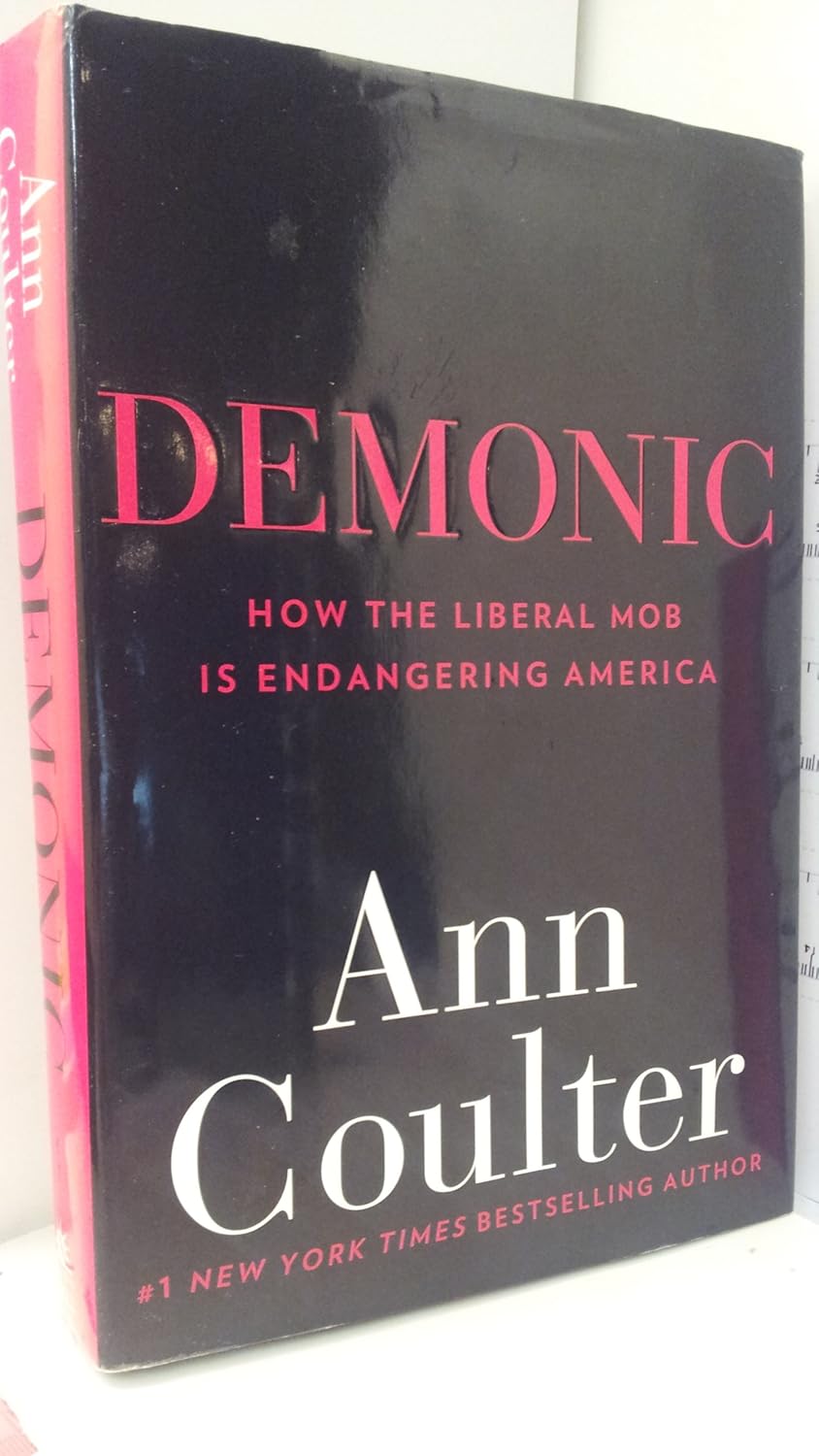
Demonic
How the Liberal Mob Is Endangering America
Crown Publishing Group · Print & ebook · June 7, 2011
The demon is a mob, and the mob is demonic.
We earn from qualifying purchases.
- Who it’s for
- A polemical argument about liberalism, mob psychology, and the politics of collective action.
- Themes
- Political groupthink, Mob psychology, Revolutionary violence
- Genres
- Conservatism & Liberalism, Political Commentary, Political Parties
Nearest books
Matched by what the books are about, then ordered by what their readers also loved. Most of these share its genres: Conservatism & Liberalism and Political Commentary.
 BulliesBen Shapiro60% match
 Outrage, Inc.Derek Hunter64% match
 Listen, LiberalThomas Frank61% matchAlso shares Political Parties
 Fear ItselfTammy Bruce60% match
 The Enemy WithinDavid Horowitz60% match
 America's Cultural RevolutionChristopher F. Rufo60% match
 Vigilante NationJon Michaels, David Noll59% match
 LawlessIlya Shapiro58% match
Start with three books, and this one can be the first.
Members get a new edition every morning: a route out from their books to essays, research and talks, with the reason for each.
Start with this bookAbout this book
The demon is a mob, and the mob is demonic. The Democratic Party activates mobs, depends on mobs, coddles mobs, publicizes and celebrates mobs—it is the mob. Sweeping in its scope and relentless in its argument, Demonic explains the peculiarities of liberals as standard groupthink behavior. To understand mobs is to understand liberals.
Continue reading
In her most provocative book to date, Ann Coulter argues that liberals exhibit all the psychological characteristics of a mob, for instance: Liberal Groupthink: “The same mob mentality that leads otherwise law-abiding people to hurl rocks at cops also leads otherwise intelligent people to refuse to believe anything they haven’t heard on NPR.” Liberal Schemes: “No matter how mad the plan is—Fraternité, the ‘New Soviet Man,’ the Master Race, the Great Leap Forward, the Cultural Revolution, Building a New Society, ObamaCare—a mob will believe it.” Liberal Enemies: “Instead of ‘counterrevolutionaries,’ liberals’ opponents are called ‘haters,’ ‘those who seek to divide us,’ ‘tea baggers,’ and ‘right-wing hate groups.’ Meanwhile, conservatives call liberals ‘liberals’—and that makes them testy.” Liberal Justice: “In the world of the liberal, as in the world of Robespierre, there are no crimes, only criminals.” Liberal Violence: “If Charles Manson’s followers hadn’t killed Roman Polanski’s wife, Sharon Tate, Clinton would have pardoned him, too, and he’d probably be teaching at Northwestern University.” Citing the father of mob psychology, Gustave Le Bon, Coulter catalogs the Left’s mob behaviors: the creation of messiahs, the fear of scientific innovation, the mythmaking, the preference for images over words, the lack of morals, and the casual embrace of contradictory ideas. Coulter traces the history of the liberal mob to the French Revolution and Robespierre’s revolutionaries (delineating a clear distinction from America’s founding fathers), who simply proclaimed that they were exercising the “general will” before slaughtering their fellow citizens “for the good of mankind.” Similarly, as Coulter demonstrates, liberal mobs, from student radicals to white-trash racists to anti-war and pro-ObamaCare fanatics today, have consistently used violence to implement their idea of the “general will.” This is not the American tradition; it is the tradition of Stalin, of Hitler, of the guillotine—and the tradition of the American Left. As the heirs of the French Revolution, Democrats have a history that consists of pandering to mobs, time and again, while Republicans, heirs to the American Revolution, have regularly stood for peaceable order. Hoping to muddy this horrifying truth, liberals slanderously accuse conservatives of their own crimes—assassination plots, conspiracy theorizing, political violence, embrace of the Ku Klux Klan. Coulter shows that the truth is the opposite: Political violence—mob violence—is always a Democratic affair. Surveying two centuries of mob movements, Coulter demonstrates that the mob is always destructive. And yet, she argues, beginning with the civil rights movement in the sixties, Americans have lost their natural, inherited aversion to mobs. Indeed, most Americans have no idea what they are even dealing with. Only by recognizing the mobs and their demonic nature can America begin to defend itself.
Politics at Full Volume
A polemical argument about liberalism, mob psychology, and the politics of collective action.
Come here for
- A combative conservative critique of liberal groupthink
- Mob psychology traced through political history
Expect
- A forceful, sweeping argument—not a neutral survey
- Sharp contrasts between political traditions
Where it sits
| Political Commentary | 62% |
|---|---|
| Conservatism & Liberalism | 60% |
| Political Parties | 42% |
Percentages are BookFrontier’s reading of the book.
Publisher categories
- Democracy
- Political Parties
- Conservatism & Liberalism
- Authors
- Ann Coulter
- Publisher
- Crown Publishing Group
- Published
- June 7, 2011
- Format
- Print & ebook
- Theme
- Political groupthink · Mob psychology · Revolutionary violence
- Reading lane
- Democracy