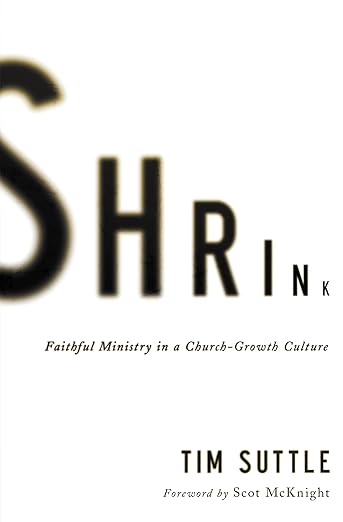
Shrink
Faithful Ministry in a Church-growth Culture
Zondervan · Print & ebook · September 2, 2014
Among followers of Jesus, great is often the enemy of good.
We earn from qualifying purchases.
- Who it’s for
- A contemplative case for faithful ministry over the pressure to prove success by visible results.
- Genres
- Pastoral Resources, Religious Leadership, Ecclesiology
- Published
- Zondervan, September 2, 2014
Nearest books
Matched by what the books are about, then ordered by what their readers also loved.
 The Divine Conspiracy ContinuedDallas Willard, Gary Black, Jr.61% match
 Faithful PresenceDavid E. Fitch63% matchShares Pastoral Resources and Ecclesiology
 Kingdom CallingAmy L. Sherman65% matchShares Religious Leadership
 Communicating for a ChangeAndy Stanley, Lane Jones56% matchShares Religious Leadership
 SiftedWayne Cordeiro, Francis Chan70% matchShares Pastoral Resources
 ANDHugh Halter, Matt Smay68% matchShares Pastoral Resources and Ecclesiology
 The Purpose Driven ChurchRick Warren67% matchShares Pastoral Resources and Ecclesiology
 How Leaders Lose Their WayPeter Greer, Jill Heisey65% match
Start with three books, and this one can be the first.
Members get a new edition every morning: a route out from their books to essays, research and talks, with the reason for each.
Start with this bookAbout this book
Among followers of Jesus, great is often the enemy of good. The drive to be great—to be a success by the standards of the world—often crowds out the qualities of goodness, virtue, and faithfulness that should define the central focus of Christian leadership. In the culture of today’s church, successful leadership is often judged by what works, while persistent faithfulness takes a back seat. If a ministry doesn’t produce results, it is dropped.
Continue reading
If people don’t respond, we move on. This pursuit of “greatness” exerts a crushing pressure on the local church and creates a consuming anxiety in its leaders. In their pursuit of this warped vision of greatness, church leaders end up embracing a leadership narrative that runs counter to the sacrificial call of the gospel story. When church leaders focus on faithfulness to God and the gospel, however, it’s always a kingdom-win—regardless of the visible results of their ministry. John the Baptist modeled this kind of leadership. As John’s disciples crossed the Jordan River to follow after Jesus, John freely released them to a greater calling than following him. Speaking of Jesus, John said: “He must increase, but I must decrease.” Joyfully satisfied to have been faithful to his calling, John knew that the size and scope of his ministry would be determined by the will of the Father, not his own will. Following the example of John the Baptist and with a careful look at the teaching of Scripture, Tim Suttle dares church leaders to risk failure by chasing the vision God has given them—no matter how small it might seem—instead of pursuing the broad path of pragmatism that leads to fame and numerical success.
Faithful Over Famous
A contemplative case for faithful ministry over the pressure to prove success by visible results.
Come here for
- A thoughtful challenge to church-growth measures of success
- Christian leadership grounded in goodness, virtue, and faithfulness
Expect
- Scriptural reflection through the example of John the Baptist
- A serious look at pragmatism, ambition, and ministry leadership
Where it sits
| Pastoral Resources | 47% |
|---|---|
| Religious Leadership | 31% |
| Ecclesiology | 21% |
Percentages are BookFrontier’s reading of the book.
Publisher categories
- Faith
- Church Growth
- Church Leadership
- Authors
- Tim Suttle, Scot McKnight
- Publisher
- Zondervan
- Published
- September 2, 2014
- Format
- Print & ebook
- Reading lane
- Faith