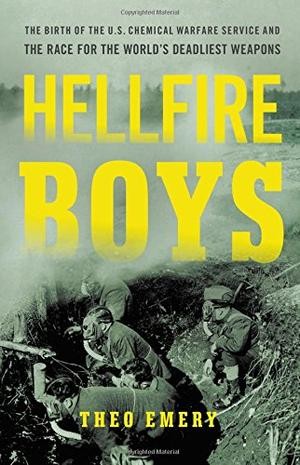
Hellfire Boys
The Birth of the U.s. Chemical Warfare Service and the Race for the World’s Deadliest Weapons
Little, Brown and Company · Print & ebook · November 14, 2017
This explosive look into the dawn of chemical warfare during World War I is "a terrifying piece of history that almost no one knows" (Hampton Sides).
We earn from qualifying purchases.
- Who it’s for
- World War I’s chemical arms race makes for a grim, absorbing history of science at war.
- Genres
- Chemical & Biological Warfare, World War I History, U.S. Military History
- Published
- Little, Brown and Company, November 14, 2017
Nearest books
Matched by what the books are about, then ordered by what their readers also loved.
 Path to BlitzkriegRobert M. Citino52% match
 American MidnightAdam Hochschild, Jonathan Todd Ross59% matchShares World War I History
 When Books Went to WarMolly Guptill Manning50% match
 The Dirty Tricks DepartmentJohn Lisle53% match
 Tuxedo ParkJennet Conant51% match
 SpearheadAdam Makos, Johnathan McClain53% matchShares U.S. Military History
 The Poisonous CloudL. F. Haber, Ludwig Fritz Haber76% matchShares Chemical & Biological Warfare and World War I History
 War of NervesJonathan Tucker73% matchShares Chemical & Biological Warfare
For younger readers: What Was World War I?, World War One: 1914-1918, The War to End All Wars
Start with three books, and this one can be the first.
Members get a new edition every morning: a route out from their books to essays, research and talks, with the reason for each.
Start with this bookAbout this book
This explosive look into the dawn of chemical warfare during World War I is "a terrifying piece of history that almost no one knows" (Hampton Sides). In 1915, when German forces executed the first successful gas attack of World War I, the world watched in horror as the boundaries of warfare were forever changed.
Continue reading
Cries of barbarianism rang throughout Europe, yet Allied nations immediately jumped into the fray, kickstarting an arms race that would redefine a war already steeped in unimaginable horror. Largely forgotten in the confines of history, the development of the U.S. Chemical Warfare Service in 1917 left an indelible imprint on World War I. This small yet powerful division, along with the burgeoning Bureau of Mines, assembled research and military unites devoted solely to chemical weaponry, outfitting regiments with hastily made gas-resistant uniforms and recruiting scientists and engineers from around the world into the fight. As the threat of new gases and more destructive chemicals grew stronger, the chemists' secret work in the laboratories transformed into an explosive fusion of steel, science, and gas on the battlefield. Drawing from years of research, Theo Emery brilliantly shows how World War I quickly spiraled into a chemists' war, one led by the companies of young American engineers-turned-soldiers who would soon become known as the "Hellfire Boys." As gas attacks began to mark the heaviest and most devastating battles, these brave and brilliant men were on the front lines, racing against the clock -- and the Germans -- to protect, develop, and unleash the latest weapons of mass destruction.
Science at War
World War I’s chemical arms race makes for a grim, absorbing history of science at war.
Come here for
- The unsettling shift from battlefield horror to chemical arms race
- A close look at science entering the machinery of war
Expect
- A focus on the U.S. Chemical Warfare Service and its wartime work
- The uneasy collision of laboratories, engineering, and the battlefield
Where it sits
| World War I History | 92% |
|---|---|
| Chemical & Biological Warfare | 90% |
| U.S. Military History | 35% |
Percentages are BookFrontier’s reading of the book.
Publisher categories
- Chemical & Biological Warfare
- Weapons Through History
- World War I History
- Authors
- Theo Emery
- Publisher
- Little, Brown and Company
- Published
- November 14, 2017
- Format
- Print & ebook
- Reading lane
- Chemical & Biological Warfare