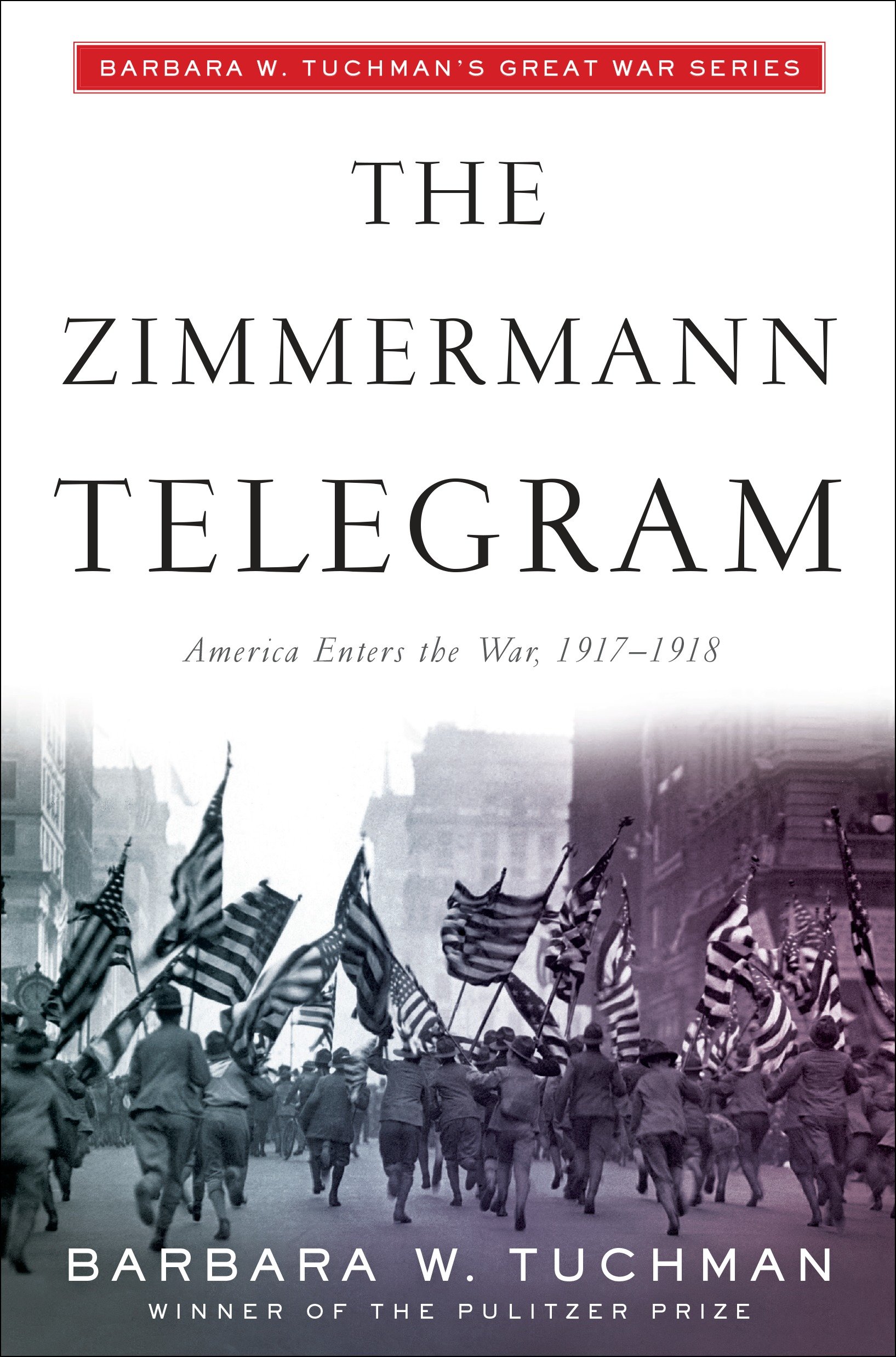
The Zimmermann Telegram
America Enters the War, 1917-1918; Barbara W. Tuchman's Great War Series
Random House Publishing Group · Print & ebook · March 12, 1985
“A tremendous tale of hushed and unhushed uproars in the linked fields of war and diplomacy” (The New York Times), from the Pulitzer Prize–winning author of The Guns of August In January 1917, the war in Europe was, at best, a tragic standoff.
We earn from qualifying purchases.
- Who it’s for
- A tense episode in wartime diplomacy, told with the momentum of an espionage story.
- Themes
- World War I diplomacy, Codebreaking and espionage, America enters the war
- Genres
- World War I History, Diplomacy, 20th-Century America
Nearest books
Matched by what the books are about, then ordered by what their readers also loved. Most of these share its genre: World War I History.
 Paris 1919Margaret MacMillan, Richard Holbrooke62% matchAlso shares Diplomacy
 Lawrence in ArabiaScott Anderson54% match
 The Third Reich at WarRichard J. Evans51% match
 The Conquering TideIan W. Toll, P. J. Ochlan50% match
 The Killing SeasonRobert Cowley60% match
 Dead WakeErik Larson56% match
 All Quiet on the Western FrontErich Maria Remarque, A. W. Wheen49% match
 American MidnightAdam Hochschild, Jonathan Todd Ross67% matchAlso shares 20th-Century America
For younger readers: The Nazi Conspiracy: the Secret Plot to Kill Roosevelt, Stalin, and Churchill, World War One: 1914-1918, What Was World War I?
Start with three books, and this one can be the first.
Members get a new edition every morning: a route out from their books to essays, research and talks, with the reason for each.
Start with this bookAbout this book
“A tremendous tale of hushed and unhushed uproars in the linked fields of war and diplomacy” (The New York Times), from the Pulitzer Prize–winning author of The Guns of August In January 1917, the war in Europe was, at best, a tragic standoff. Britain knew that all was lost unless the United States joined the war, but President Wilson was unshakable in his neutrality.
Continue reading
At just this moment, a crack team of British decoders in a quiet office known as Room 40 intercepted a document that would change history. The Zimmermann telegram was a top-secret message to the president of Mexico, inviting him to join Germany and Japan in an invasion of the United States. How Britain managed to inform the American government without revealing that the German codes had been broken makes for an incredible story of espionage and intrigue as only Barbara W. Tuchman could tell it. The Proud Tower, The Guns of August, and The Zimmermann Telegram comprise Barbara W. Tuchman’s classic histories of the First World War era.
Codes and Consequences
A tense episode in wartime diplomacy, told with the momentum of an espionage story.
Come here for
- The secrecy and stakes of wartime codebreaking
- A close look at diplomacy under pressure
Expect
- Narrative history centered on the Zimmermann telegram
- War and diplomacy intertwined
Where it sits
| World War I History | 100% |
|---|---|
| Diplomacy | 47% |
| 20th-Century America | 45% |
Percentages are BookFrontier’s reading of the book.
Publisher categories
- World War II History
- 20th-Century America
- 20th-Century History
- Authors
- Barbara W. Tuchman
- Publisher
- Random House Publishing Group
- Published
- March 12, 1985
- Format
- Print & ebook
- Theme
- World War I diplomacy · Codebreaking and espionage · America enters the war
- Reading lane
- World War II History