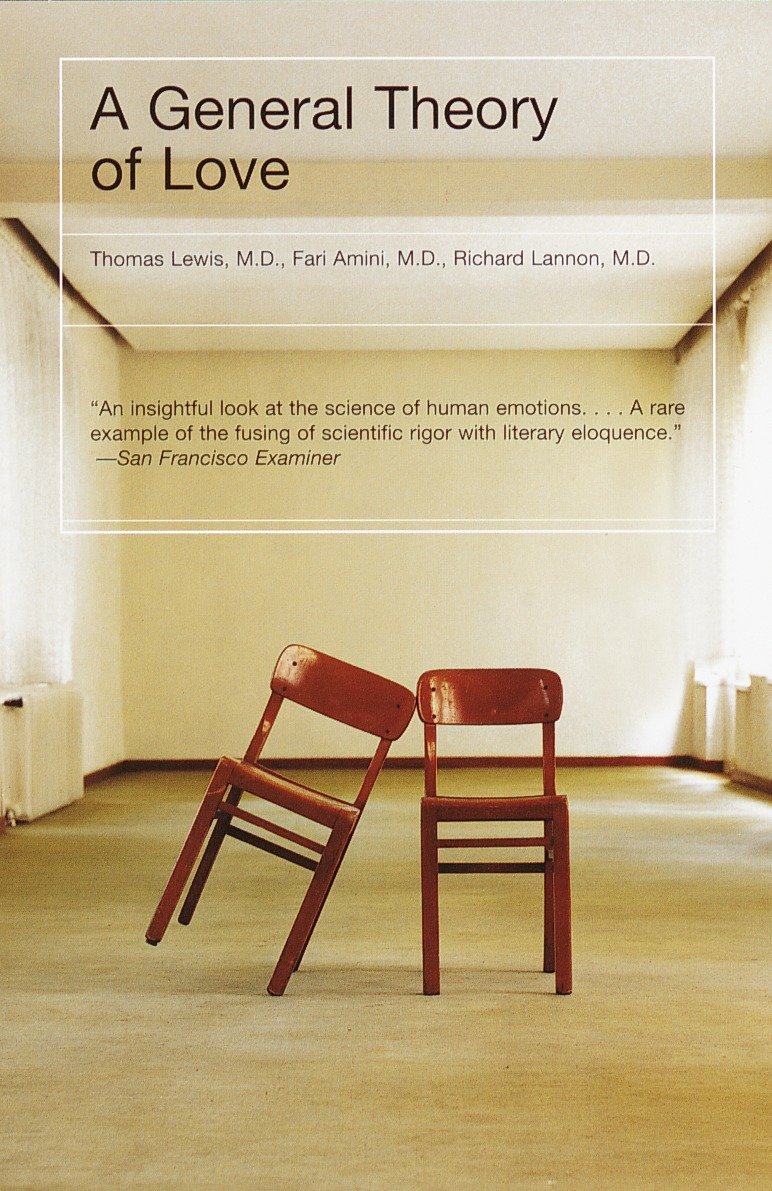
A General Theory of Love
Knopf Doubleday Publishing Group · Print & ebook · January 9, 2001
A Psychology pick for readers exploring A General Theory of Love.
We earn from qualifying purchases.
- Who it’s for
- A lucid account of intimacy brings brain science into conversation with art and thought.
- Themes
- Love and human well-being, Emotional bonds and brain development, Parent-child influence
- Genres
- Relationships, Neuroscience, Love & Romance
Nearest books
Matched by what the books are about, then ordered by what their readers also loved.
 HeRobert A. Johnson55% match
 The Body Keeps the ScoreBessel van der Kolk M.D., Bessel van der Kolk53% match
 Owning Your Own ShadowRobert A. Johnson50% match
 Wired for LoveStan Tatkin PsyD MFT, Harville Hendrix PhD67% match
 The Art of LovingErich Fromm, Nathan McMillan66% matchShares Relationships and Love & Romance
 How to Love BetterYung Pueblo50% matchShares Relationships and Love & Romance
 No Bad PartsRichard Schwartz PhD, Richard C. Schwartz51% match
Start with three books, and this one can be the first.
Members get a new edition every morning: a route out from their books to essays, research and talks, with the reason for each.
Start with this bookAbout this book
This original and lucid account of the complexities of love and its essential role in human well-being draws on the latest scientific research. Three eminent psychiatrists tackle the difficult task of reconciling what artists and thinkers have known for thousands of years about the human heart with what has only recently been learned about the primitive functions of the human brain.
Continue reading
A General Theory of Love demonstrates that our nervous systems are not self-contained: from earliest childhood, our brains actually link with those of the people close to us, in a silent rhythm that alters the very structure of our brains, establishes life-long emotional patterns, and makes us, in large part, who we are. Explaining how relationships function, how parents shape their child’s developing self, how psychotherapy really works, and how our society dangerously flouts essential emotional laws, this is a work of rare passion and eloquence that will forever change the way you think about human intimacy.
Love, Reconsidered
A lucid account of intimacy brings brain science into conversation with art and thought.
Come here for
- A view of love grounded in both humanistic insight and neuroscience
- A thoughtful look at how close relationships shape us
Expect
- Connections between early bonds, emotional patterns, and the developing self
- A wide-ranging account of relationships, psychotherapy, and emotional life
Where it sits
| Love & Romance | 54% |
|---|---|
| Neuroscience | 36% |
| Relationships | 34% |
Percentages are BookFrontier’s reading of the book.
Publisher categories
- Emotions
- Neuroscience
- Marriage & Family
- Authors
- Thomas Lewis, Fari Amini, Richard Lannon
- Publisher
- Knopf Doubleday Publishing Group
- Published
- January 9, 2001
- Format
- Print & ebook
- Theme
- Love and human well-being · Emotional bonds and brain development · Parent-child influence
- Reading lane
- Emotions