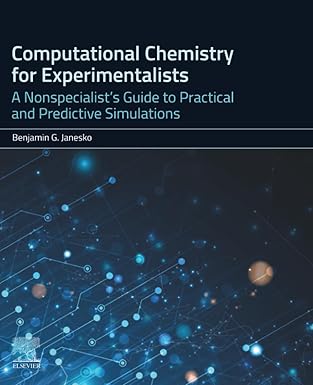
Computational Chemistry for Experimentalists
A Nonspecialist's Guide to Practical and Predictive Simulations
Elsevier Science · Print & ebook · February 12, 2026
We earn from qualifying purchases.
- Who it’s for
- Move from chemical concepts to simulations of laboratory techniques and molecular behavior.
- Genres
- Molecular Modeling
- Published
- Elsevier Science, February 12, 2026
Nearest books
Matched by what the books are about, then ordered by what their readers also loved. Most of these share its genre: Molecular Modeling.
 Computational Chemistry and Molecular ModelingK. I. Ramachandran, Gopakumar Deepa74% match
 Understanding Molecular SimulationDaan Frenkel, Berend Smit71% match
 Handbook of Computational Quantum ChemistryDavid B. Cook66% match
 Fundamentals of Computational ChemistryDaniel Sullivan65% match
 Computational Chemistry MethodsPonnadurai Ramasami64% match
 Coding for ChemistsChristopher J. Johnson, Benjamin J. Lear63% match
 ChemistryRichard Post, Chad Snyder61% match
 Computational Methods in Physics, Chemistry and BiologyPaul Harrison61% match
For younger readers: Super Simple Chemistry, CHEM MAT & CHG SE, Everything You Need to Ace Chemistry in One Big Fat Notebook
Start with three books, and this one can be the first.
Members get a new edition every morning: a route out from their books to essays, research and talks, with the reason for each.
Start with this bookAbout this book
Computational Chemistry for Experimentalists: A Nonspecialist's Guide to Practical and Predictive Simulations empowers chemists—especially those at emerging institutions or in small and medium enterprises—by transforming foundational chemical concepts into practical computational skills. A modular approach, paired with hands-on video tutorials, ensures that even nonspecialists can confidently apply simulations to their research, regardless of career stage or specialization.
Continue reading
Beyond its accessible structure, the book features six modules covering core topics such as electronic structure theory and molecular dynamics. Ten experimental modules focus on simulating specific laboratory techniques—reaction mechanisms, NMR, UV/vis, band structures, XPS, and organometallic chemistry. Regularly updated online tutorials complement the material, providing project-based, real-world training. By bridging theory and practice, this guide serves mid-career professionals, undergraduate and graduate students, and early-career researchers, making computational chemistry approachable and practical for all experimental chemists. - Provides experimentalists with a simple and accessible on-ramp to computation for non-specialists - Highlights the idea that computational chemistry’s core ideas, including chemical bonding, hybridization, and molecular structure are part of core chemical knowledge - Includes relevant equations and algorithmic details - Enables readers to rapidly acquire the most relevant knowledge - Includes modules that are paired with online video tutorials, providing real-world-hands-on training using different software packages
Laboratory Simulations
Move from chemical concepts to simulations of laboratory techniques and molecular behavior.
Come here for
- Electronic structure theory
- Molecular dynamics
Expect
- Six modules covering core topics
- Ten experimental modules focused on laboratory techniques
Where it sits
| Molecular Modeling | 100% |
|---|
Percentages are BookFrontier’s reading of the book.
Publisher categories
- Physical Chemistry
- Authors
- Benjamin G. Janesko
- Publisher
- Elsevier Science
- Published
- February 12, 2026
- Format
- Print & ebook
- Reading lane
- Physical Chemistry