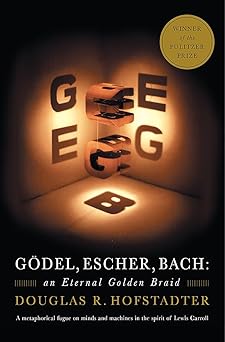
Gödel, Escher, Bach
An Eternal Golden Braid
Basic Books · Print & ebook · February 5, 1999
Winner of the Pulitzer Prize and National Book Award A metaphorical fugue on minds and machines in the spirit of Lewis Carroll “Every few decades an unknown author brings out a book of such depth, charity, range, wit, beauty, and originality that it is recognized at once as a major literary event.
We earn from qualifying purchases.
- Who it’s for
- A brainy braid of art, science, and philosophy that stays surprisingly readable.
- Themes
- consciousness, self-reference, cognitive science
- Pacing
- Reflective
Nearest books
Matched by what the books are about, then ordered by what their readers also loved.
 The Singularity Is NearRay Kurzweil49% match
 Permutation CityGreg Egan52% match
 Einstein's DreamsAlan Lightman59% match
 DiasporaGreg Egan49% match
For younger readers: Ludwig and the Rhinoceros, Alphamaniacs, Makers
Start with three books, and this one can be the first.
Members get a new edition every morning: a route out from their books to essays, research and talks, with the reason for each.
Start with this bookAbout this book
Winner of the Pulitzer Prize and National Book Award A metaphorical fugue on minds and machines in the spirit of Lewis Carroll “Every few decades an unknown author brings out a book of such depth, charity, range, wit, beauty, and originality that it is recognized at once as a major literary event.
Continue reading
This is such a work.” —Scientific American GEB is a unique insight into the nature of “I,” self, soul, and consciousness, centered on a notion that its youthful author dubbed “strange loop,” inspired by the twisty self-referential construction invented by logician Kurt Gödel, whereby a sentence asserts its own unprovability. The book’s chapters alternate with Bach-like contrapuntal dialogues between whimsical characters (especially Achilles and the Tortoise), and each dialogue’s intricate structure exemplifies the notion being discussed in it, thus creating indirect self-reference (a fact unsuspected by the characters). The book, filled with analogies, wordplay, humor, and mind-twisting prints by M. C. Escher, has inspired generations of bright students to study cognitive science and the philosophy of mind.
Braided Ideas
A brainy braid of art, science, and philosophy that stays surprisingly readable.
Come here for
- rigorous cross-disciplinary play
- dip-in sections that reward curiosity
Expect
- cultural-literacy density
- edgy, idea-forward detours
Where it sits
| Cognitive Science | 49% |
|---|---|
| Mathematical Logic | 43% |
| How We Think & Learn | 39% |
Percentages are BookFrontier’s reading of the book.
Publisher categories
- Computation Theory
- Mathematical Logic
- Philosophy
- Authors
- Douglas R Hofstadter
- Publisher
- Basic Books
- Published
- February 5, 1999
- Format
- Print & ebook
- Theme
- consciousness · self-reference · cognitive science
- Reading lane
- Computation Theory