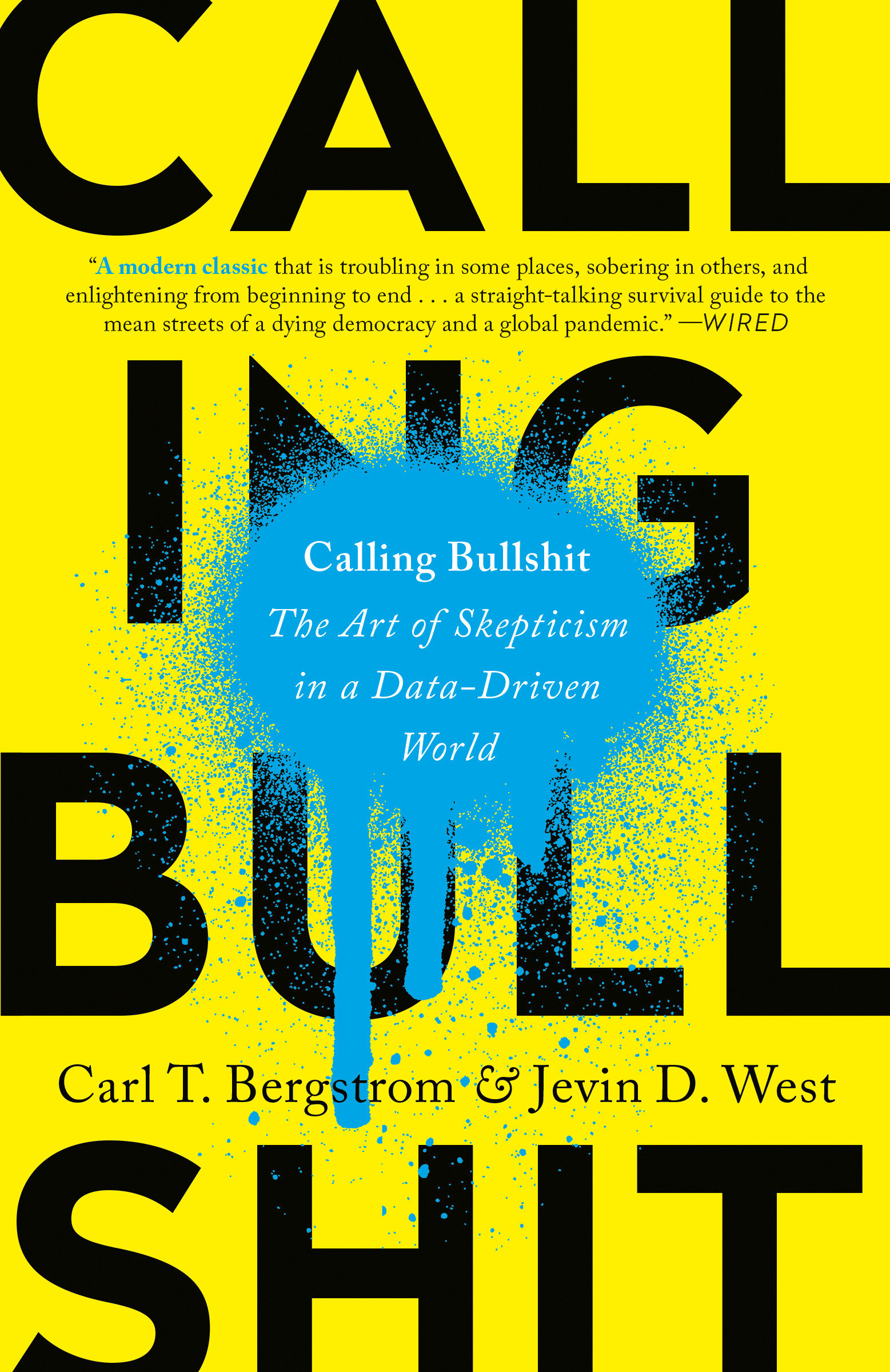
Calling Bullshit
The Art of Skepticism in a Data-driven World
Random House Publishing Group · Print & ebook · April 20, 2021
Bullshit isn’t what it used to be.
We earn from qualifying purchases.
- Who it’s for
- Find clearer ways to think amid fake news, bad data, and scientific-sounding claims.
- Themes
- Misinformation and fake news, Data literacy and statistical reasoning, Skepticism and critical thinking
- Genres
- Statistics for Social Science, How Media Works, Propaganda
Nearest books
Matched by what the books are about, then ordered by what their readers also loved.
 David and GoliathMalcolm Gladwell, Little, Brown & Company51% match
 Weapons of Math DestructionCathy O'Neil58% match
 The AI ConEmily M. Bender, Alex Hanna56% match
For younger readers: Big Lies, What the Fact?, True or False
Start with three books, and this one can be the first.
Members get a new edition every morning: a route out from their books to essays, research and talks, with the reason for each.
Start with this bookAbout this book
Bullshit isn’t what it used to be. Now, two science professors give us the tools to dismantle misinformation and think clearly in a world of fake news and bad data. “A modern classic . . . a straight-talking survival guide to the mean streets of a dying democracy and a global pandemic.”—Wired Misinformation, disinformation, and fake news abound and it’s increasingly difficult to know what’s true. Our media environment has become hyperpartisan.
Continue reading
Science is conducted by press release. Startup culture elevates bullshit to high art. We are fairly well equipped to spot the sort of old-school bullshit that is based in fancy rhetoric and weasel words, but most of us don’t feel qualified to challenge the avalanche of new-school bullshit presented in the language of math, science, or statistics. In Calling Bullshit, Professors Carl Bergstrom and Jevin West give us a set of powerful tools to cut through the most intimidating data. You don’t need a lot of technical expertise to call out problems with data. Are the numbers or results too good or too dramatic to be true? Is the claim comparing like with like? Is it confirming your personal bias? Drawing on a deep well of expertise in statistics and computational biology, Bergstrom and West exuberantly unpack examples of selection bias and muddled data visualization, distinguish between correlation and causation, and examine the susceptibility of science to modern bullshit. We have always needed people who call bullshit when necessary, whether within a circle of friends, a community of scholars, or the citizenry of a nation. Now that bullshit has evolved, we need to relearn the art of skepticism.
Skepticism, Sharpened
Find clearer ways to think amid fake news, bad data, and scientific-sounding claims.
Come here for
- Spotting the tricks hidden in numbers, charts, and confident claims
- Practical skepticism without technical expertise
Expect
- Examples of selection bias and muddled data visualization
- A clear distinction between correlation and causation
Where it sits
| Statistics for Social Science | 46% |
|---|---|
| How Media Works | 44% |
| Propaganda | 28% |
Percentages are BookFrontier’s reading of the book.
Publisher categories
- Sociolinguistics
- Corruption & Misconduct
- Applied Psychology
- Authors
- Carl T. Bergstrom, Jevin D. West
- Publisher
- Random House Publishing Group
- Published
- April 20, 2021
- Format
- Print & ebook
- Theme
- Misinformation and fake news · Data literacy and statistical reasoning · Skepticism and critical thinking
- Reading lane
- Sociolinguistics