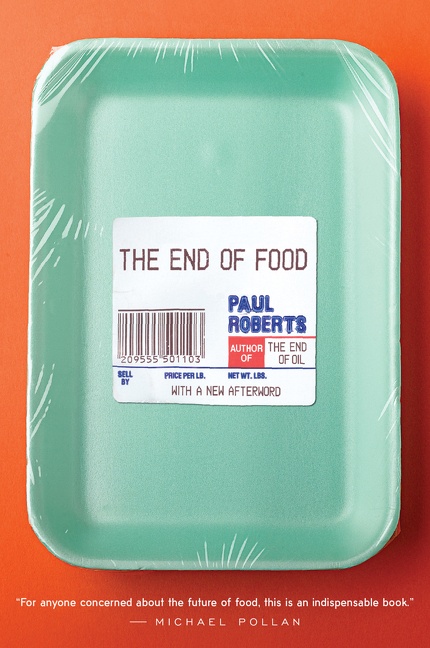
The End of Food
HarperCollins · Paperback · May 6, 2009
Paul Roberts, the best-selling author of The End of Oil, turns his attention to the modern food economy and finds that the system entrusted to meet our most basic need is failing.
We earn from qualifying purchases.
- Who it’s for
- Paul Roberts traces the tensions built into a food system producing more while straining its foundations.
- Genres
- Agriculture & Food Systems, Agriculture & Food Policy, The Food Business
- Published
- HarperCollins, May 6, 2009
Nearest books
Matched by what the books are about, then ordered by what their readers also loved. Most of these share its genres: Agriculture & Food Systems and Agriculture & Food Policy.
 Stuffed and StarvedRaj Patel69% match
 The 150 Healthiest Foods on Earth, Revised EditionJonny Bowden57% match
 The Fate of FoodAmanda Little71% match
 The Last SupperSam Kass68% match
 Food FixDr. Mark Hyman MD, Mark Hyman68% match
 Food, Inc. 2Participant, Karl Weber67% matchAlso shares The Food Business
For younger readers: The Story of Seeds, Eyes Wide Open: Going Behind the Environmental Headlines, What the World Eats
Start with three books, and this one can be the first.
Members get a new edition every morning: a route out from their books to essays, research and talks, with the reason for each.
Start with this bookAbout this book
Paul Roberts, the best-selling author of The End of Oil, turns his attention to the modern food economy and finds that the system entrusted to meet our most basic need is failing. In this carefully researched, vivid narrative, Roberts lays out the stark economic realities behind modern food and shows how our system of making, marketing, and moving what we eat is growing less and less compatible with the billions of consumers that system was built to serve.
Continue reading
At the heart of The End of Food is a grim paradox: the rise of large-scale food production, though it generates more food more cheaply than at any time in history, has reached a point of dangerously diminishing returns. Our high-volume factory systems are creating new risks for food-borne illness, from E. coli to avian flu. Our high-yield crops and livestock generate grain, vegetables, and meat of declining nutritional quality. While nearly one billion people worldwide are overweight or obese, the same number of people—one in every seven of us—can’t get enough to eat. In some of the hardest-hit regions, such as sub-Saharan Africa, the lack of a single nutrient, vitamin A, has left more than five million children permanently blind. Meanwhile, the shift to heavily mechanized, chemically intensive farming has so compromised soil and water that it’s unclear how long such output can be maintained. And just as we’ve begun to understand the limits of our abundance, the burgeoning economies of Asia, with their rising middle classes, are adopting Western-style, meat-heavy diets, putting new demands on global food supplies. Comprehensive in scope and full of fresh insights, The End of Food presents a lucid, stark vision of the future. It is a call for us to make crucial decisions to help us survive the demise of food production as we know it.
Food’s Fault Lines
Paul Roberts traces the tensions built into a food system producing more while straining its foundations.
Come here for
- The economics behind how food is grown, marketed, and moved
- A clear-eyed look at abundance, hunger, and mounting risks
Expect
- Vivid narrative grounded in the realities of modern food production
- A wide-angle view of nutrition, farming, and global demand
Where it sits
| Agriculture & Food Systems | 60% |
|---|---|
| The Food Business | 25% |
| Agriculture & Food Policy | 21% |
Percentages are BookFrontier’s reading of the book.
Publisher categories
- Trade & Commercial Policy
- Management Science
- Business Motivation
- Agribusiness
Show all 8 publisher categories
- The Food Business
- Leadership
- Food Through History
- Agricultural Law
- Authors
- Paul Roberts
- Publisher
- HarperCollins
- Published
- May 6, 2009
- Format
- Paperback
- Reading lane
- Trade & Commercial Policy