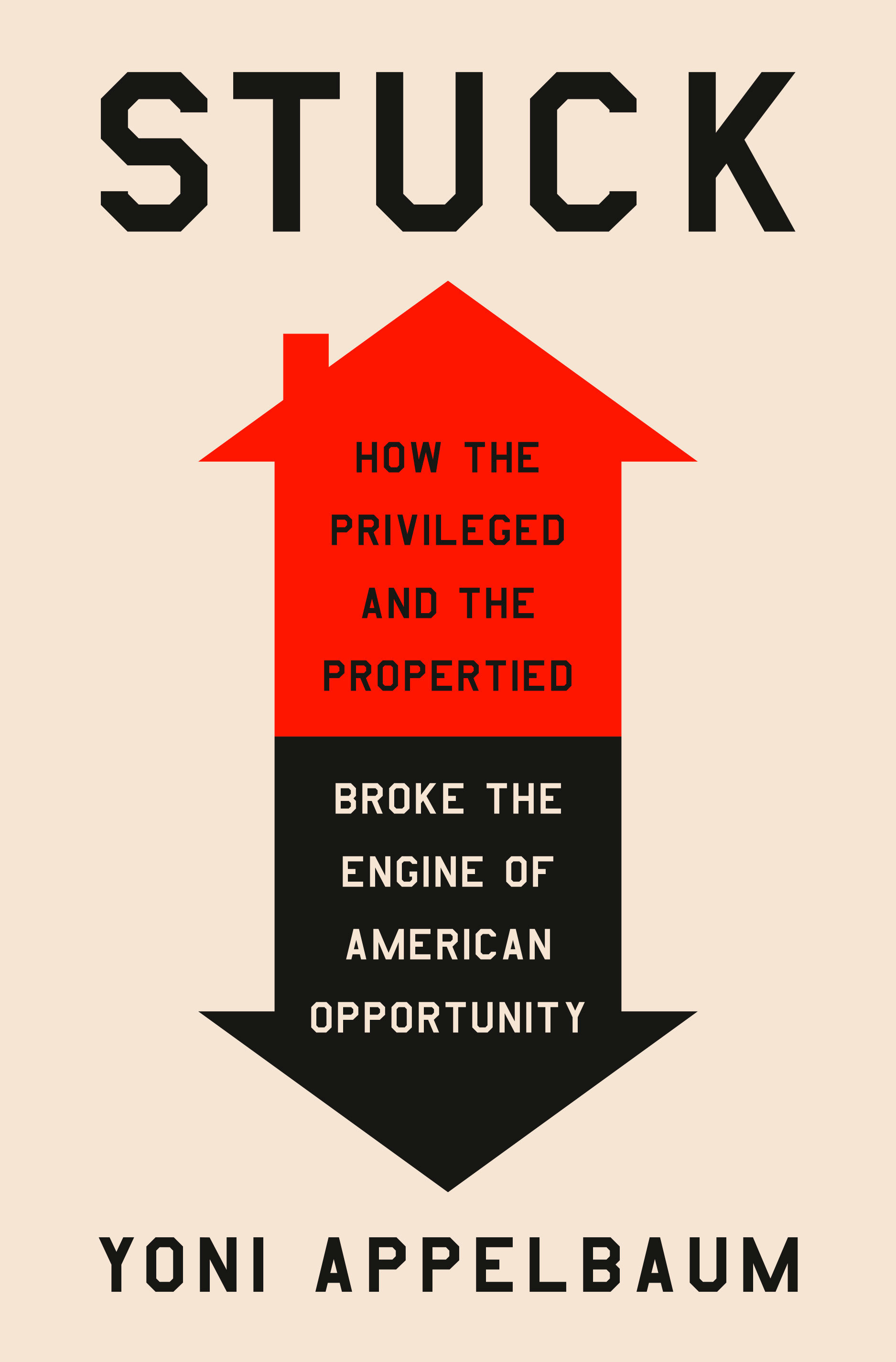
Stuck
How the Privileged and the Propertied Broke the Engine of American Opportunity
Random House Publishing Group · Print & ebook · February 18, 2025
How did America cease to be the land of opportunity?
We earn from qualifying purchases.
- Who it’s for
- A readable account of how American opportunity got jammed up.
- Genres
- Cities & Urban Planning, Urban Life, Race & Discrimination
- Published
- Random House Publishing Group, February 18, 2025
Nearest books
Matched by what the books are about, then ordered by what their readers also loved.
 Seven Social Movements That Changed AmericaLinda Gordon59% match
 The Age of EntitlementChristopher Caldwell62% match
 OutclassedJoan C. Williams57% match
 Coming ApartCharles Murray56% match
For younger readers: Shift Happens: the History of Labor in the United States, America Redux: Visual Stories From Our Dynamic History, Better Than We Found It: Conversations to Help Save the World
Start with three books, and this one can be the first.
Members get a new edition every morning: a route out from their books to essays, research and talks, with the reason for each.
Start with this bookAbout this book
How did America cease to be the land of opportunity? LONGLISTED FOR THE PORCHLIGHT BUSINESS BOOK AWARD We take it for granted that good neighborhoods—with good schools and good housing—are only accessible to the wealthy. But in America, this wasn’t always the case.
Continue reading
Though for most of world history, your prospects were tied to where you were born, Americans came up with a revolutionary idea: If you didn’t like your lot in life, you could find a better location and reinvent yourself there. Americans moved to new places with unprecedented frequency, and, for two hundred years, that remarkable mobility was the linchpin of American economic and social opportunity. In this illuminating debut, Yoni Appelbaum, historian and journalist for The Atlantic, shows us that this idea has been under attack since reformers first developed zoning laws to ghettoize Chinese Americans in nineteenth-century Modesto, California. The century of legal segregation that ensued—from the zoning laws enacted to force Jewish workers back into New York’s Lower East Side to the private-sector discrimination and racist public policy that trapped Black families in Flint, Michigan to Jane Jacobs’ efforts to protect her vision of the West Village—has raised housing prices, deepened political divides, emboldened bigots, and trapped generations of people in poverty. Appelbaum shows us that these problems have a common explanation: people can’t move as readily as they used to. They are, in a word, stuck. Cutting through more than a century of mythmaking, Stuck tells a vivid, surprising story of the people and ideas that caused our economic and social sclerosis and lays out common-sense ways to get Americans moving again.
Why It Clicks
A readable account of how American opportunity got jammed up.
Come here for
- urban-rural tension
- clear-eyed historical framing
Expect
- civil rights and political history
- straightforward explanation
Where it sits
| Cities & Urban Planning | 88% |
|---|---|
| Urban Life | 39% |
| Race & Discrimination | 21% |
Percentages are BookFrontier’s reading of the book.
Publisher categories
- 20th-Century America
- Civil Rights
- Social Class
- Authors
- Ari Fliakos, Yoni Appelbaum, Random House Audio
- Publisher
- Random House Publishing Group
- Published
- February 18, 2025
- Format
- Print & ebook
- Reading lane
- 20th-Century America