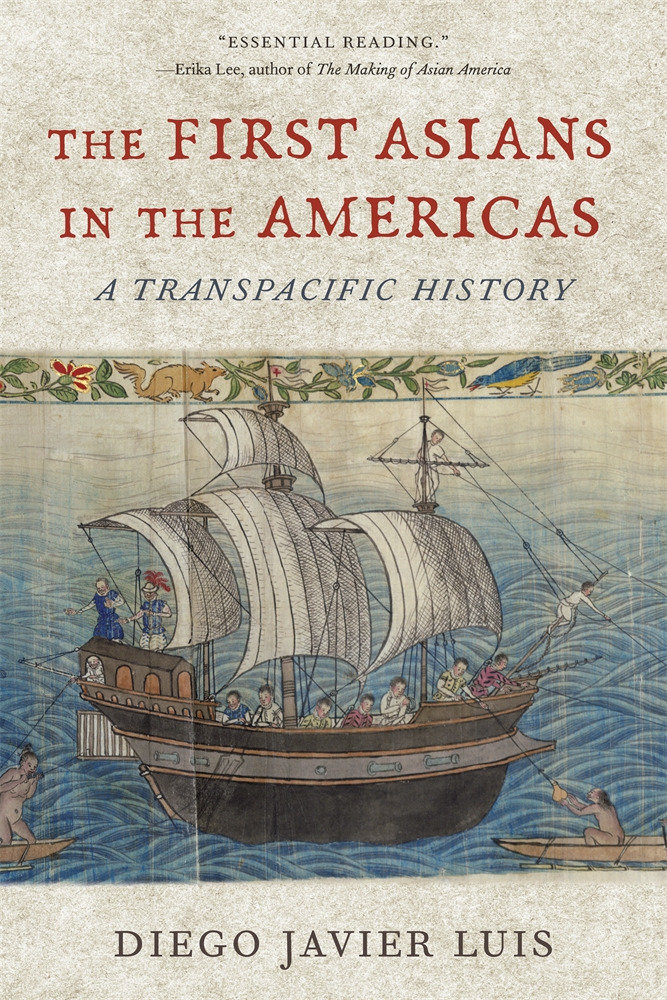
First Asians in the Americas
A Transpacific History
WW Norton · Print & ebook · December 9, 2025
The definitive account of transpacific Asian movement through the Spanish empire—from Manila to Acapulco and beyond—and its implications for the history of race and colonization in the Americas.
We earn from qualifying purchases.
- Who it’s for
- Diego Javier Luis traces Asian movement across the Pacific and its place in colonial Mexican society.
- Genres
- Mexican History, Asian American Studies, Immigration & Emigration
- Published
- WW Norton, December 9, 2025
Nearest books
Matched by what the books are about, then ordered by what their readers also loved.
 Atlantic Africa and the Spanish Caribbean, 1570-1640David Wheat58% match
 Empire UnseenMélanie Lamotte56% match
 The Making of Asian AmericaErika Lee55% matchShares Asian American Studies and Immigration & Emigration
 Harvest of EmpireJuan Gonzalez55% matchShares Immigration & Emigration
 1491Charles C. Mann55% matchShares Mexican History
 ConquistadoresFernando Cervantes55% match
For younger readers: Exclusion and the Chinese American Story, Borderlands and the Mexican American Story, 1493 for Young People
Start with three books, and this one can be the first.
Members get a new edition every morning: a route out from their books to essays, research and talks, with the reason for each.
Start with this bookAbout this book
The definitive account of transpacific Asian movement through the Spanish empire—from Manila to Acapulco and beyond—and its implications for the history of race and colonization in the Americas. Between 1565 and 1815, the so-called Manila galleons enjoyed a near-complete monopoly on transpacific trade between Spain’s Asian and American colonies.
Continue reading
Sailing from the Philippines to Mexico and back, these Spanish trading ships also facilitated the earliest migrations and displacements of Asian peoples to the Americas. Hailing from Gujarat, Nagasaki, and many places in between, both free and enslaved Asians boarded the galleons and made the treacherous transpacific journey each year. Once in Mexico, they became “chinos” within the New Spanish caste system. Diego Javier Luis chronicles this first sustained wave of Asian mobility to the early Americas. Uncovering how and why Asian peoples crossed the Pacific, he sheds new light on the daily lives of those who disembarked at Acapulco. There, the term “chino” officially racialized diverse ethnolinguistic populations into a single caste, vulnerable to New Spanish policies of colonial control. Yet Asians resisted these strictures, often by forging new connections across ethnic groups. Social adaptation and cultural convergence, Luis argues, defined Asian experiences in the Spanish Americas from the colonial invasions of the sixteenth century to the first cries for Mexican independence in the nineteenth. The First Asians in the Americas speaks to an important era in the construction of race, vividly unfolding what it meant to be “chino” in the early modern Spanish empire. In so doing, it demonstrates the significance of colonial Latin America to Asian diasporic history and reveals the fundamental role of transpacific connections to the development of colonial societies in the Americas.
Manila to Acapulco
Diego Javier Luis traces Asian movement across the Pacific and its place in colonial Mexican society.
Come here for
- Asian migration from Manila to Acapulco
- The caste meaning of “chino” in colonial Mexico
Expect
- Galleon travel and the lives of people arriving in Acapulco
- Race, colonial control, and connections across ethnic groups
Where it sits
| Mexican History | 71% |
|---|---|
| Asian American Studies | 43% |
| Immigration & Emigration | 41% |
Percentages are BookFrontier’s reading of the book.
Publisher categories
- Mexican History
- 17th-Century History
- 16th-Century History
- Authors
- Diego Javier Luis
- Publisher
- WW Norton
- Published
- December 9, 2025
- Format
- Print & ebook
- Reading lane
- Mexican History