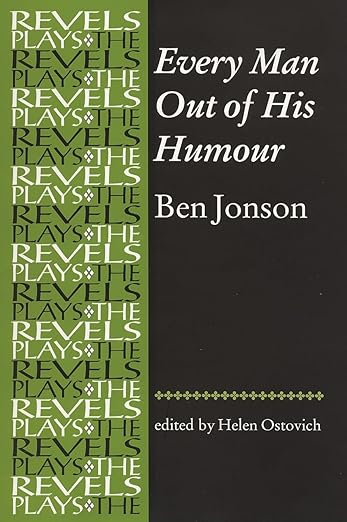
Every Man Out of His Humour
Ben Jonson
Manchester University Press · Print & ebook · September 1, 2008
Despite its popularity when it first appeared in print in 1600, Every Man out of His Humour has never appeared as a single modern critical edition until now.
We earn from qualifying purchases.
- Who it’s for
- An introduction and annotations connect this play’s concerns with wealth and self-display to their historical context.
- Genres
- British & Irish Plays
- Published
- Manchester University Press, September 1, 2008
Nearest books
Matched by what the books are about, then ordered by what their readers also loved. Most of these share its genre: British & Irish Plays.
 Antonio's RevengeJohn Marston, W. Reavley Gair54% match
 The Cid, Cinna, the Theatrical IllusionPierre Corneille42% match
 Philaster: or Love Lies A-bleedingAndrew Gurr, Francis Beaumont57% match
 The MalcontentGeorge Hunter, George K. Hunter56% match
 Five PlaysJean Anouilh44% match
 Bartholomew FairSuzanne Gossett67% match
 The Knight of the Burning PestleSheldon Zitner, Francis Beaumont64% match
 Epicene, or the Silent WomanRichard Dutton63% match
For younger readers: Shakespeare's First Folio: All the Plays: a Children's Edition, Welcome to the Globe, Bard of Avon: the Story of William Shakespeare
Start with three books, and this one can be the first.
Members get a new edition every morning: a route out from their books to essays, research and talks, with the reason for each.
Start with this bookAbout this book
Despite its popularity when it first appeared in print in 1600, Every Man out of His Humour has never appeared as a single modern critical edition until now. The volume's introduction and annotations convey early modern obsessions with wealth and self-display by providing historical contexts and pointing out the continuity of those obsessions into modern life.
Continue reading
The play is of interest because of its influence on the course of city comedy and its wealth of information about social relationships and colloquial language at the end of Elizabeth's reign. Jonson's experiments in generating theatrical meaning continued throughout his career, but Every Man out of His Humour – with its youthful vigour and extraordinary visualizations of the urban capacity for self-deceit – is a text that enriches the understanding of all the plays that come after it.
Wealth and Self-Display
An introduction and annotations connect this play’s concerns with wealth and self-display to their historical context.
Come here for
- Historical contexts and annotations on wealth and self-display
- Social relationships and colloquial language at the end of Elizabeth’s reign
Expect
- A play influential in the course of city comedy
- A single modern critical edition
Where it sits
| British & Irish Plays | 82% |
|---|
Percentages are BookFrontier’s reading of the book.
Publisher categories
- 16th-Century Literary Criticism
- Television History & Criticism
- Authors
- Helen Ostovich, Ben Jonson
- Publisher
- Manchester University Press
- Published
- September 1, 2008
- Format
- Print & ebook
- Reading lane
- 16th-Century Literary Criticism