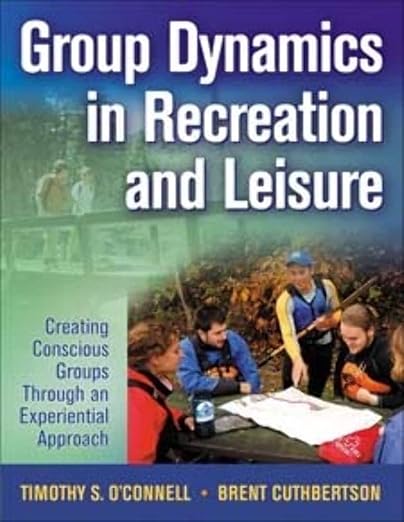
Group Dynamics in Recreation and Leisure
Creating Conscious Groups Through an Experiential Approach
Human Kinetics · Print & ebook · August 29, 2008
People who choose a career in the recreation or leisure fields will spend a large amount of their time in groups.
We earn from qualifying purchases.
- Who it’s for
- This text connects group dynamics theory with the practical work of leading recreation and leisure groups.
- Genres
- Parks & Recreation Management, Social Psychology, Sports & Recreation
- Published
- Human Kinetics, August 29, 2008
Nearest books
Matched by what the books are about, then ordered by what their readers also loved. Most of these share its genre: Parks & Recreation Management.
 Introduction to Recreation and LeisureTyler Tapps, Mary Sara Wells61% match
 Leisure Program Planning and DeliveryRuth V. Russell, Lynn M. Jamieson61% matchAlso shares Sports & Recreation
 Leisure Program Planning and DeliveryAmy R. Hurd, Denise M. Anderson59% match
 Group Dynamics in Occupational TherapyMarilyn B. Cole57% match
 Leisure Services ManagementAmy R. Hurd, Robert J. Barcelona56% match
 Experiential Youth Ministry HandbookJohn Losey, Youth Specialties54% match
 Studies in Outdoor RecreationRobert E. Manning54% match
 The Little Book of Restorative Teaching ToolsLindsey Pointer, Kathleen McGoey54% match
Start with three books, and this one can be the first.
Members get a new edition every morning: a route out from their books to essays, research and talks, with the reason for each.
Start with this bookAbout this book
People who choose a career in the recreation or leisure fields will spend a large amount of their time in groups. Group Dynamics in Recreation and Leisure: Creating Conscious Groups Through an Experiential Approach builds skills not only in working in group settings but also in creating and facilitating conscious groups. A conscious group is one that recognizes the personal growth of its members as the main group objective.
Continue reading
Most people in recreational activities and events are looking to meet people and take part in positive group interaction, providing recreation professionals with a perfect opportunity to develop successful conscious groups. Group Dynamics in Recreation and Leisure introduces group dynamics theory and current research as it applies to recreation and leisure settings. It presents the key concepts and terms, a brief history of the field, and the various theories and models of group development. The text then explains the concept of the conscious group, describes the nature and components of a conscious group, and applies experiential learning theory to working with these groups. Group Dynamics in Recreation and Leisure also moves beyond the theory to show students that their understanding of group dynamics can be a meaningful and realistic tool. They'll learn to apply the theory to the practical factors and issues involved in leading and working with conscious groups. They'll explore group goal setting; clarification of objectives and expectations; processes for decision making and problem solving; positive communication; ethics, morals, and values; effective leadership of recreation groups; and the effects of conflict, power, gender, and environment on group functioning. Students will also find a thorough examination of common issues that arise when working with groups, including potential pitfalls and strategies for dealing with or avoiding those pitfalls. They'll learn about the strengths, weaknesses, and myths of group interaction, including signs of “illness” within groups; working with alternative groups, such as cooperative living groups, as well as involuntary groups and unwilling participants; and capitalizing on diversity and difference. Because those in recreation professions so often work with large groups, crowd dynamics is also discussed. The authors describe how individual and small-group behavior can affect larger groups and also look at mob behavior and riots. Throughout the book, case studies, scenarios, and examples from leisure services, parks, tourism, and experiential education help students better understand and apply the information. These are some other student-friendly features: -Toolbox Tips on strategies and techniques for working with groups -Learning activities that apply the principles discussed in the text -Web sites for further exploration of the ideas in the text Group Dynamics in Recreation and Leisure: Creating Conscious Groups Through an Experiential Approach provides a new view of group dynamics with a unique focus on recreation, leisure, and experiential education settings. Through its concentration on skill development to facilitate productive group work, Group Dynamics in Recreation and Leisure renders the topic of group dynamics as meaningful,realistic, and applicable for both students and practitioners.
Conscious Groups
This text connects group dynamics theory with the practical work of leading recreation and leisure groups.
Come here for
- How group dynamics theory applies to recreation and leisure settings
- Guidance on goals, decision making, communication, leadership, and conflict
Expect
- The conscious group concept and models of group development
- Case studies, scenarios, learning activities, and Toolbox Tips
Where it sits
| Sports & Recreation | 44% |
|---|---|
| Parks & Recreation Management | 41% |
| Social Psychology | 35% |
Percentages are BookFrontier’s reading of the book.
Publisher categories
- Sports & Recreation
- Authors
- Timothy S. O'Connell, Brent Cuthbertson
- Publisher
- Human Kinetics
- Published
- August 29, 2008
- Format
- Print & ebook
- Reading lane
- Sports & Recreation