Bathsheba's Breast
Women, Cancer, and History
The Johns Hopkins University Press · Print & ebook · April 29, 2003
"Breast cancer may very well be history's oldest malaise, known as well to the ancients as it is to us.
We earn from qualifying purchases.
- Genres
- Breast Cancer, Medical History, Women's History
- Published
- The Johns Hopkins University Press, April 29, 2003
Nearest books
Matched by what the books are about, then ordered by what their readers also loved. Most of these share its genre: Breast Cancer.
 RadicalKate Pickert74% match
 Dr. Susan Love's Breast BookSusan M. Love MD, Karen Lindsey64% match
 The Cancer JournalsAudre Lorde63% match
 Twisting FatePamela Munster, Pamela N. Munster62% match
 No Longer RadicalDr Rachel Brem, Dr Christy Teal62% match
 All in Her HeadElizabeth Comen61% matchAlso shares Medical History
 The UndyingAnne Boyer61% match
For younger readers: Bold Women of Medicine, Women of Colonial America, Plague-busters!
Start with three books, and this one can be the first.
Members get a new edition every morning: a route out from their books to essays, research and talks, with the reason for each.
Start with this bookAbout this book
"Breast cancer may very well be history's oldest malaise, known as well to the ancients as it is to us. The women who have endured it share a unique sisterhood. Queen Atossa and Dr. Jerri Nielsen—separated by era and geography, by culture, religion, politics, economics, and world view—could hardly have been more different. Born 2,500 years apart, they stand as opposite bookends on the shelf of human history.
Continue reading
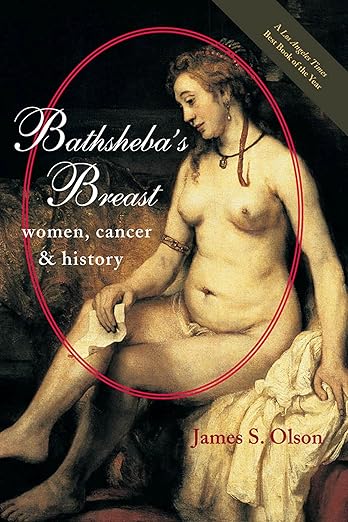
One was the most powerful woman in the ancient world, the daughter of an emperor, the mother of a god; the other is a twenty-first-century physician with a streak of adventure coursing through her veins. From the imperial throne in ancient Babylon, Atossa could not have imagined the modern world, and only in the driest pages of classical literature could Antarctica-based Jerri Nielsen even have begun to fathom the Near East five centuries before the birth of Christ. For all their differences, however, they shared a common fear that transcends time and space."—from Bathsheba's Breast In 1967, an Italian surgeon touring Amsterdam's Rijks museum stopped in front of Rembrandt's Bathsheba at Her Bath, on loan from the Louvre, and noticed an asymmetry to Bathsheba's left breast; it seemed distended, swollen near the armpit, discolored, and marked with a distinctive pitting. With a little research, the physician learned that Rembrandt's model, his mistress Hendrickje Stoffels, later died after a long illness, and he conjectured in a celebrated article for an Italian medical journal that the cause of her death was almost certainly breast cancer. A horror known to every culture in every age, breast cancer has been responsible for the deaths of 25 million women throughout history. An Egyptian physician writing 3,500 years ago concluded that there was no treatment for the disease. Later surgeons recommended excising the tumor or, in extreme cases, the entire breast. This was the treatment advocated by the court physician to sixth-century Byzantine empress Theodora, the wife of Justinian, though she chose to die in pain rather than lose her breast. Only in the past few decades has treatment advanced beyond disfiguring surgery. In Bathsheba's Breast, historian James S. Olson—who lost his left hand and forearm to cancer while writing this book—provides an absorbing and often frightening narrative history of breast cancer told through the heroic stories of women who have confronted the disease, from Theodora to Anne of Austria, Louis XIV's mother, who confronted "nun's disease" by perfecting the art of dying well, to Dr. Jerri Nielson, who was dramatically evacuated from the South Pole in 1999 after performing a biopsy on her own breast and self-administering chemotherapy. Olson explores every facet of the disease: medicine's evolving understanding of its pathology and treatment options; its cultural significance; the political and economic logic that has dictated the terms of a war on a "woman's disease"; and the rise of patient activism. Olson concludes that, although it has not yet been conquered, breast cancer is no longer the story of individual women struggling alone against a mysterious and deadly foe.
History in Focus
Come here for
- history, women, and science in conversation
- cultural context around cancer
Expect
- an explanatory, sustained read
- cultural literacy over case-by-case drama
Where it sits
| Breast Cancer | 83% |
|---|---|
| Medical History | 50% |
| Women's History | 40% |
Percentages are BookFrontier’s reading of the book.
Publisher categories
- Women's History
- Breast Cancer
- Gender Studies
- Authors
- James S. Olson, James Stuart Olson
- Publisher
- The Johns Hopkins University Press
- Published
- April 29, 2003
- Format
- Print & ebook
- Reading lane
- Women's History