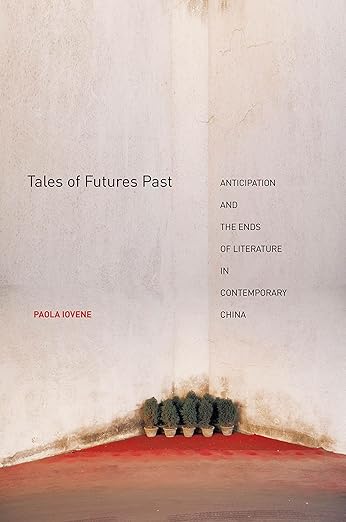
Tales of Futures Past
Anticipation and the Ends of Literature in Contemporary China
Stanford University Press · Print & ebook · July 9, 2014
Most studies of Chinese literature conflate the category of the future with notions of progress and nation building, and with the utopian visions broadcast by the Maoist and post-Mao developmental state.
We earn from qualifying purchases.
- Who it’s for
- Iovene traces how changing expectations reshape Chinese literary culture from the 1950s to 2011.
- Genres
- Chinese Literary Criticism, 20th-Century Literary Criticism, 21st Century Literature
- Published
- Stanford University Press, July 9, 2014
Nearest books
Matched by what the books are about, then ordered by what their readers also loved. Most of these share its genre: Chinese Literary Criticism.
 Changing Stories in the Chinese WorldMark Elvin63% match
 Translingual PracticeLydia Liu, Lydia H. Liu63% match
 Questioning BordersRobin Visser59% match
For younger readers: Sweet and Sour, Along the River, Out There
Start with three books, and this one can be the first.
Members get a new edition every morning: a route out from their books to essays, research and talks, with the reason for each.
Start with this bookAbout this book
Most studies of Chinese literature conflate the category of the future with notions of progress and nation building, and with the utopian visions broadcast by the Maoist and post-Mao developmental state. The future is thus understood as a preconceived endpoint that is propagated, at times even imposed, by a center of power.
Continue reading
By contrast, Tales of Futures Past introduces "anticipation"—the expectations that permeate life as it unfolds—as a lens through which to reexamine the textual, institutional, and experiential aspects of Chinese literary culture from the 1950s to 2011. In doing so, Paola Iovene connects the emergence of new literary genres with changing visions of the future in contemporary China. This book provides a nuanced and dynamic account of the relationship between state discourses, market pressures, and individual writers and texts. It stresses authors' and editors' efforts to redefine what constitutes literature under changing political and economic circumstances. Engaging with questions of translation, temporality, formation of genres, and stylistic change, Iovene mines Chinese science fiction and popular science, puts forward a new interpretation of familiar Chinese avant-garde fiction, and offers close readings of texts that have not yet received any attention in English-language scholarship. Far-ranging in its chronological scope and impressive in its interdisciplinary approach, this book rethinks the legacies of socialism in postsocialist Chinese literary modernity.
Anticipation in China
Iovene traces how changing expectations reshape Chinese literary culture from the 1950s to 2011.
Come here for
- Anticipation as a lens on Chinese literary culture
- Close readings of Chinese science fiction and popular science
Expect
- A study spanning the 1950s through 2011
- Attention to translation and stylistic change
Where it sits
| Chinese Literary Criticism | 100% |
|---|---|
| 21st Century Literature | 51% |
| 20th-Century Literary Criticism | 25% |
Percentages are BookFrontier’s reading of the book.
Publisher categories
- Chinese Literary Criticism
- Authors
- Paola Iovene
- Publisher
- Stanford University Press
- Published
- July 9, 2014
- Format
- Print & ebook
- Reading lane
- Chinese Literary Criticism