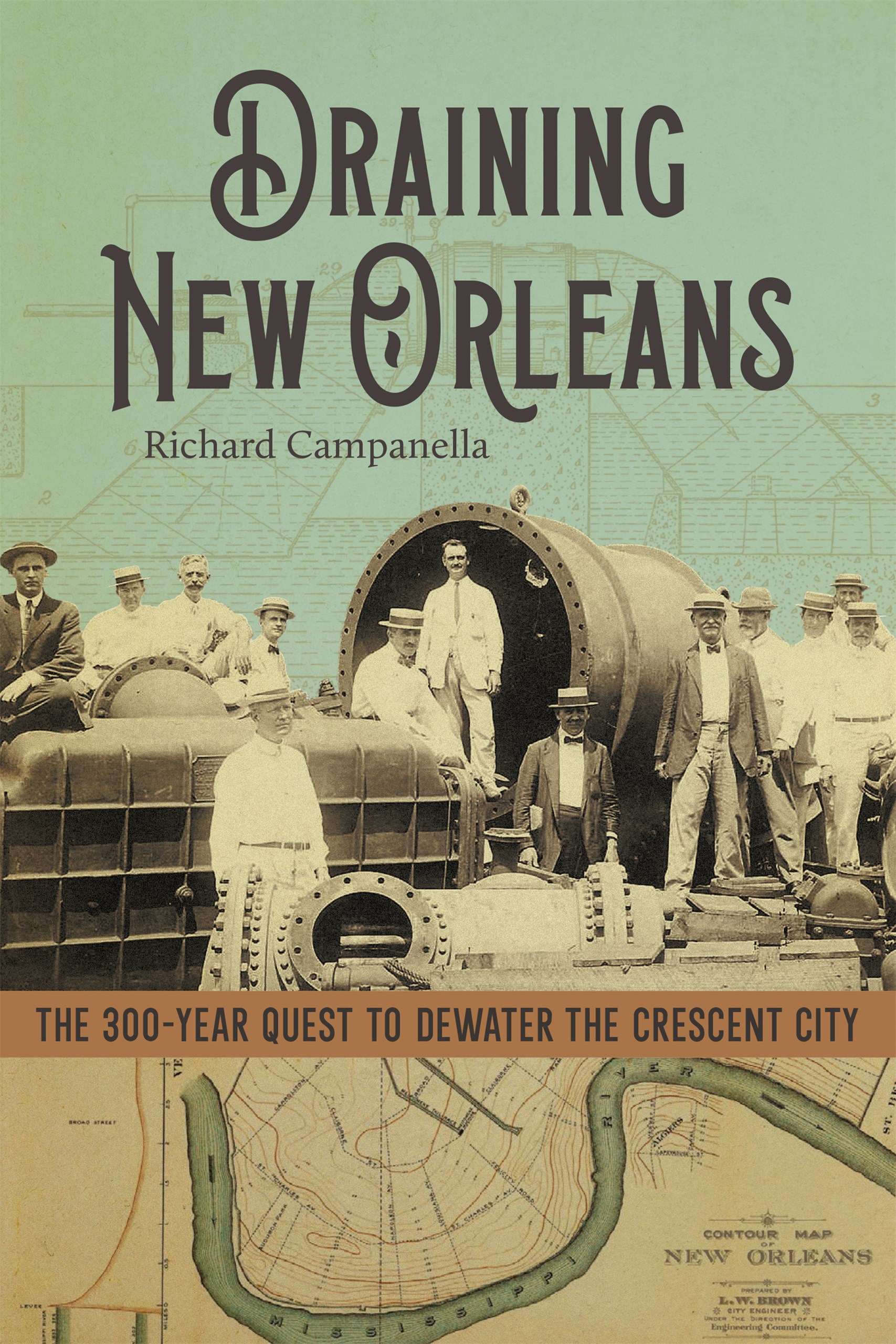
Draining New Orleans
The 300-year Quest to Dewater the Crescent City
LSU Press · Print & ebook · May 3, 2023
In Draining New Orleans, the first full-length book devoted to ?the world?s toughest drainage problem,? renowned geographer Richard Campanella recounts the epic challenges and ingenious efforts to dewater the Crescent City.
We earn from qualifying purchases.
- Who it’s for
- Readers interested in New Orleans's drainage history
- Themes
- Urban drainage and engineering, Wetland reclamation and urban expansion, Power and the making of place
- Genres
- Southern U.S. History, Flood Control Engineering, Historical Geography
Nearest books
Matched by what the books are about, then ordered by what their readers also loved.
 Rising TideJohn M. Barry59% matchShares Southern U.S. History
 Empire of WaterDavid Soll58% match
 Ditch of DreamsSteven Noll, David Tegeder55% matchShares Southern U.S. History
 Cadillac DesertMarc Reisner55% match
 Water to the AngelsLes Standiford55% match
 New OrleansCharles D. Chamberlain54% matchShares Southern U.S. History
For younger readers: Drowned City, Many Voices, Zane and the Hurricane: a Story of Katrina
Start with three books, and this one can be the first.
Members get a new edition every morning: a route out from their books to essays, research and talks, with the reason for each.
Start with this bookAbout this book
In Draining New Orleans, the first full-length book devoted to ?the world?s toughest drainage problem,? renowned geographer Richard Campanella recounts the epic challenges and ingenious efforts to dewater the Crescent City. With forays into geography, public health, engineering, architecture, politics, sociology, race relations, and disaster response, he chronicles the herculean attempts to ?reclaim? the city?
Continue reading
s swamps and marshes and install subsurface drainage for massive urban expansion. The study begins with a vivid description of a festive event on Mardi Gras weekend 1915, which attracted an entourage of elite New Orleanians to the edge of Bayou Barataria to witness the christening of giant water pumps. President Woodrow Wilson, connected via phoneline from the White House, planned to activate the station with the push of a button, effectively draining the West Bank of New Orleans. What transpired in the years and decades that followed can only be understood by examining the large swath of history dating back two centuries earlier?to the geological formation and indigenous occupation of this delta?and extending through the colonial, antebellum, postbellum, and Progressive eras to modern times. The consequences of dewatering New Orleans proved both triumphant and tragic. The city?s engineering prowess transformed it into a world leader in drainage technology, yet the municipality also fell victim to its own success. Rather than a story about mud and machinery, this is a history of people, power, and the making of place. Campanella emphasizes the role of determined and sometimes unsavory individuals who spearheaded projects to separate water from dirt, creating lucrative opportunities in the process not only for the community but also for themselves.
Who it’s for
- Readers interested in New Orleans's drainage history
- Readers interested in engineering and urban development
Where it sits
| Southern U.S. History | 86% |
|---|---|
| Flood Control Engineering | 50% |
| Historical Geography | 38% |
Percentages are BookFrontier’s reading of the book.
Publisher categories
- Southern U.S. History
- Historical Geography
- Flood Control Engineering
- Authors
- Richard Campanella
- Publisher
- LSU Press
- Published
- May 3, 2023
- Format
- Print & ebook
- Theme
- Urban drainage and engineering · Wetland reclamation and urban expansion · Power and the making of place
- Reading lane
- Southern U.S. History