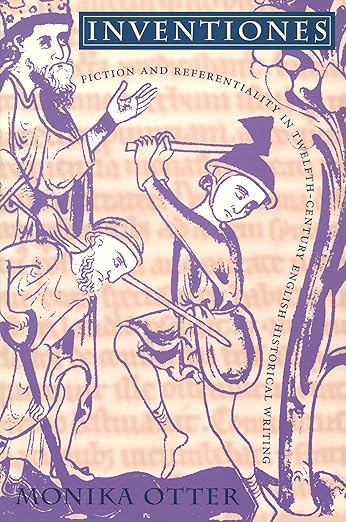
Inventiones
Fiction and Referentiality in Twelfth-century English Historical Writing
The University of North Carolina Press · Print & ebook · November 14, 1996
Combining literary theory and historiography, Monika Otter explores the relationship between history and fiction in the Latin literature of twelfth-century England.
We earn from qualifying purchases.
- Genres
- Medieval Literary Criticism, British & Irish Literary Criticism, Medieval History
- Published
- The University of North Carolina Press, November 14, 1996
Nearest books
Matched by what the books are about, then ordered by what their readers also loved.
 The History of the Kings of BritainGeoffrey of Monmouth, Lewis Thorpe54% match
 The Romance of Italy and the English ImaginationMaura O'Connor49% matchShares British & Irish Literary Criticism
 Anglo-saxon ChronicleMichael Swanton, Anglo-Saxon Chronicle49% match
 Hollow MenSusan Gaylard49% match
For younger readers: Stories of King Arthur and His Knights, The Story of the Middle Ages, Good Masters! Sweet Ladies!
Start with three books, and this one can be the first.
Members get a new edition every morning: a route out from their books to essays, research and talks, with the reason for each.
Start with this bookAbout this book
Combining literary theory and historiography, Monika Otter explores the relationship between history and fiction in the Latin literature of twelfth-century England. The beginnings of fiction have commonly been associated with vernacular romance, but Otter demonstrates that writers of Latin historical narratives also employed the self-referential techniques characteristic of fiction.
Continue reading
Beginning with inventiones, a genre dealing with the discovery of saints' relics, Otter reveals how exploring the fundamental problems of writing history and the nature of truth itself leads monastic or clerical Latin writers to a budding awareness of fictionality. According to Otter, accounts of conquests, treasure hunts, descents into underground worlds, and efforts (usually unsuccessful) to retrieve subterranean objects serve as self-referential metaphors for the problems of accessing and retrieving the past; they are thus designed to shake the reader’s faith in historical representation and highlight the textuality of the historical account. Otter traces this self-conscious use of fictional elements within historical narrative through the works of William of Malmesbury, Geoffrey of Monmouth, Gerald of Wales, Walter Map, and William of Newburgh. Originally published in 1996. A UNC Press Enduring Edition — UNC Press Enduring Editions use the latest in digital technology to make available again books from our distinguished backlist that were previously out of print. These editions are published unaltered from the original, and are presented in affordable paperback formats, bringing readers both historical and cultural value.
Where it sits
| Medieval Literary Criticism | 95% |
|---|---|
| Medieval History | 45% |
| British & Irish Literary Criticism | 38% |
Percentages are BookFrontier’s reading of the book.
Publisher categories
- British & Irish Literary Criticism
- Authors
- Monika Otter
- Publisher
- The University of North Carolina Press
- Published
- November 14, 1996
- Format
- Print & ebook
- Reading lane
- British & Irish Literary Criticism