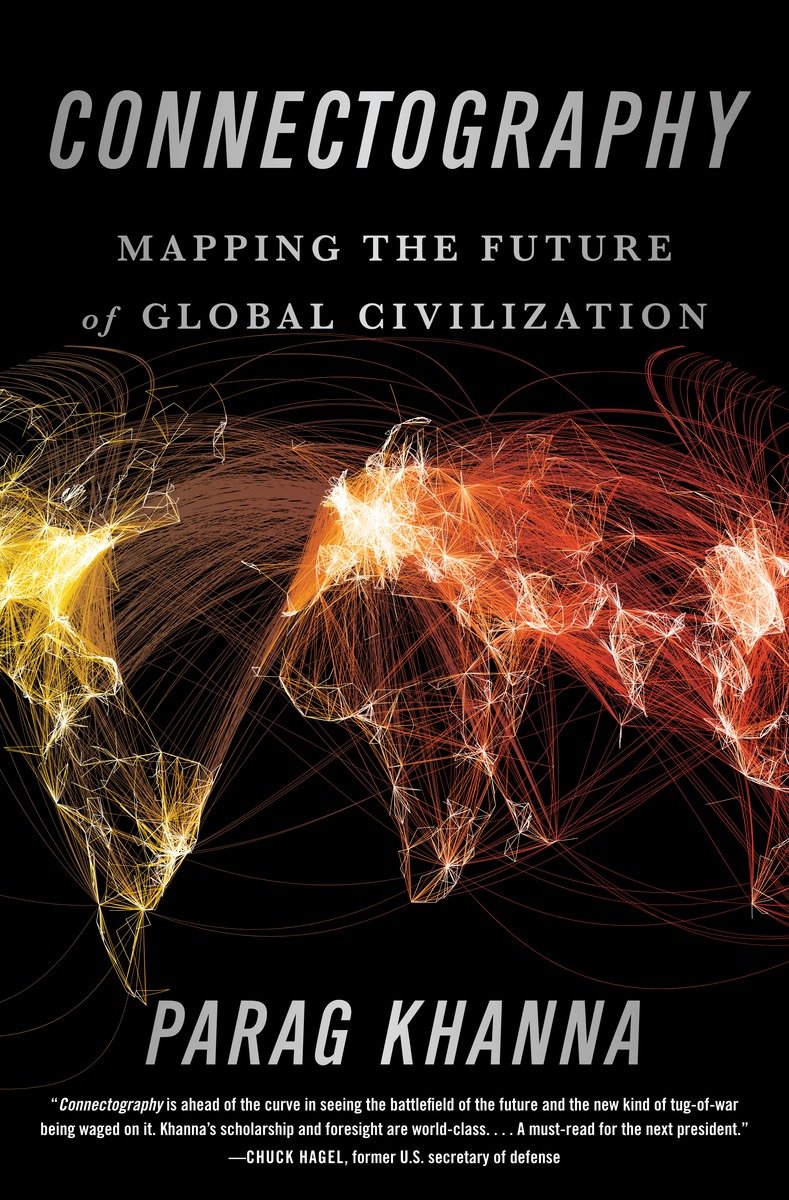
Connectography
Mapping the Future of Global Civilization
Random House Publishing Group · Print & ebook · April 19, 2016
From the visionary bestselling author of The Second World and How to Run the World comes a bracing and authoritative guide to a future shaped less by national borders than by global supply chains, a world in which the most connected powers—and people—will win.
We earn from qualifying purchases.
- Who it’s for
- Explore how infrastructure and supply chains reshape geopolitics, economics, and the map itself.
- Themes
- Global connectivity, Infrastructure and supply chains, Geopolitics
- Genres
- Geopolitics, Globalization, Infrastructure
Nearest books
Matched by what the books are about, then ordered by what their readers also loved.
 Has China Won?Kishore Mahbubani53% matchShares Geopolitics
 AerotropolisJohn D. Kasarda, Greg Lindsay57% match
 The Wires of WarJacob Helberg58% matchShares Geopolitics
 The Age of Surveillance CapitalismShoshana Zuboff, PublicAffairs55% match
 The 10 Rules of Successful NationsRuchir Sharma52% match
 Why Nations FailDan Woren, Daron Acemoglu55% match
 The Culture MapErin Meyer52% match
 The Revolt of the Public and the Crisis of Authority in the New MillenniumMartin Gurri51% match
For younger readers: The Kingfisher Atlas of the Modern World
Start with three books, and this one can be the first.
Members get a new edition every morning: a route out from their books to essays, research and talks, with the reason for each.
Start with this bookAbout this book
From the visionary bestselling author of The Second World and How to Run the World comes a bracing and authoritative guide to a future shaped less by national borders than by global supply chains, a world in which the most connected powers—and people—will win. Connectivity is the most revolutionary force of the twenty-first century.
Continue reading
Mankind is reengineering the planet, investing up to ten trillion dollars per year in transportation, energy, and communications infrastructure linking the world’s burgeoning megacities together. This has profound consequences for geopolitics, economics, demographics, the environment, and social identity. Connectivity, not geography, is our destiny. In Connectography, visionary strategist Parag Khanna travels from Ukraine to Iran, Mongolia to North Korea, Pakistan to Nigeria, and across the Arctic Circle and the South China Sea to explain the rapid and unprecedented changes affecting every part of the planet. He shows how militaries are deployed to protect supply chains as much as borders, and how nations are less at war over territory than engaged in tugs-of-war over pipelines, railways, shipping lanes, and Internet cables. The new arms race is to connect to the most markets—a race China is now winning, having launched a wave of infrastructure investments to unite Eurasia around its new Silk Roads. The United States can only regain ground by fusing with its neighbors into a super-continental North American Union of shared resources and prosperity. Connectography offers a unique and hopeful vision for the future. Khanna argues that new energy discoveries and technologies have eliminated the need for resource wars; ambitious transport corridors and power grids are unscrambling Africa’s fraught colonial borders; even the Arab world is evolving a more peaceful map as it builds resource and trade routes across its war-torn landscape. At the same time, thriving hubs such as Singapore and Dubai are injecting dynamism into young and heavily populated regions, cyber-communities empower commerce across vast distances, and the world’s ballooning financial assets are being wisely invested into building an inclusive global society. Beneath the chaos of a world that appears to be falling apart is a new foundation of connectivity pulling it together. Praise for Connectography “Incredible . . . With the world rapidly changing and urbanizing, [Khanna’s] proposals might be the best way to confront a radically different future.”—The Washington Post “Clear and coherent . . . a well-researched account of how companies are weaving ever more complicated supply chains that pull the world together even as they squeeze out inefficiencies. . . . [He] has succeeded in demonstrating that the forces of globalization are winning.”—Adrian Woolridge, The Wall Street Journal “Bold . . . With an eye for vivid details, Khanna has . . . produced an engaging geopolitical travelogue.”—Foreign Affairs “For those who fear that the world is becoming too inward-looking, Connectography is a refreshing, optimistic vision.”—The Economist “Connectivity has become a basic human right, and gives everyone on the planet the opportunity to provide for their family and contribute to our shared future. Connectography charts the future of this connected world.”—Marc Andreessen, general partner, Andreessen Horowitz “Khanna’s scholarship and foresight are world-class. A must-read for the next president.”—Chuck Hagel, fo
A Connected World
Explore how infrastructure and supply chains reshape geopolitics, economics, and the map itself.
Come here for
- A fresh lens on power beyond national borders
- Global connections traced across regions and industries
Expect
- Geopolitics viewed through pipelines, railways, shipping lanes, and cables
- An ambitious, hopeful argument about what connectivity can change
Where it sits
| Geopolitics | 80% |
|---|---|
| Globalization | 33% |
| Infrastructure | 27% |
Percentages are BookFrontier’s reading of the book.
Publisher categories
- Infrastructure
- International Economics
- Globalization
- Authors
- Parag Khanna
- Publisher
- Random House Publishing Group
- Published
- April 19, 2016
- Format
- Print & ebook
- Theme
- Global connectivity · Infrastructure and supply chains · Geopolitics
- Reading lane
- Infrastructure