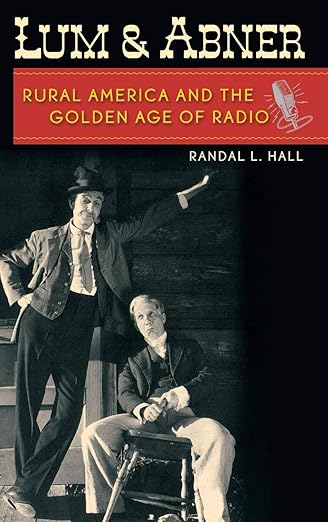
Lum and Abner
Rural America and the Golden Age of Radio
University Press of Kentucky · Print & ebook · September 7, 2007
In the 1930s radio stations filled the airwaves with programs and musical performances about rural Americans—farmers and small-town residents struggling through the Great Depression.
We earn from qualifying purchases.
- Who it’s for
- A history of the program, its creators, national audience, and twenty-nine early scripts.
- Themes
- American radio history, Rural life, The Great Depression
- Genres
- Radio History, Southern U.S. History, 20th-Century America
Nearest books
Matched by what the books are about, then ordered by what their readers also loved.
 Broadcasting FreedomBarbara Dianne Savage46% matchShares Radio History
 Redeeming the DialTona J. Hangen46% matchShares Radio History
 Once Upon a TownBob Greene45% matchShares 20th-Century America
 Hollowing Out the MiddlePatrick J. Carr, Maria J. Kefalas45% match
 No Applause - Just Throw MoneyTrav S.D.44% match
 First Majority-last MinorityJohn Shover44% match
 Confessions of a Prairie BitchAlison Arngrim43% match
 Little HeathensMildred Armstrong Kalish43% matchShares 20th-Century America
For younger readers: Dust for Dinner, Little House Complete 9-book Box Set, American Tall Tales
Start with three books, and this one can be the first.
Members get a new edition every morning: a route out from their books to essays, research and talks, with the reason for each.
Start with this bookAbout this book
In the 1930s radio stations filled the airwaves with programs and musical performances about rural Americans—farmers and small-town residents struggling through the Great Depression. One of the most popular of these shows was Lum and Abner, the brainchild of Chester "Chet" Lauck and Norris "Tuffy" Goff, two young businessmen from Arkansas.
Continue reading
Beginning in 1931 and lasting for more than two decades, the show revolved around the lives of ordinary people in the fictional community of Pine Ridge, based on the hamlet of Waters, Arkansas. The Title characters, who are farmers, local officials, and the keepers of the Jot 'Em Down Store, manage to entangle themselves in a variety of hilarious dilemmas. The program's gentle humor and often complex characters had wide appeal both to rural southerners, who were accustomed to being the butt of jokes in the national media, and to urban listeners who were fascinated by descriptions of life in the American countryside. Lum and Abner was characterized by the snappy, verbal comedic dueling that became popular on radio programs of the 1930s. Using this format, Lauck and Goff allowed their characters to subvert traditional authority and to poke fun at common misconceptions about rural life. The show also featured hillbilly and other popular music, an innovation that drew a bigger audience. As a result, Arkansas experienced a boom in tourism, and southern listeners began to immerse themselves in a new national popular culture. In Lum and Abner: Rural America and the Golden Age of Radio, historian Randal L. Hall explains the history and importance of the program, its creators, and its national audience. He also presents a treasure trove of twenty-nine previously unavailable scripts from the show's earliest period, scripts that reveal much about the Great Depression, rural life, hillbilly stereotypes, and a seminal period of American radio.
Pine Ridge Radio
A history of the program, its creators, national audience, and twenty-nine early scripts.
Come here for
- The program’s history and creators
- Twenty-nine previously unavailable scripts from its earliest period
Expect
- Scripts illuminating the Great Depression
- Scripts addressing rural life and hillbilly stereotypes
Where it sits
| Radio History | 84% |
|---|---|
| 20th-Century America | 83% |
| Southern U.S. History | 61% |
Percentages are BookFrontier’s reading of the book.
Publisher categories
- Radio History
- Authors
- Randal L. Hall
- Publisher
- University Press of Kentucky
- Published
- September 7, 2007
- Format
- Print & ebook
- Theme
- American radio history · Rural life · The Great Depression
- Reading lane
- Radio History