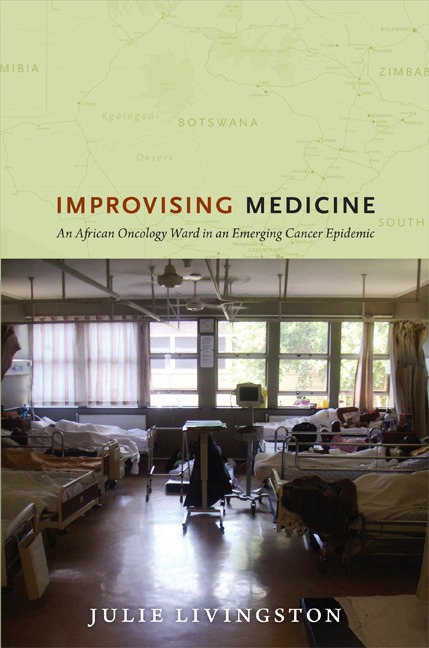
Improvising Medicine
An African Oncology Ward in an Emerging Cancer Epidemic
Duke University Press · Print & ebook · August 29, 2012
In Improvising Medicine, Julie Livingston tells the story of Botswana's only dedicated cancer ward, located in its capital city of Gaborone.
We earn from qualifying purchases.
- Who it’s for
- An ethnography of cancer care in Botswana, attentive to the people and institutions holding hope together.
- Themes
- Illness and care as social experiences, Healthcare politics in Africa, Hope and futility in hospital care
- Pacing
- Reflective
Nearest books
Matched by what the books are about, then ordered by what their readers also loved.
 Botswana - Culture Smart!Culture Smart!, Michael Main46% matchShares How Cultures Work
 Sizwe's TestJonny Steinberg61% match
 The Invisible CureHelen Epstein, Helen C. Epstein56% match
 Illness As Metaphor and AIDS and Its MetaphorsSusan Sontag, Tavia Gilbert51% match
 No Place Left to Bury the DeadNicole Itano61% match
 Scrambling for AfricaJohanna Tayloe Crane59% matchShares How Cultures Work
 HIV ExceptionalismAdia Benton58% matchShares How Cultures Work
For younger readers: Bless the Blood, The Fight of Our Lives: AIDS in America, New York Times Deadly Invaders
Start with three books, and this one can be the first.
Members get a new edition every morning: a route out from their books to essays, research and talks, with the reason for each.
Start with this bookAbout this book
In Improvising Medicine, Julie Livingston tells the story of Botswana's only dedicated cancer ward, located in its capital city of Gaborone. This affecting ethnography follows patients, their relatives, and ward staff as a cancer epidemic emerged in Botswana.
Continue reading
The epidemic is part of an ongoing surge in cancers across the global south; the stories of Botswana's oncology ward dramatize the human stakes and intellectual and institutional challenges of an epidemic that will shape the future of global health. They convey the contingencies of high-tech medicine in a hospital where vital machines are often broken, drugs go in and out of stock, and bed-space is always at a premium. They also reveal cancer as something that happens between people. Serious illness, care, pain, disfigurement, and even death emerge as deeply social experiences. Livingston describes the cancer ward in terms of the bureaucracy, vulnerability, power, biomedical science, mortality, and hope that shape contemporary experience in southern Africa. Her ethnography is a profound reflection on the social orchestration of hope and futility in an African hospital, the politics and economics of healthcare in Africa, and palliation and disfigurement across the global south.
Care Under Pressure
An ethnography of cancer care in Botswana, attentive to the people and institutions holding hope together.
Come here for
- A close view of illness as a deeply social experience
- The tensions between biomedical care and scarce hospital resources
Expect
- Patients, relatives, and ward staff in focus
- A thoughtful account of vulnerability, mortality, and hope
Where it sits
| Cancer | 46% |
|---|---|
| How Cultures Work | 38% |
| Health Care Delivery | 29% |
Percentages are BookFrontier’s reading of the book.
Publisher categories
- Southern African History
- Public Health
- How Cultures Work
- Authors
- Julie Livingston
- Publisher
- Duke University Press
- Published
- August 29, 2012
- Format
- Print & ebook
- Theme
- Illness and care as social experiences · Healthcare politics in Africa · Hope and futility in hospital care
- Reading lane
- Southern African History