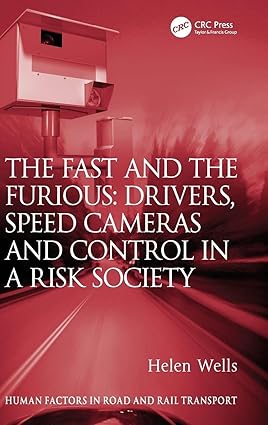
The Fast and the Furious
Drivers, Speed Cameras and Control in a Risk Society
Taylor and Francis · Print & ebook · March 31, 2017
We earn from qualifying purchases.
- Who it’s for
- Helen Wells examines speed-camera debates through drivers’ experiences of risk, control and automated justice.
- Genres
- Criminology, Transportation, Social Theory
- Published
- Taylor and Francis, March 31, 2017
Nearest books
Matched by what the books are about, then ordered by what their readers also loved.
 Killer on the RoadGinger Strand46% match
 The Digital FrontierSangeet Kumar45% match
 The Secret Life of DataAram Sinnreich, Jesse Gilbert45% match
For younger readers: They Broke the Law - You Be the Judge, Velocity, Slaying Digital Dragons ™
Start with three books, and this one can be the first.
Members get a new edition every morning: a route out from their books to essays, research and talks, with the reason for each.
Start with this bookAbout this book
The Fast and The Furious: Drivers, Speed Cameras and Control in a Risk Society presents a sociological and criminological perspective critical to understanding the driver's role at the centre of road safety interventions. Such an approach is, it is argued, as crucial to an understanding of attempts to reduce road crashes, deaths and injuries as approaching such questions from an engineering or educational perspective.
Continue reading
The book offers an explanation for the continued debate about one road safety intervention - the speed camera - by situating that debate within contemporary literature about the 'risk society' (Beck, 1992) and more broadly understood experiences of risk faced on a daily basis by drivers. Rather than a focus on risk as something that can be objectively assessed, measured and managed separately from the social context in which it is encountered, it suggests that 'risk' is something that permeates this particular debate from every angle. The book achieves its aims by utilising sociological and criminological perspectives to investigate issues such as: - the social context in which it is possible for drivers to reject official scientific expertise about crash causation and camera effectiveness - the self-defined 'respectability' of the population being problematised and its juxtaposition with a 'proper' police focus on 'real criminals' - the reconceptualisation of law-breaking as risk-taking rather than inherently 'wrong' behaviour and its consequences for the enforcement of laws based on risk assessment - the experience of being controlled by technology and of receiving what is essentially 'automated justice'. These and other issues are explored and suggested as illuminating of both the real concerns underpinning this debate and potentially instructive for future attempts to control risky behaviour both within and beyond a road safety context.
Speed Cameras and Risk
Helen Wells examines speed-camera debates through drivers’ experiences of risk, control and automated justice.
Come here for
- Drivers’ challenges to official expertise on crashes and camera effectiveness
- Questions of respectability, policing and “real criminals”
Expect
- A sociological and criminological account of road safety interventions
- Discussion of risk-taking, law enforcement and technology
Where it sits
| Criminology | 95% |
|---|---|
| Social Theory | 27% |
| Transportation | 21% |
Percentages are BookFrontier’s reading of the book.
Publisher categories
- Industrial Health & Safety
- Authors
- Helen Wells
- Publisher
- Taylor and Francis
- Published
- March 31, 2017
- Format
- Print & ebook
- Reading lane
- Industrial Health & Safety