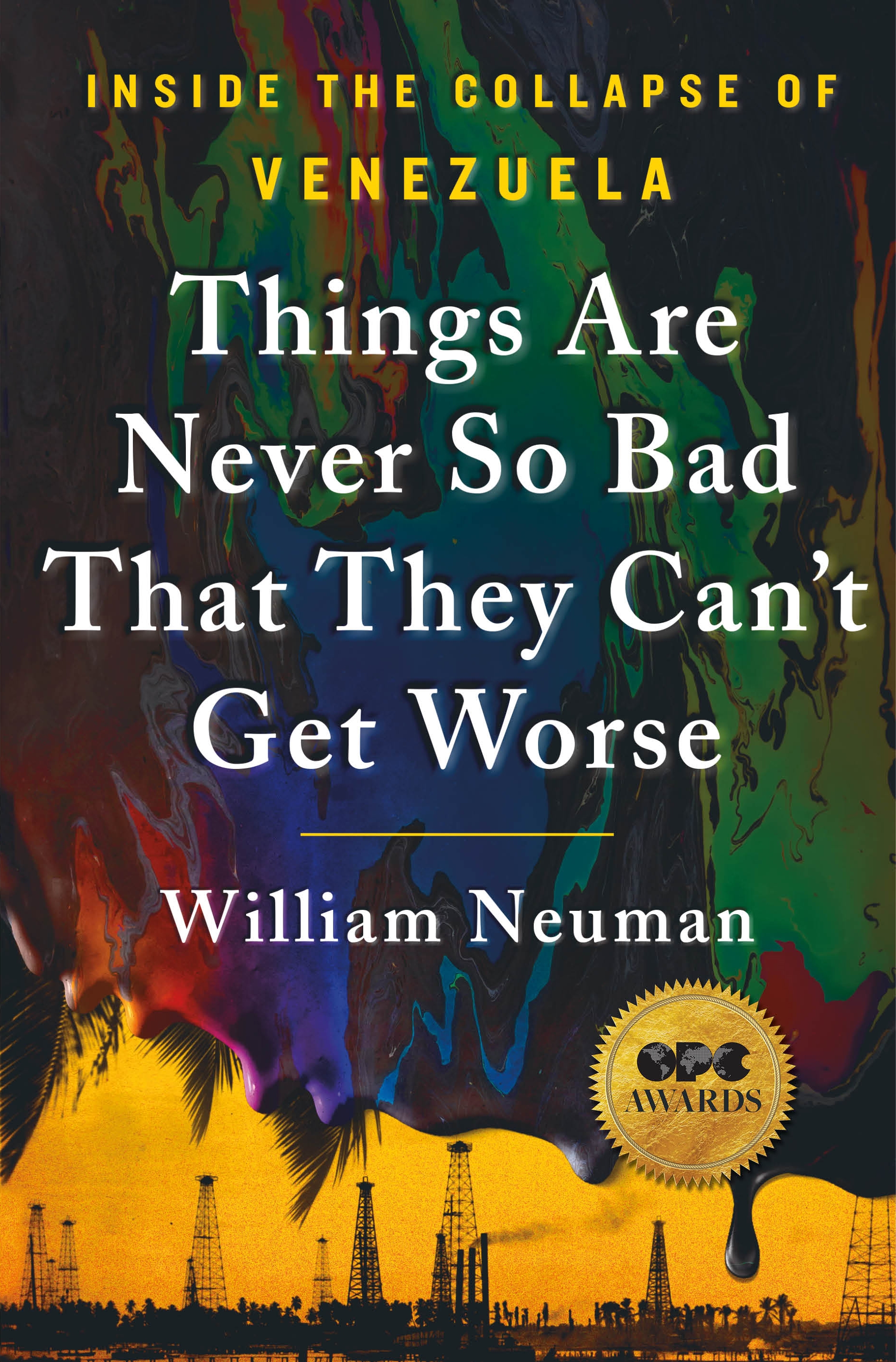
Things Are Never So Bad That They Can't Get Worse
Inside the Collapse of Venezuela
St. Martin's Press · Print & ebook · March 15, 2022
“Richly reported…a thorough and important history.” — Tim Padgett, The New York Times The award-winning, richly nuanced account of the collapse of Venezuela and what it could mean for the rest of the world.
We earn from qualifying purchases.
- Who it’s for
- William Neuman’s reported history makes Venezuela’s long crisis vivid without pretending it has simple answers.
- Genres
- South American History, Caribbean & Latin American Politics, Political Economy
- Published
- St. Martin's Press, March 15, 2022
Nearest books
Matched by what the books are about, then ordered by what their readers also loved.
 Volga BluesMarzio G. Mian, Alessandro Cosmelli45% match
 Brazil on the RiseLarry Rohter51% matchShares South American History
 Cuban RevelationsMarc Frank46% match
 Wealth and DemocracyKevin Phillips47% matchShares Political Economy
 Poverty, by AmericaMatthew Desmond45% match
 Crude NationRaúl Gallegos70% matchShares South American History and Caribbean & Latin American Politics
 The Loom of TimeRobert D. Kaplan44% match
Start with three books, and this one can be the first.
Members get a new edition every morning: a route out from their books to essays, research and talks, with the reason for each.
Start with this bookAbout this book
“Richly reported…a thorough and important history.” — Tim Padgett, The New York Times The award-winning, richly nuanced account of the collapse of Venezuela and what it could mean for the rest of the world. Venezuela has been mired in crisis for over a decade—characterized by economic collapse, political polarization, mass emigration, and widespread hardship—even as the country sits atop some of the world’s largest oil reserves.
Continue reading
In Things Are Never So Bad That They Can’t Get Worse, William Neuman provides a vivid, granular chronicle of that descent. Drawing on his experience as The New York Times Andes Region Bureau Chief and years of reporting from Caracas, Neuman explores the interplay of charismatic populism, economic mismanagement, corruption, and the international forces that have shaped Venezuela’s fate. The book traces how once-abundant oil wealth became a source of distortion rather than development, how political power concentrated around Hugo Chávez and later Nicolás Maduro, and how everyday Venezuelans endured rolling blackouts, hyperinflation, shortages of food and medicine, and threats to personal safety. Neuman blends history, journalism, and personal narrative into a clear-eyed account of how a petro-rich nation imploded, displacing millions and disrupting the region. Winner of Best Books of the Year from Foreign Affairs, the National Endowment for Democracy and the Overseas Press Club of America, the book’s historical context provides readers indispensable insight into how decades of policy choices, institutional breakdown, and external pressures set the stage for the crises of today. Rather than offering simple answers, Things Are Never So Bad That They Can’t Get Worse equips readers with the historical grounding needed to understand both Venezuela’s past and the complexities shaping its future.
Crisis, Closely Seen
William Neuman’s reported history makes Venezuela’s long crisis vivid without pretending it has simple answers.
Come here for
- How oil wealth, political power, and economic collapse became entangled
- A grounded view of Venezuela’s crisis and its regional consequences
Expect
- A granular blend of history, journalism, and personal narrative
- Attention to policy choices, institutional breakdown, and everyday hardship
Where it sits
| South American History | 65% |
|---|---|
| Political Economy | 56% |
| Caribbean & Latin American Politics | 47% |
Percentages are BookFrontier’s reading of the book.
Publisher categories
- South American History
- Caribbean & Latin American Politics
- Corruption & Misconduct
- Authors
- William Neuman
- Publisher
- St. Martin's Press
- Published
- March 15, 2022
- Format
- Print & ebook
- Reading lane
- South American History