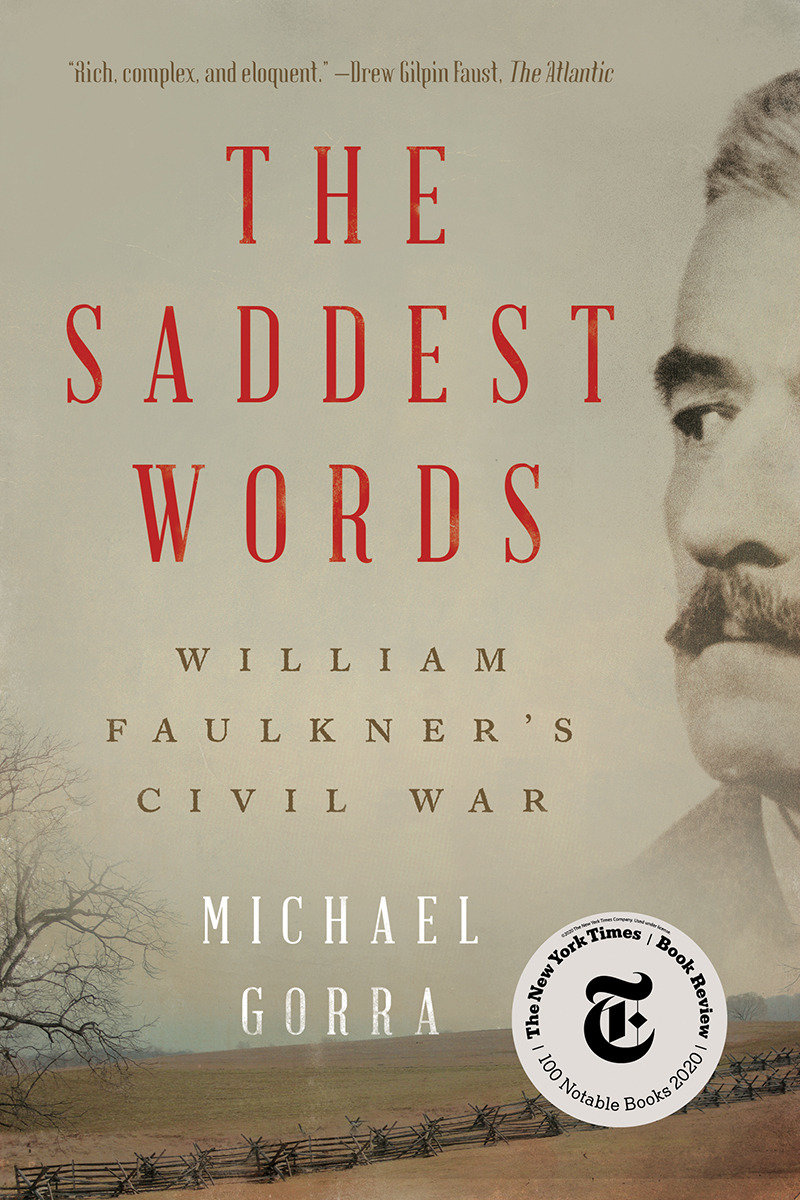
The Saddest Words
William Faulkner's Civil War
WW Norton · Print & ebook · October 12, 2021
A New York Times Notable Book of 2020 How do we read William Faulkner in the twenty-first century? asks Michael Gorra, in this reconsideration of Faulkner's life and legacy.
We earn from qualifying purchases.
- Who it’s for
- A fresh reading of Faulkner brings literary criticism into conversation with race and American memory.
- Themes
- Faulkner's literary legacy, Race and American literature, Slavery and the Civil War
- Genres
- Writers' Lives, 20th-Century Literary Criticism, Regional American Literature
Nearest books
Matched by what the books are about, then ordered by what their readers also loved.
 The Soul of AmericaJon Meacham50% match
 Hymns of the RepublicS. C. Gwynne, Robert Petkoff55% match
 Looking for the Good WarElizabeth D Samet55% match
 The Rise and Fall of the Second American RepublicManisha Sinha49% match
 Spying on the SouthTony Horwitz54% match
 The Demon of UnrestErik Larson52% match
 SartorisWilliam Faulker72% match
For younger readers: How I Found the Strong, Riot, Now Is Your Time!
Start with three books, and this one can be the first.
Members get a new edition every morning: a route out from their books to essays, research and talks, with the reason for each.
Start with this bookAbout this book
A New York Times Notable Book of 2020 How do we read William Faulkner in the twenty-first century? asks Michael Gorra, in this reconsideration of Faulkner's life and legacy. William Faulkner, one of America’s most iconic writers, is an author who defies easy interpretation. Born in 1897 in Mississippi, Faulkner wrote such classic novels as Absolom, Absolom!
Continue reading
and The Sound and The Fury, creating in Yoknapatawpha county one of the most memorable gallery of characters ever assembled in American literature. Yet, as acclaimed literary critic Michael Gorra explains, Faulkner has sustained justified criticism for his failures of racial nuance—his ventriloquism of black characters and his rendering of race relations in a largely unreconstructed South—demanding that we reevaluate the Nobel laureate’s life and legacy in the twenty-first century, as we reexamine the junctures of race and literature in works that once rested firmly in the American canon. Interweaving biography, literary criticism, and rich travelogue, The Saddest Words argues that even despite these contradictions—and perhaps because of them—William Faulkner still needs to be read, and even more, remains central to understanding the contradictions inherent in the American experience itself. Evoking Faulkner’s biography and his literary characters, Gorra illuminates what Faulkner maintained was “the South’s curse and its separate destiny,” a class and racial system built on slavery that was devastated during the Civil War and was reimagined thereafter through the South’s revanchism. Driven by currents of violence, a “Lost Cause” romanticism not only defined Faulkner’s twentieth century but now even our own age. Through Gorra’s critical lens, Faulkner’s mythic Yoknapatawpha County comes alive as his imagined land finds itself entwined in America’s history, the characters wrestling with the ghosts of a past that refuses to stay buried, stuck in an unending cycle between those two saddest words, “was” and “again.” Upending previous critical traditions, The Saddest Words returns Faulkner to his sociopolitical context, revealing the civil war within him and proving that “the real war lies not only in the physical combat, but also in the war after the war, the war over its memory and meaning.” Filled with vignettes of Civil War battles and generals, vivid scenes from Gorra’s travels through the South—including Faulkner’s Oxford, Mississippi—and commentaries on Faulkner’s fiction, The Saddest Words is a mesmerizing work of literary thought that recontextualizes Faulkner in light of the most plangent cultural issues facing America today.
Reading Faulkner Again
A fresh reading of Faulkner brings literary criticism into conversation with race and American memory.
Come here for
- Faulkner considered through biography, fiction, and the South’s contested past
- Literary criticism alongside scenes from Gorra’s travels in the South
Expect
- Biography, criticism, and travelogue woven together
- A serious look at Civil War memory and Faulkner’s legacy
Where it sits
| 20th-Century Literary Criticism | 31% |
|---|---|
| Writers' Lives | 31% |
| Regional American Literature | 28% |
Percentages are BookFrontier’s reading of the book.
Publisher categories
- Writers' Lives
- Civil War Era
- American Lit Crit
- Authors
- Michael Gorra
- Publisher
- WW Norton
- Published
- October 12, 2021
- Format
- Print & ebook
- Theme
- Faulkner's literary legacy · Race and American literature · Slavery and the Civil War
- Reading lane
- Writers' Lives