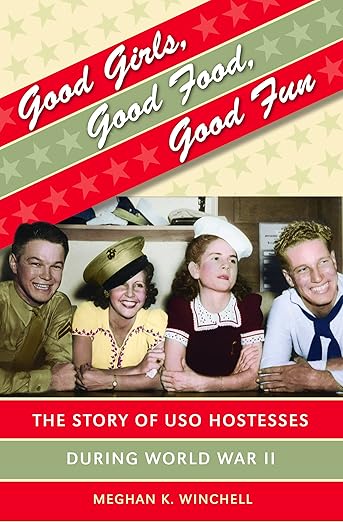
Good Girls, Good Food, Good Fun
The Story of USO Hostesses During World War II
The University of North Carolina Press · Print & ebook · January 1, 2015
Throughout World War II, when Saturday nights came around, servicemen and hostesses happily forgot the war for a little while as they danced together in USO clubs, which served as havens of stability in a time of social, moral, and geographic upheaval.
We earn from qualifying purchases.
- Who it’s for
- USO hostesses reveal how wartime clubs shaped gender, race, and sexual respectability.
- Themes
- World War II home front, Gender roles and sexual codes, Race, class, and respectability
- Genres
- World War II History, Women's History, Women's Studies
Nearest books
Matched by what the books are about, then ordered by what their readers also loved.
 Girls Next DoorKara Dixon Vuic68% matchShares Women's History and Women's Studies
 Dance Floor DemocracySherrie Tucker65% match
 Come Fly the WorldJulia Cooke56% match
 When Books Went to WarMolly Guptill Manning54% matchShares World War II History
 SpitfiresBecky Aikman, Laurel Lefkow50% match
 The Wounded GenerationDavid Nasaw50% matchShares World War II History
 Capital DamesCokie Roberts49% matchShares Women's History
 Unexpected BraveryA.J. Schenkman49% match
For younger readers: Great or Nothing, Candy Bomber, A Whole New Ball Game
Start with three books, and this one can be the first.
Members get a new edition every morning: a route out from their books to essays, research and talks, with the reason for each.
Start with this bookAbout this book
Throughout World War II, when Saturday nights came around, servicemen and hostesses happily forgot the war for a little while as they danced together in USO clubs, which served as havens of stability in a time of social, moral, and geographic upheaval. Meghan Winchell demonstrates that in addition to boosting soldier morale, the USO acted as an architect of the gender roles and sexual codes that shaped the “greatest generation.”
Continue reading
Combining archival research with extensive firsthand accounts from among the hundreds of thousands of female USO volunteers, Winchell shows how the organization both reflected and shaped 1940s American society at large. The USO had hoped that respectable feminine companionship would limit venereal disease rates in the military. To that end, Winchell explains, USO recruitment practices characterized white middle-class women as sexually respectable, thus implying that the sexual behavior of working-class women and women of color was suspicious. In response, women of color sought to redefine the USO’s definition of beauty and respectability, challenging the USO’s vision of a home front that was free of racial, gender, and sexual conflict. Despite clashes over class and racial ideologies of sex and respectability, Winchell finds that most hostesses benefited from the USO’s chaste image. In exploring the USO’s treatment of female volunteers, Winchell not only brings the hostesses' stories to light but also supplies a crucial missing piece for understanding the complex ways in which the war both destabilized and restored certain versions of social order.
USO Hostesses
USO hostesses reveal how wartime clubs shaped gender, race, and sexual respectability.
Come here for
- Archival research and firsthand accounts from female USO volunteers
Expect
- How recruitment linked white middle-class women with sexual respectability
- How women of color challenged the USO’s standards of beauty and respectability
Where it sits
| World War II History | 84% |
|---|---|
| Women's History | 39% |
| Women's Studies | 33% |
Percentages are BookFrontier’s reading of the book.
Publisher categories
- World War II History
- Women's Studies
- Gender Studies
- Authors
- Meghan K. Winchell
- Publisher
- The University of North Carolina Press
- Published
- January 1, 2015
- Format
- Print & ebook
- Theme
- World War II home front · Gender roles and sexual codes · Race, class, and respectability
- Reading lane
- World War II History