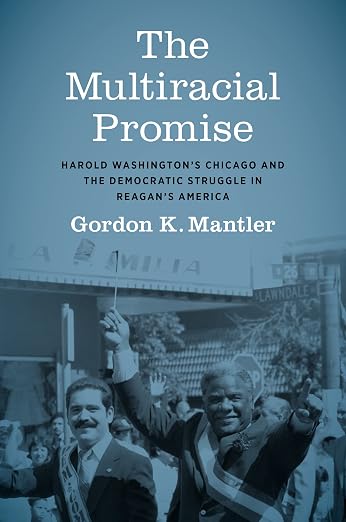
The Multiracial Promise
Harold Washington's Chicago and the Democratic Struggle in Reagan's America
The University of North Carolina Press · Print & ebook · March 14, 2023
In April 1983, a dynamic, multiracial political coalition did the unthinkable, electing Harold Washington as the first Black mayor of Chicago.
We earn from qualifying purchases.
- Who it’s for
- Harold Washington’s movement reveals coalition politics and electoral reform’s limits.
- Genres
- Elections & Campaigns, Race & Ethnic Relations, Local Government
- Published
- The University of North Carolina Press, March 14, 2023
Nearest books
Matched by what the books are about, then ordered by what their readers also loved.
 The Fight to Save the TownMichelle Wilde Anderson53% match
 Seven Social Movements That Changed AmericaLinda Gordon52% match
 By the Light of Burning DreamsDavid Talbot, Margaret Talbot51% match
 Shattered Dreams, Infinite HopeBrandon M. Terry49% matchShares Race & Ethnic Relations
 Three Days in MoscowBret Baier, Catherine Whitney49% match
 W.e.b. Du Bois: Black Reconstruction (LOA #350)W.E.B. Du Bois49% matchShares Race & Ethnic Relations
 The First EightJim Clyburn49% match
For younger readers: A Few Red Drops, Stolen Justice: the Struggle for African American Voting Rights (scholastic Focus), Freedom's Children
Start with three books, and this one can be the first.
Members get a new edition every morning: a route out from their books to essays, research and talks, with the reason for each.
Start with this bookAbout this book
In April 1983, a dynamic, multiracial political coalition did the unthinkable, electing Harold Washington as the first Black mayor of Chicago. Washington’s victory was unlikely not just because America’s second city was one of the nation’s most racially balkanized but also because it came at a time when Ronald Reagan and other political conservatives seemed resurgent. Washington’s initial win and reelection in 1987 established the charismatic politician as a folk hero.
Continue reading
It also bolstered hope among Democrats that the party could win elections by pulling together multiracial urban voters around progressive causes. Yet what could be called the Washington era revealed clear limits to electoral politics and racial coalition building when decoupled from neighborhood-based movement organizing. Drawing on a rich array of archives and oral history interviews, Gordon K. Mantler offers a bold reexamination of the Harold Washington movement and moment. Taking readers into Chicago’s street-level politics and the often tense relationships among communities and their organizers, Mantler shows how white supremacy, deindustrialization, dysfunction, and voters' own contradictory expectations stubbornly impeded many of Washington’s proposed reforms. Ultimately, Washington’s historic victory and the thwarted ambitions of his administration provide a cautionary tale about the peril of placing too much weight on electoral politics above other forms of civic action—a lesson today’s activists would do well to heed.
Washington’s Chicago
Harold Washington’s movement reveals coalition politics and electoral reform’s limits.
Come here for
- A reexamination of the Harold Washington movement
- Chicago’s street-level politics
Expect
- Tense relationships among communities and organizers
- The limits of electoral politics without neighborhood-based organizing
Where it sits
| Race & Ethnic Relations | 30% |
|---|---|
| Elections & Campaigns | 24% |
| Local Government | 21% |
Percentages are BookFrontier’s reading of the book.
Publisher categories
- 20th-Century America
- Political History & Ideas
- African American Studies
- Authors
- Gordon K. Mantler
- Publisher
- The University of North Carolina Press
- Published
- March 14, 2023
- Format
- Print & ebook
- Reading lane
- 20th-Century America