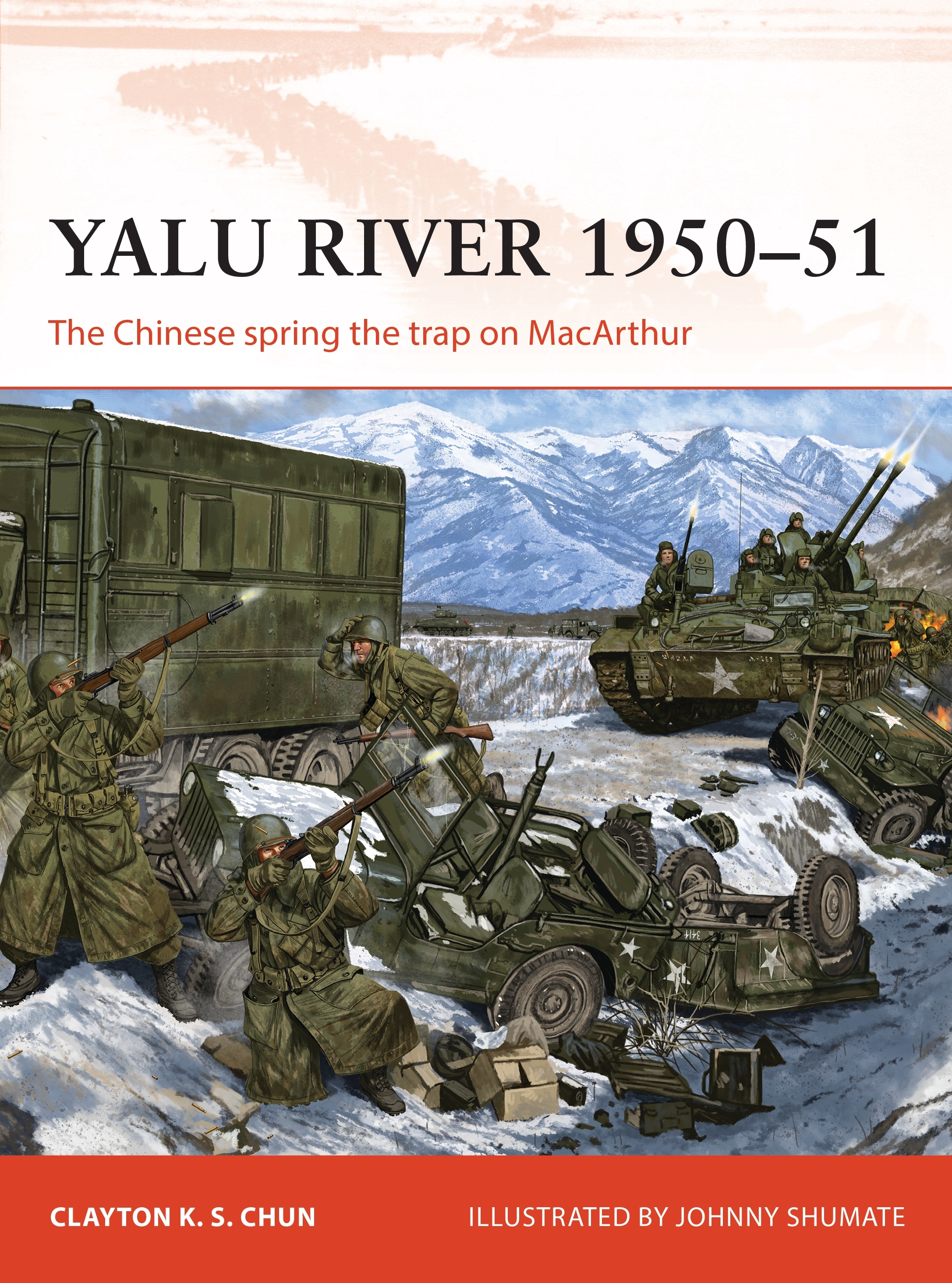
Yalu River 1950-51
The Chinese Spring the Trap on Macarthur
Osprey · Print & ebook · February 18, 2020
This gripping new study details the crisis point of the Korean War: the UN advance across into North Korea and the following Chinese offensive that drove the forces back south of the 38th Parallel.
We earn from qualifying purchases.
- Who it’s for
- A study of the UN advance, Chinese offensive, and retreat across Korea.
- Genres
- Korean War History, Korean History, Cold War History
- Published
- Osprey, February 18, 2020
Nearest books
Matched by what the books are about, then ordered by what their readers also loved. Most of these share its genre: Korean War History.
 Ground Forces in the Korean War 1950-53 (2)Robert Mackowiak, Johnny Shumate53% match
 Give Me TomorrowPatrick K. O'Donnell53% matchAlso shares Korean History
 Southern StormNoah Andre Trudeau43% match
 US Army Forces in the Korean War 1950-53Donald Boose, Donald W. Boose Jr.69% match
 Passing the TestWilliam T. Bowers, John T. Greenwood69% matchAlso shares Korean History
 Mao's Generals Remember KoreaXiaobing Li, Allan R. Millett67% matchAlso shares Cold War History
 The Farthest ValleyJoseph Wheelan, Jeff Harding67% matchAlso shares Korean History
 The General Vs. the PresidentScott Brick, H. W. Brands67% match
For younger readers: I Remember Korea, Cold War Correspondent (nathan Hale’s Hazardous Tales #11), The Hundred Choices Department Store
Start with three books, and this one can be the first.
Members get a new edition every morning: a route out from their books to essays, research and talks, with the reason for each.
Start with this bookAbout this book
This gripping new study details the crisis point of the Korean War: the UN advance across into North Korea and the following Chinese offensive that drove the forces back south of the 38th Parallel. Following the Inchon landings and the breakout from the Pusan Perimeter, UN forces crossed the North Korean border on October 9 and moved on the capital Pyongyang.
Continue reading
Many in America believed the war would be over by Christmas, but some Washington diplomatic, military, and intelligence experts continued to raise dire warnings that the People's Republic of China might intervene. Nevertheless, General MacArthur decided to push on to the Chinese/North Korean border, the Yalu River. On October 25, Communist Chinese Forces unexpectedly attacked Republic of Korea forces near Unsan. Then, on November 25, the day after MacArthur announced a “final offensive to end the war,” the Chinese 13th Army Group struck in mass against the Eighth Army in the northwest corner of North Korea, overrunning the US 2nd and 25th Infantry Divisions. The Chinese attacks quickly shattered Truman's dream of a unified Korea. American, UN, and ROK forces could not hold a successful defensive line against the combined CCF and NKPA attacks. At the Chosin Reservoir, US Marine Corps and Army units retreated south while MacArthur's forces withdrew from Pyongyang and X Corps later pulled out of Hungnam. Using expert research, bird's-eye views, and full-color maps, this study tells the fascinating history of the critical Yalu campaign, including the famous retreat past the 38th Parallel.
The Yalu Campaign
A study of the UN advance, Chinese offensive, and retreat across Korea.
Come here for
- Bird’s-eye views of the Yalu campaign
- Full-color maps of the campaign
Expect
- The Chinese offensive and retreat south of the 38th Parallel
Where it sits
| Korean War History | 100% |
|---|---|
| Cold War History | 32% |
| Korean History | 32% |
Percentages are BookFrontier’s reading of the book.
Publisher categories
- Korean History
- Korean War History
- 20th-Century History
- Authors
- Clayton K. S. Chun, Johnny Shumate
- Publisher
- Osprey
- Published
- February 18, 2020
- Format
- Print & ebook
- Reading lane
- Korean History