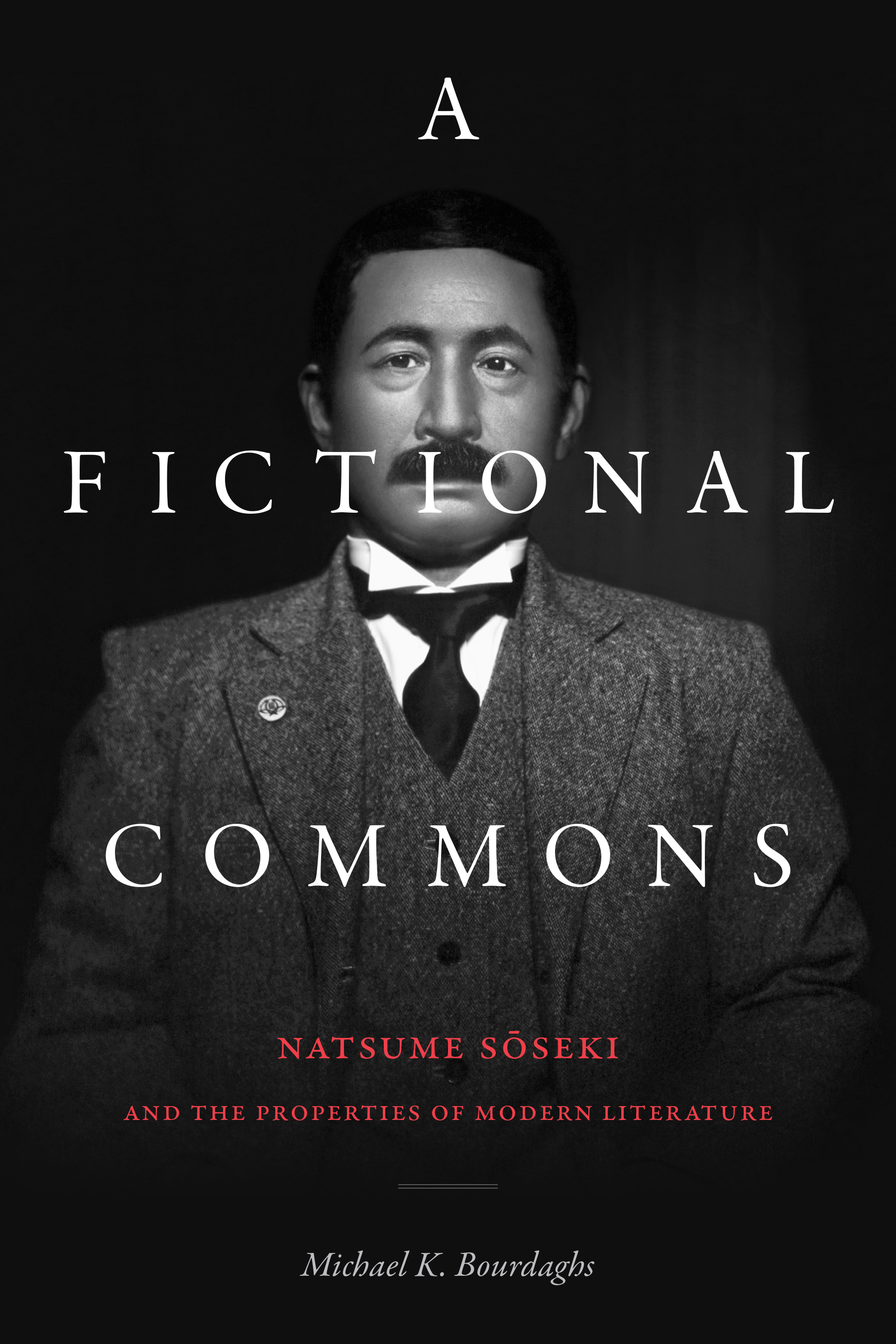
A Fictional Commons
Natsume Soseki and the Properties of Modern Literature
Duke University Press · Print & ebook · September 24, 2021
Modernity arrived in Japan, as elsewhere, through new forms of ownership.
We earn from qualifying purchases.
- Who it’s for
- Bourdaghs reads Sōseki’s literature as a way to think beyond private property.
- Genres
- Japanese Literary Criticism, 20th-Century Literary Criticism, Literary Theory
- Published
- Duke University Press, September 24, 2021
Nearest books
Matched by what the books are about, then ordered by what their readers also loved. Most of these share its genre: Japanese Literary Criticism.
 Origins of Modern Japanese LiteratureKojin Karatani62% matchAlso shares Literary Theory
 The GateNatsume Soseki59% match
 Imagining HarmonyPeter Flueckiger58% match
 The Textual TownsmanThomas Gaubatz56% match
 Writing the Love of BoysJeffrey Angles54% match
 Translingual PracticeLydia Liu, Lydia H. Liu53% match
For younger readers: Go, Samurai Shortstop
Start with three books, and this one can be the first.
Members get a new edition every morning: a route out from their books to essays, research and talks, with the reason for each.
Start with this bookAbout this book
Modernity arrived in Japan, as elsewhere, through new forms of ownership. In A Fictional Commons, Michael K. Bourdaghs explores how the literary and theoretical works of Natsume Sōseki (1867–1916), widely celebrated as Japan's greatest modern novelist, exploited the contradictions and ambiguities that haunted this new system.
Continue reading
Many of his works feature narratives about inheritance, thievery, and the struggle to obtain or preserve material wealth while also imagining alternative ways of owning and sharing. For Sōseki, literature was a means for thinking through—and beyond—private property. Bourdaghs puts Sōseki into dialogue with thinkers from his own era (including William James and Mizuno Rentarō, author of Japan’s first copyright law) and discusses how his work anticipates such theorists as Karatani Kōjin and Franco Moretti. As Bourdaghs shows, Sōseki both appropriated and rejected concepts of ownership and subjectivity in ways that theorized literature as a critical response to the emergence of global capitalism.
Sōseki and Ownership
Bourdaghs reads Sōseki’s literature as a way to think beyond private property.
Come here for
- Sōseki’s narratives of inheritance
- Literature’s imagined alternatives to private ownership
Expect
- Sōseki in dialogue with William James and Mizuno Rentarō
- Literature theorized as a response to global capitalism
Where it sits
| Japanese Literary Criticism | 99% |
|---|---|
| Literary Theory | 42% |
| 20th-Century Literary Criticism | 39% |
Percentages are BookFrontier’s reading of the book.
Publisher categories
- Literary Theory
- Japanese Literary Criticism
- Authors
- Michael K. Bourdaghs
- Publisher
- Duke University Press
- Published
- September 24, 2021
- Format
- Print & ebook
- Reading lane
- Literary Theory