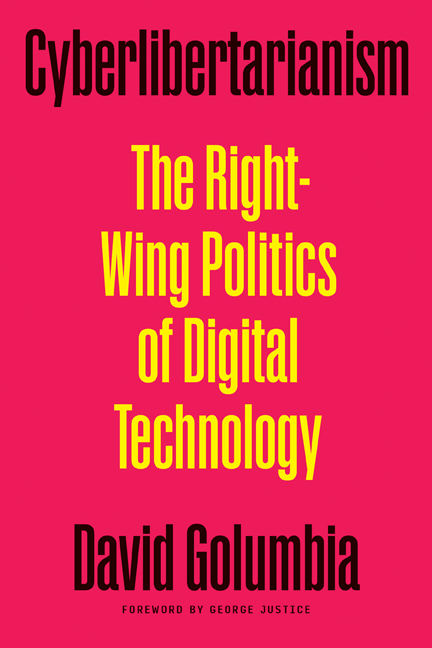
Cyberlibertarianism
The Right-wing Politics of Digital Technology
University of Minnesota Press · Print & ebook · November 12, 2024
An urgent reckoning with digital technology’s fundamentally right-wing legal and economic underpinnings In a timely challenge to the potent political role of digital technology, Cyberlibertarianism argues that right-wing ideology was built into both the technical and social construction of the digital world from the start.
We earn from qualifying purchases.
- Who it’s for
- David Golumbia examines how right-wing ideology shaped digital technology and its legal and economic foundations.
- Themes
- Right-wing digital politics, Internet regulation, Technology and inequality
- Genres
- Libertarianism, Science & Tech Policy, Media, Politics & the Internet
Nearest books
Matched by what the books are about, then ordered by what their readers also loved.
 Your Computer Is on FireThomas S. Mullaney, Benjamin Peters62% match
 The Digital FrontierSangeet Kumar60% match
 Kill All NormiesAngela Nagle60% match
 Ten Arguments for Deleting Your Social Media Accounts Right NowJaron Lanier60% match
 The Chaos MachineMax Fisher, Peter Ganim60% matchShares Media, Politics & the Internet
Start with three books, and this one can be the first.
Members get a new edition every morning: a route out from their books to essays, research and talks, with the reason for each.
Start with this bookAbout this book
An urgent reckoning with digital technology’s fundamentally right-wing legal and economic underpinnings In a timely challenge to the potent political role of digital technology, Cyberlibertarianism argues that right-wing ideology was built into both the technical and social construction of the digital world from the start.
Continue reading
Leveraging more than a decade of research, David Golumbia traces how digital evangelism has driven the worldwide shift toward the political right, concealing inequality, xenophobia, dishonesty, and massive corporate concentrations of wealth and power beneath the utopian presumption of digital technology as an inherent social good. Providing an incisive critique of the push for open access and open-source software and the legal battles over online censorship and net neutrality, Cyberlibertarianism details how the purportedly democratic internet has been employed as an organizing tool for terror and hate groups and political disinformation campaigns. As he unpacks our naively utopian conception of the digital world, Golumbia highlights technology’s role in the advancement of hyperindividualist and antigovernment agendas, demonstrating how Silicon Valley corporations and right-wing economists; antiestablishment figures such as Julian Assange, Elon Musk, Peter Thiel, Edward Snowden, and Mark Zuckerberg; and seemingly positive voices such as John Perry Barlow, Cory Doctorow, the Electronic Freedom Foundation, and Wikipedia all have worked to hamper regulation and weaken legal safeguards against exploitation. Drawing from a wide range of thought in digital theory, economics, law, and political philosophy as well as detailed research and Golumbia’s own experience as a software developer, Cyberlibertarianism serves as a clarion call to reevaluate the fraught politics of the internet. In the hope of providing a way of working toward a more genuinely democratic and egalitarian future for digital technology, this magisterial work insists that we must first understand the veiled dogmas from which it has been constructed. Retail e-book files for this title are screen-reader friendly.
Digital Politics
David Golumbia examines how right-wing ideology shaped digital technology and its legal and economic foundations.
Come here for
- How digital evangelism intersects with inequality and corporate power
- Critiques of open access, open-source software, censorship, and net neutrality
Expect
- Connections between internet politics and antigovernment agendas
- Discussion of digital tools used for hate-group organizing and political disinformation
Where it sits
| Libertarianism | 30% |
|---|---|
| Science & Tech Policy | 26% |
| Media, Politics & the Internet | 24% |
Percentages are BookFrontier’s reading of the book.
Publisher categories
- Tech & Society
- Libertarianism
- Media, Politics & the Internet
- Authors
- David Golumbia
- Publisher
- University of Minnesota Press
- Published
- November 12, 2024
- Format
- Print & ebook
- Theme
- Right-wing digital politics · Internet regulation · Technology and inequality
- Reading lane
- Tech & Society