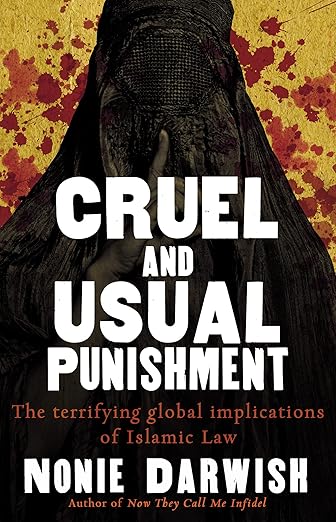
Cruel and Usual Punishment
The Terrifying Global Implications of Islamic Law
Thomas Nelson · Print & ebook · January 4, 2009
Nonie Darwish lived for thirty years in a majority Muslim nation.
We earn from qualifying purchases.
- Who it’s for
- A stark, polemical look at Islamic law’s global implications, built for argument and reference.
- Genres
- Islamic Law, Islam - General, Arab & Middle Eastern Lives
- Published
- Thomas Nelson, January 4, 2009
Nearest books
Matched by what the books are about, then ordered by what their readers also loved. Most of these share its genre: Islam - General.
 Israel and CivilizationJosh Hammer48% match
 MuhammadRobert Spencer45% match
 Heaven on EarthSadakat Kadri72% matchAlso shares Islamic Law
 Myth of Islamic ToleranceRobert Spencer69% match
 HereticAyaan Hirsi Ali64% match
 Seeking Allah, Finding Jesus Study GuideNabeel Qureshi, Kevin & Sherry Harney43% match
 The Caged VirginAyaan Hirsi Ali63% match
 Shariah LawMohammad Hashim Kamali, Mohammad Kamali62% matchAlso shares Islamic Law
For younger readers: She Wore Red Trainers, Emotion of Great Delight, an, Love, Hate and Other Filters
Start with three books, and this one can be the first.
Members get a new edition every morning: a route out from their books to essays, research and talks, with the reason for each.
Start with this bookAbout this book
Nonie Darwish lived for thirty years in a majority Muslim nation. Everything about her life?family, sexuality, hygiene, business, banking, contracts, economics, politics, social issues, everything?was dictated by the Islamic law code known as Sharia. But Sharia isn't staying in majority Muslim nations. Darwish now lives in the West and brings a warning; the goal of radical Islam is to bring Sharia law to your country.
Continue reading
If that happens, the fabric of Western law and liberty will be ripped in two. Under Sharia law: - A woman can be beaten for talking to men who are not her relatives and flogged for not wearing a headdress - Daughters, sisters, and wives can be legally killed by the men in their family - Non-Muslims can be beheaded, and their Muslim killers will not receive the death penalty - Certain kinds of child molestation are allowed - The husband of a "rebellious" wife can deny her medical care or place her under house arrest Think it can't happen? In 2008, England?once the seat of Western liberty and now the home of many Muslim immigrants?declared that Sharia courts in Britain have the force of law. When Muslim populations reach as little as 1 or 2 percent, says Darwish, they begin making demands of the larger community, such as foot-level faucets for washing before praying in public schools, businesses, and airports. "Airports in Kansas City, Phoenix, and Indianapolis are among those who have already installed foot baths for Muslim cab drivers," writes Darwish. These demands test how far Westerners will go in accommodating the Muslim minority. How far will they push? The Organization of the Islamic Conference works to Islamize international human rights laws and apply Sharia "standards" for blasphemy to all nations. The penalty for blasphemy? Death. Weaving personal experience together with extensive documentation and research, Darwish exposes the facts and reveals the global threat posed by Sharia law. Anyone concerned about Western rights and liberties ignores her warning and analysis at their peril.
Sharp Edges
A stark, polemical look at Islamic law’s global implications, built for argument and reference.
Come here for
- civil rights, women’s rights, and Islamic law in one frame
- serious, conversation-starting territory
Expect
- rights, history, and theology in tension
- a grave, discussion-ready tone
Where it sits
| Islam - General | 39% |
|---|---|
| Islamic Law | 34% |
| Arab & Middle Eastern Lives | 30% |
Percentages are BookFrontier’s reading of the book.
Publisher categories
- Human Rights
- Middle Eastern Politics
- Islamic Studies
- Authors
- Nonie Darwish
- Publisher
- Thomas Nelson
- Published
- January 4, 2009
- Format
- Print & ebook
- Reading lane
- Human Rights