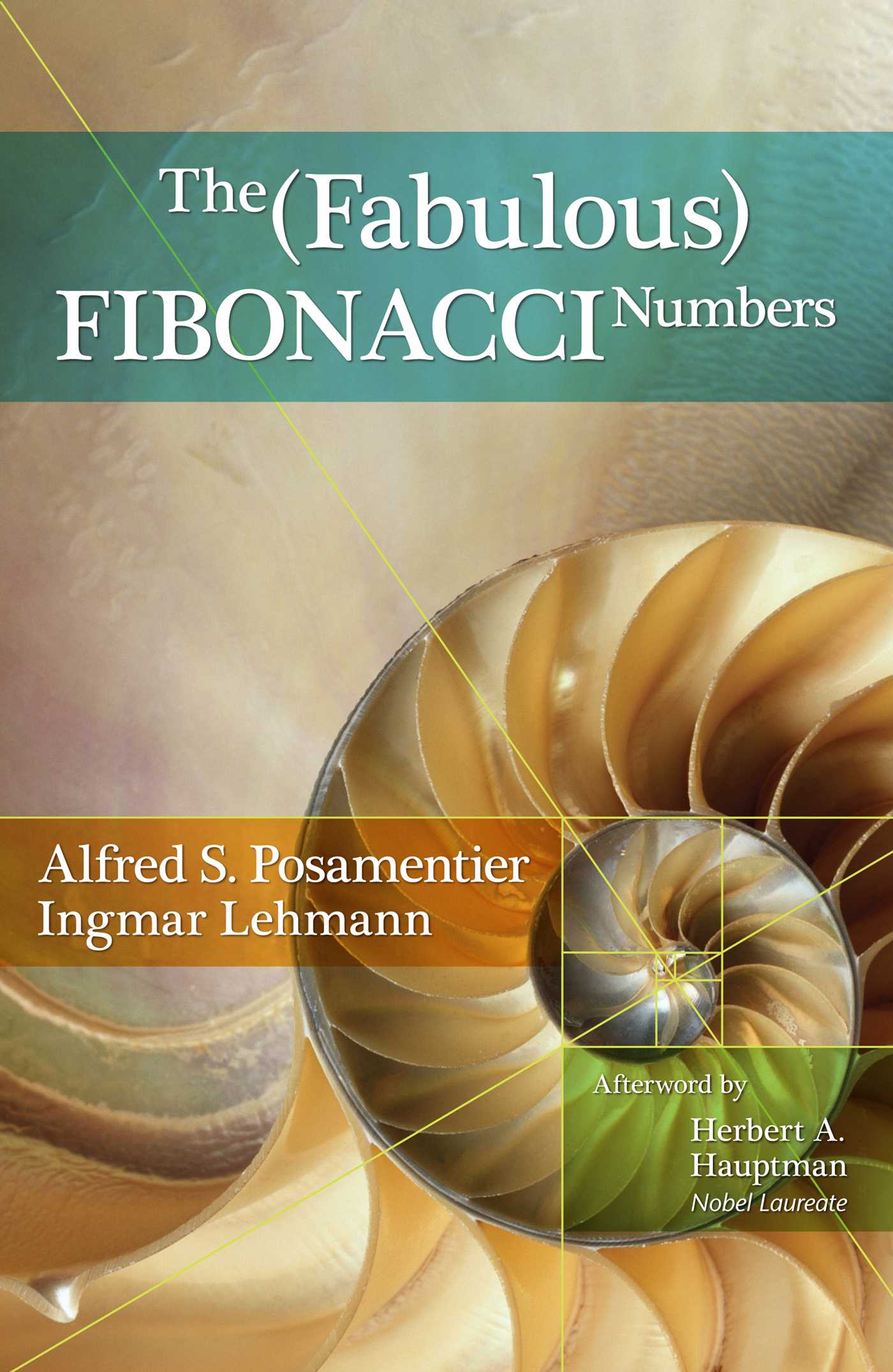
Fabulous Fibonacci Numbers
Globe Pequot Publishing · Print & ebook · February 10, 2023
A Mathematics pick for readers exploring Fabulous Fibonacci Numbers.
We earn from qualifying purchases.
- Who it’s for
- Trace Fibonacci numbers through natural forms, culture, and mathematics, with clarity instead of mystique.
- Themes
- Fibonacci patterns in nature, Mathematics in art and culture, Applications of the Fibonacci sequence
- Genres
- Number Theory, History & Philosophy of Math, Applied Math
Nearest books
Matched by what the books are about, then ordered by what their readers also loved.
 Secrets of Mental MathArthur Benjamin, Michael Shermer48% match
 Math Without NumbersMilo Beckman63% match
 The Joy of XSteven Strogatz58% matchShares History & Philosophy of Math
 One, Two, ThreeDavid Berlinski57% matchShares History & Philosophy of Math
 Secrets of TrianglesAlfred S. Posamentier, Ingmar Lehmann56% match
 Fantastic Numbers and Where to Find ThemAntonio Padilla56% match
 SymmetryMarcus du Sautoy56% matchShares History & Philosophy of Math
 Concrete MathematicsRonald L. Graham, Donald E. Knuth51% matchShares Applied Math
For younger readers: Everyday STEM Maths - Maths in Action, Anno's Counting Book, It's a Numbers Game! Basketball
Start with three books, and this one can be the first.
Members get a new edition every morning: a route out from their books to essays, research and talks, with the reason for each.
Start with this bookAbout this book
The most ubiquitous, and perhaps the most intriguing, number pattern in mathematics is the Fibonacci sequence. In this simple pattern beginning with two ones, each succeeding number is the sum of the two numbers immediately preceding it (1, 1, 2, 3, 5, 8, 13, 21, ad infinitum). Far from being just a curiosity, this sequence recurs in structures found throughout nature - from the arrangement of whorls on a pinecone to the branches of certain plant stems.
Continue reading
All of which is astounding evidence for the deep mathematical basis of the natural world. With admirable clarity, two veteran math educators take us on a fascinating tour of the many ramifications of the Fibonacci numbers. They begin with a brief history of a distinguished Italian discoverer, who, among other accomplishments, was responsible for popularizing the use of Arabic numerals in the West. Turning to botany, the authors demonstrate, through illustrative diagrams, the unbelievable connections between Fibonacci numbers and natural forms (pineapples, sunflowers, and daisies are just a few examples). In art, architecture, the stock market, and other areas of society and culture, they point out numerous examples of the Fibonacci sequence as well as its derivative, the "golden ratio." And of course in mathematics, as the authors amply demonstrate, there are almost boundless applications in probability, number theory, geometry, algebra, and Pascal's triangle, to name a few.Accessible and appealing to even the most math-phobic individual, this fun and enlightening book allows the reader to appreciate the elegance of mathematics and its amazing applications in both natural and cultural settings.
Patterns in Plain Sight
Trace Fibonacci numbers through natural forms, culture, and mathematics, with clarity instead of mystique.
Come here for
- Pinecones, sunflowers, and the numbers behind their patterns
- Mathematics meeting art, architecture, and everyday culture
Expect
- Clear explanations spanning botany, algebra, and probability
- A lively tour of the Fibonacci sequence and golden ratio
Where it sits
| Number Theory | 51% |
|---|---|
| History & Philosophy of Math | 43% |
| Applied Math | 31% |
Percentages are BookFrontier’s reading of the book.
Publisher categories
- Algebra
- Algebraic Geometry
- Number Theory
- Authors
- Alfred S. Posamentier, Ingmar Lehmann
- Publisher
- Globe Pequot Publishing
- Published
- February 10, 2023
- Format
- Print & ebook
- Theme
- Fibonacci patterns in nature · Mathematics in art and culture · Applications of the Fibonacci sequence
- Reading lane
- Algebra