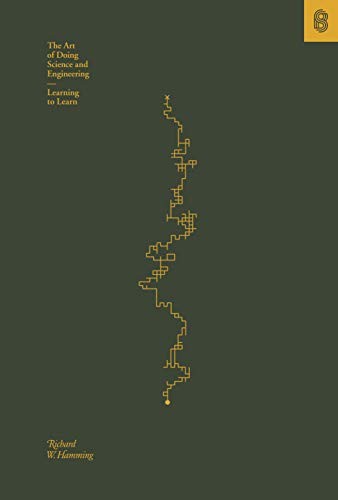
The Art of Doing Science and Engineering
Learning to Learn
Stripe Matter, Inc. · Print & ebook · May 26, 2020
A groundbreaking treatise by one of the great mathematicians of our age, who outlines a style of thinking by which great ideas are conceived.
We earn from qualifying purchases.
- Who it’s for
- Hamming makes a case for learning how to think—and work—toward ideas that matter.
- Genres
- Engineering Research, Information Theory, Science & Society
- Published
- Stripe Matter, Inc., May 26, 2020
Nearest books
Matched by what the books are about, then ordered by what their readers also loved.
 The Model ThinkerScott E. Page, Jamie Renell55% match
 A Mind at PlayJimmy Soni, Rob Goodman61% matchShares Information Theory
 Algorithm DesignJon Kleinberg, Eva Tardos51% match
 The Joy of XSteven Strogatz56% match
 The Art of StrategyAvinash K Dixit, Barry J Nalebuff50% match
 How to Invent EverythingRyan North52% match
 A Man for All MarketsEdward O. Thorp53% match
 Learn You a Haskell for Great Good!Miran Lipovaca53% match
For younger readers: The CS Detective, The Way Things Work: Newly Revised Edition, Basher Science Mini: Artificial Intelligence
Start with three books, and this one can be the first.
Members get a new edition every morning: a route out from their books to essays, research and talks, with the reason for each.
Start with this bookAbout this book
A groundbreaking treatise by one of the great mathematicians of our age, who outlines a style of thinking by which great ideas are conceived. What inspires and spurs on a great idea? Can we train ourselves to think in a way that will enable world-changing understandings and insights to emerge? Richard Hamming said we can.
Continue reading
He first inspired a generation of engineers, scientists, and researchers in 1986 with “You and Your Research,” an electrifying sermon on why some scientists do great work, why most don’t, why he did, and why you can—and should—too. The Art of Doing Science and Engineering is the full expression of what “You and Your Research” outlined. It's a book about thinking; more specifically, a style of thinking by which great ideas are conceived. The book is filled with stories of great people performing mighty deeds—but they are not meant simply to be admired. Instead, they are to be aspired to, learned from, and surpassed. Hamming consistently returns to Shannon’s information theory, Einstein’s theory of relativity, Grace Hopper’s work on high-level programming, Kaiser’s work on digital filters, and his own work on error-correcting codes. He also recounts a number of his spectacular failures as clear examples of what to avoid. Originally published in 1996 and adapted from a course that Hamming taught at the US Naval Postgraduate School, this edition includes an all-new foreword by designer, engineer, and founder of Dynamicland Bret Victor, plus more than 70 redrawn graphs and charts. The Art of Doing Science and Engineering is a reminder that a capacity for learning and creativity are accessible to everyone. Hamming was as much a teacher as a scientist, and having spent a lifetime forming and confirming a theory of great people and great ideas, he prepares the next generation for even greater distinction.
Thinking Toward Ideas
Hamming makes a case for learning how to think—and work—toward ideas that matter.
Come here for
- A practical philosophy of how consequential ideas take shape
- Lessons drawn from scientific breakthroughs and Hamming’s own failures
Expect
- A teacherly look at creativity across science and engineering
- Examples to learn from, including a few cautionary failures
Where it sits
| Engineering Research | 36% |
|---|---|
| Information Theory | 28% |
| Science & Society | 25% |
Percentages are BookFrontier’s reading of the book.
Publisher categories
- Computer Science
- Information Technology
- Engineering Research
- Authors
- Richard Hamming, Bret Victor, Richard W. Hamming
- Publisher
- Stripe Matter, Inc.
- Published
- May 26, 2020
- Format
- Print & ebook
- Reading lane
- Computer Science