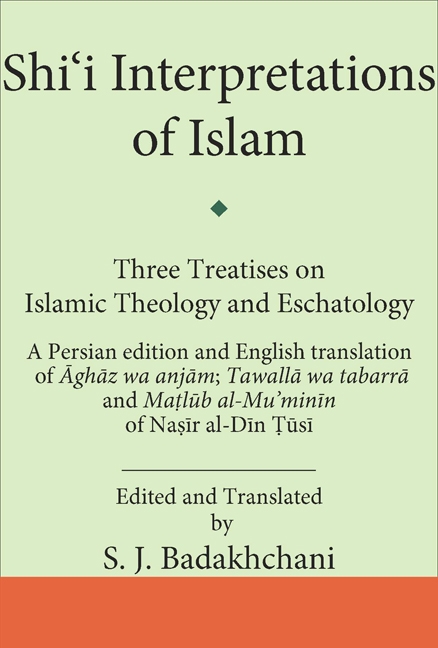
Shi'i Interpretations of Islam
Three Treatises on Theology and Eschatology
I.B. Tauris & Co Ltd · Print & ebook · December 15, 2010
One of the most prominent Muslim scholars and scientists of the medieval era, the Persian polymath Nasir al-Din Tusi (1201-1274) joined the Shi‘a Nizari Ismaili community at a young age, as the armies of Genghis Khan poured across his homeland.
We earn from qualifying purchases.
- Who it’s for
- Three treatises interpret Ismaili doctrine through human origins and destiny.
- Genres
- Shi'a Islam, Islamic Theology
- Published
- I.B. Tauris & Co Ltd, December 15, 2010
Nearest books
Matched by what the books are about, then ordered by what their readers also loved.
 The Study of Shi‘i IslamGurdofarid Miskinzoda, Farhad Daftary58% matchShares Shi'a Islam and Islamic Theology
 The Paradise of SubmissionNasir al-Din al-Tusi, Seyyed Jalal Hosseini Badakhchani82% matchShares Shi'a Islam
 Sectarian MilieuJohn E. Wansbrough, John Wansbrough55% match
 Justice and RemembranceReza Shah-Kazemi53% matchShares Shi'a Islam and Islamic Theology
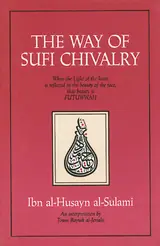 The Way of Sufi ChivalryIbn al-Husayn al-Sulami53% match
 A Handbook of Spiritual MedicineIbn Daud52% match
 Shi'ismHeinz Halm, Janet Watson52% matchShares Shi'a Islam and Islamic Theology
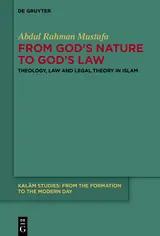 From God's Nature to God's LawAbdul Rahman Mustafa52% matchShares Islamic Theology
For younger readers: Riding a Donkey Backwards, Islamic Faith and Worship, Uthman Ibn Affan
Start with three books, and this one can be the first.
Members get a new edition every morning: a route out from their books to essays, research and talks, with the reason for each.
Start with this bookAbout this book
One of the most prominent Muslim scholars and scientists of the medieval era, the Persian polymath Nasir al-Din Tusi (1201-1274) joined the Shi‘a Nizari Ismaili community at a young age, as the armies of Genghis Khan poured across his homeland.
Continue reading
In the course of a long and eminent career, first under the patronage of the Ismailis at the fortress of Alamut, and later with the conquering Mongols, he produced over 150 works on diverse subjects from theology and philosophy to mathematics and astronomy. His principal works on Ismaili doctrine, the Rawda-yi taslim (The Paradise of Submission) and the autobiographical Sayr wa suluk (Contemplation and Action), are already available in English translation by S. J. Badakhchani. In this volume, he offers new critical editions and translations of three shorter Ismaili works by Tusi, namely Aghaz wa anjam (The Beginning and the End), Tawalla wa tabarra (Solidarity and Dissociation), and Matlub al-mu’minin (Desideratum of the Faithful). In these three treatises, Tusi provides concise interpretations of key motifs in Ismaili doctrine, with special reference to the primordial nature of man, his earthly existence in relation to the imam, and his destiny in the hereafter.
Tusi’s Ismaili Treatises
Three treatises interpret Ismaili doctrine through human origins and destiny.
Come here for
- Concise interpretations of key motifs in Ismaili doctrine.
Expect
- Humanity’s primordial nature and earthly existence in relation to the imam.
- Human destiny in the hereafter.
Where it sits
| Shi'a Islam | 99% |
|---|---|
| Islamic Theology | 61% |
Percentages are BookFrontier’s reading of the book.
Publisher categories
- Islamic Theology
- Authors
- S. J. Badakhchani
- Publisher
- I.B. Tauris & Co Ltd
- Published
- December 15, 2010
- Format
- Print & ebook
- Reading lane
- Islamic Theology