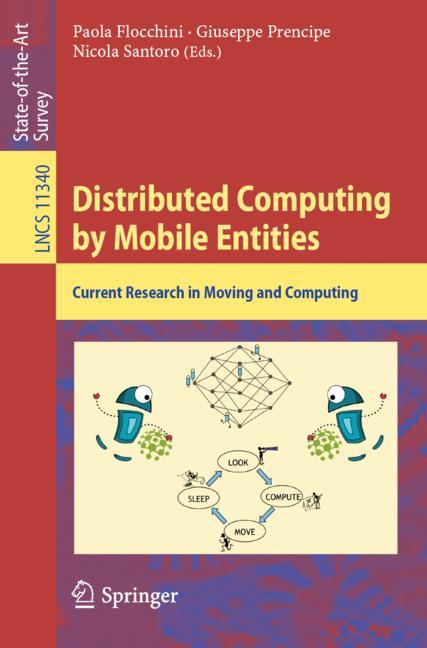
Distributed Computing by Mobile Entities
Current Research in Moving and Computing
Springer Nature · Print & ebook · January 15, 2019
We earn from qualifying purchases.
- Who it’s for
- Explore what mobile computational entities can accomplish, under what conditions, and at what cost.
- Genres
- Cloud Computing, Algorithms, Parallel Programming
- Published
- Springer Nature, January 15, 2019
Nearest books
Matched by what the books are about, then ordered by what their readers also loved.
 Composites With Micro- and Nano-structureVladimír Kompiš, Vladimír Kompis47% match
 Fundamentals of Computational ChemistryDaniel Sullivan46% match
 Computational Chemistry and Molecular ModelingK. I. Ramachandran, Gopakumar Deepa45% match
 Many-electron Approaches in Physics, Chemistry and MathematicsVolker Bach, Luigi Delle Site45% match
 Software Architecture: the Hard PartsNeal Ford, Mark Richards44% matchShares Cloud Computing
 Computational Methods in Physics, Chemistry and BiologyPaul Harrison44% match
 Knowledge MachinesEric T. Meyer, Ralph Schroeder44% match
 2d and 3d NanostructuresJean-Claude Serge Levy, Jean-Claude Serge Lévy44% match
For younger readers: The CS Detective, Science Comics: Computers, Digital Revolutionaries
Start with three books, and this one can be the first.
Members get a new edition every morning: a route out from their books to essays, research and talks, with the reason for each.
Start with this bookAbout this book
Distributed Computing by Mobile Entitiesis concerned with the study of the computational and complexity issues arising in systems of decentralized computational entities operating in a spatial universe Encompassing and modeling a large variety of application environments and systems, from robotic swarms to networks of mobile sensors, from software mobile agents in communication networks to crawlers and viruses on the web, the theoretical research in this area intersects distributed computing with the fields of computational geometry (especially for continuous spaces), control theory, graph theory and combinatorics (especially for discrete spaces).
Continue reading
The research focus is on determining what tasks can be performed by the entities, under what conditions, and at what cost. In particular, the central question is to determine what minimal hypotheses allow a given problem to be solved. This book is based on the lectures and tutorial presented at the research meeting on "Moving and Computing" (mac) held at La Maddalena Island in June 2017. Greatly expanded, revised and updated, each of the lectures forms an individual Chapter. Together, they provide a map of the current knowledge about the boundaries of distributed computing by mobile entities.
Mobile Entities
Explore what mobile computational entities can accomplish, under what conditions, and at what cost.
Come here for
- Computational and complexity questions in decentralized mobile systems
- Applications ranging from robotic swarms to web crawlers
Expect
- A map of current research on distributed computing by mobile entities
- Connections to computational geometry, control theory, graph theory, and combinatorics
Where it sits
| Algorithms | 45% |
|---|---|
| Cloud Computing | 38% |
| Parallel Programming | 30% |
Percentages are BookFrontier’s reading of the book.
Publisher categories
- Systems Architecture
- Computer Networking
- Authors
- Paola Flocchini, Giuseppe Prencipe, Nicola Santoro
- Publisher
- Springer Nature
- Published
- January 15, 2019
- Format
- Print & ebook
- Reading lane
- Systems Architecture