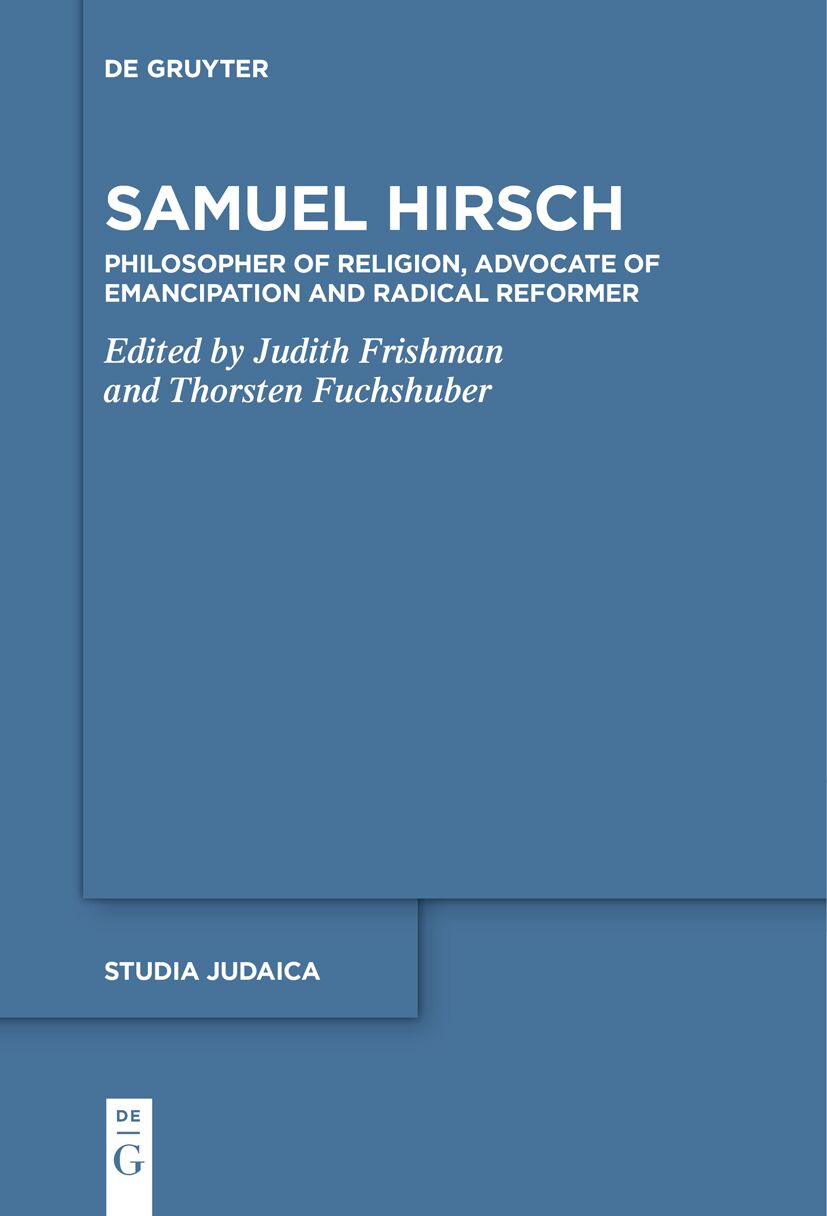
Samuel Hirsch
Philosopher of Religion, Advocate of Emancipation and Radical Reformer
De Gruyter · Print & ebook · October 24, 2022
Rabbi Samuel Hirsch (Thalfang 1815 – Chicago 1889) was instrumental in the development of Reform Judaism in Europe and the USA.
We earn from qualifying purchases.
- Who it’s for
- Trace Samuel Hirsch’s religious philosophy and reform ideas across Europe and the United States.
- Genres
- Reform Judaism, Jewish History
- Published
- De Gruyter, October 24, 2022
Nearest books
Matched by what the books are about, then ordered by what their readers also loved.
 Hakham Tsevi Ashkenazi and the Battlegrounds of the Early Modern RabbinateYosie Levine62% matchShares Jewish History
 Response to ModernityMichael A. Meyer59% matchShares Reform Judaism and Jewish History
 God in Search of ManAbraham Joshua Heschel59% match
 The Rise of Reform JudaismW. Gunther Plaut59% matchShares Reform Judaism and Jewish History
 Reform Judaism and DarwinDaniel Langton58% matchShares Reform Judaism
 A New Hasidism: RootsArthur Green, Ariel Evan Mayse57% match
 One People, Two WorldsAmmiel Hirsch, Yaakov Yosef Reinman55% match
 Modern Orthodox JudaismMenachem-Martin Gordon54% match
For younger readers: Tough Questions Jews Ask 2/e, On a Chariot of Fire
Start with three books, and this one can be the first.
Members get a new edition every morning: a route out from their books to essays, research and talks, with the reason for each.
Start with this bookAbout this book
Rabbi Samuel Hirsch (Thalfang 1815 – Chicago 1889) was instrumental in the development of Reform Judaism in Europe and the USA. This volume is the first lengthy publication devoted to this striking personality whose significance was no less than that of his contemporaries Abraham Geiger and David Einhorn. En route from Thalfang via Dessau and Luxembourg to Philadelphia, Hirsch left his mark on societal, religious, and philosophical developments in manifold ways.
Continue reading
By the time he was appointed Chief Rabbi of the Jewish community in Luxembourg in 1843, he had already written many of his most important works on the philosophy of religion. In them he engaged in debate with the Young Hegelians on the importance of Judaism, the religion that, more than any other, enabled the human actualization of freedom so central to Hegel’s philosophy. Over time Hirsch took an increasingly radical stance on issues such as Jewish rituals and mixed marriage. The goal of his reforms was not assimilation. He strove to strengthen Judaism to meet the demands of modernity and enable its survival in the modern era. Hirsch’s story is key to understanding the transnational history of Reform Judaism and the struggle of Jews to secure a place in history and society.
Hirsch and Reform
Trace Samuel Hirsch’s religious philosophy and reform ideas across Europe and the United States.
Come here for
- Hirsch’s debates with the Young Hegelians about Judaism and freedom
- His route from Thalfang through Dessau and Luxembourg to Philadelphia
Expect
- His increasingly radical stance on Jewish rituals
- His views on mixed marriage
Where it sits
| Reform Judaism | 81% |
|---|---|
| Jewish History | 38% |
Percentages are BookFrontier’s reading of the book.
Publisher categories
- Religion & Philosophy
- Jewish History
- Jewish Studies
- Authors
- Judith Frishman, Thorsten Fuchshuber, Judith
- Publisher
- De Gruyter
- Published
- October 24, 2022
- Format
- Print & ebook
- Reading lane
- Religion & Philosophy