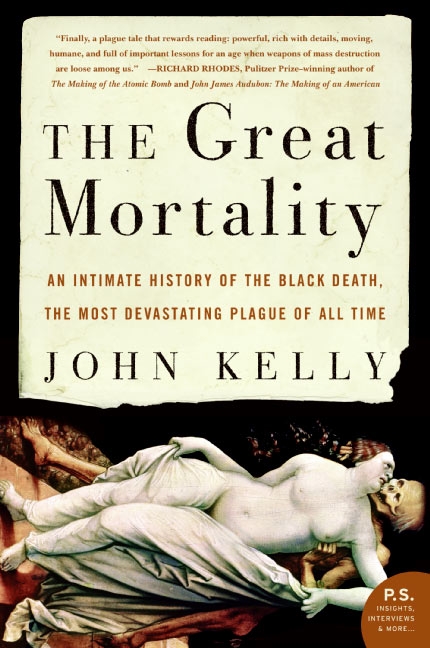
The Great Mortality
An Intimate History of the Black Death, the Most Devastating Plague of All Time
HarperCollins · Print & ebook · January 31, 2006
“Powerful, rich with details, moving, humane, and full of important lessons for an age when weapons of mass destruction are loose among us.” — Richard Rhodes, Pulitzer Prize-winning author of The Making of the Atomic Bomb The Great Plague is one of the most compelling events in human history—even more so now, when the notion of plague has never loomed larger as a contemporary public concern.
We earn from qualifying purchases.
- Who it’s for
- A sweeping account of the Black Death, told through the intimate human costs statistics can’t convey.
- Themes
- The Black Death, Social breakdown, Mass mortality
- Genres
- Medieval History, Contagious Diseases, Medical History
Nearest books
Matched by what the books are about, then ordered by what their readers also loved.
 Midnight in ChernobylAdam Higginbotham50% match
 Dead WakeErik Larson49% match
 The Great InfluenzaJohn M. Barry70% matchShares Medical History
 A Distant MirrorBarbara Wertheim Tuchman, Barbara W. Tuchman61% matchShares Medieval History
 The Killing SeasonRobert Cowley53% match
 A Higher Form of KillingDiana Preston52% match
 The Splendid and the VileJohn Lee, Erik Larson52% match
For younger readers: Very, Very, Very Dreadful, What Was the Plague?, The Deadliest Diseases Then and Now (the Deadliest #1, Scholastic Focus)
Start with three books, and this one can be the first.
Members get a new edition every morning: a route out from their books to essays, research and talks, with the reason for each.
Start with this bookAbout this book
“Powerful, rich with details, moving, humane, and full of important lessons for an age when weapons of mass destruction are loose among us.” — Richard Rhodes, Pulitzer Prize-winning author of The Making of the Atomic Bomb The Great Plague is one of the most compelling events in human history—even more so now, when the notion of plague has never loomed larger as a contemporary public concern.
Continue reading
The plague that devastated Asia and Europe in the 14th century has been of never-ending interest to both scholarly and general readers. Many books on the plague rely on statistics to tell the story: how many people died; how farm output and trade declined. But statistics can’t convey what it was like to sit in Siena or Avignon and hear that a thousand people a day are dying two towns away. Or to have to chose between your own life and your duty to a mortally ill child or spouse. Or to live in a society where the bonds of blood and sentiment and law have lost all meaning, where anyone can murder or rape or plunder anyone else without fear of consequence. In The Great Mortality, author John Kelly lends an air of immediacy and intimacy to his telling of the journey of the plague as it traveled from the steppes of Russia, across Europe, and into England, killing 75 million people—one third of the known population—before it vanished.
History Up Close
A sweeping account of the Black Death, told through the intimate human costs statistics can’t convey.
Come here for
- The human choices behind a catastrophe measured in millions
- A vivid sense of plague’s reach across Europe
Expect
- A narrative history focused on lived experience
- A grave, humane look at social bonds under pressure
Where it sits
| Medieval History | 67% |
|---|---|
| Contagious Diseases | 40% |
| Medical History | 35% |
Percentages are BookFrontier’s reading of the book.
Publisher categories
- World History
- Medieval History
- Infectious Diseases
- Epidemiology
Show all 8 publisher categories
- Medical History
- Microbiology
- Biology
- History of Science
- Authors
- John Kelly
- Publisher
- HarperCollins
- Published
- January 31, 2006
- Format
- Print & ebook
- Theme
- The Black Death · Social breakdown · Mass mortality
- Reading lane
- World History