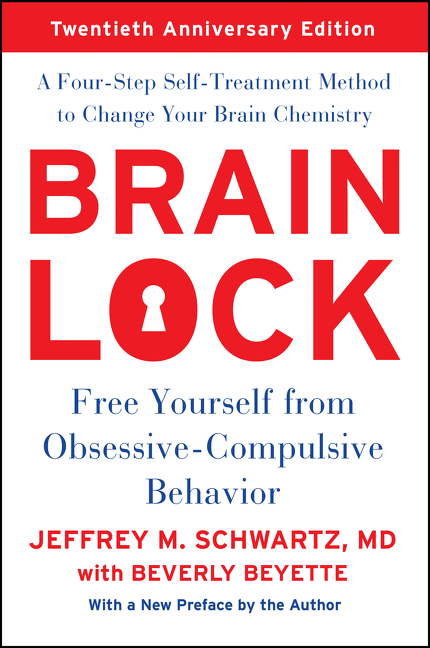
Brain Lock, Twentieth Anniversary Edition
Free Yourself From Obsessive-compulsive Behavior
HarperCollins · Print & ebook · December 6, 2016
“This book will make a world of difference in the lives of people with OCD.” —Eric Hollander, M.D., Compulsive, Impulsive & Anxiety Disorders Program, Mt.
We earn from qualifying purchases.
- Who it’s for
- A practical guide to OCD pairs a four-step method with real-life patient stories.
- Themes
- Obsessive-compulsive disorder, Cognitive self-therapy, Behavior modification
- Genres
- Living with OCD, CBT, Compulsive Behavior
Nearest books
Matched by what the books are about, then ordered by what their readers also loved. Most of these share its genres: Living with OCD and CBT.
 Freeing Your Child From Obsessive-compulsive Disorder, Revised and Updated EditionTamar E. Chansky, Ph.D.73% match
 Needing to Know for SureMartin N. Seif PhD, Sally M. Winston PsyD62% match
 Breaking Free of Child Anxiety and OCDLebowitz, Eli R. Lebowitz63% match
 Rewire Your OCD BrainCatherine M. Pittman PhD, William H. Youngs PhD80% match
 Freedom From Obsessive Compulsive DisorderJonathan Grayson79% matchAlso shares Compulsive Behavior
For younger readers: Crushing OCD Workbook for Kids, Obsessed, A Kids Book About OCD
Start with three books, and this one can be the first.
Members get a new edition every morning: a route out from their books to essays, research and talks, with the reason for each.
Start with this bookAbout this book
“This book will make a world of difference in the lives of people with OCD.” —Eric Hollander, M.D., Compulsive, Impulsive & Anxiety Disorders Program, Mt.
Continue reading
Sinai School of Medicine The definitive classic that has helped more than 400,000 people defeat obsessive-compulsive behavior, with all-new material from the author An estimated 5 million Americans suffer from obsessive-compulsive disorder (OCD) and live diminished lives in which they are compelled to obsess about something or to repeat a similar task over and over. Traditionally, OCD has been treated with Prozac or similar drugs. The problem with medication, aside from its cost, is that 30 percent of people treated don't respond to it, and when the pills stop, the symptoms invariably return. In Brain Lock, Jeffrey M. Schwartz, M.D., presents a simple four-step method for overcoming OCD that is so effective, it's now used in academic treatment centers throughout the world. Proven by brain-imaging tests to actually alter the brain's chemistry, this method doesn't rely on psychopharmaceuticals. Instead, patients use cognitive self-therapy and behavior modification to develop new patterns of response to their obsessions. In essence, they use the mind to fix the brain. Using the real-life stories of actual patients, Brain Lock explains this revolutionary method and provides readers with the inspiration and tools to free themselves from their psychic prisons and regain control of their lives.
Changing the Pattern
A practical guide to OCD pairs a four-step method with real-life patient stories.
Come here for
- A structured, non-medication approach to changing responses to obsessions
- Cognitive self-therapy and behavior modification, explained through patient stories
Expect
- A four-step method for developing new patterns of response
- A focus on regaining control from obsessive-compulsive behavior
Where it sits
| Living with OCD | 96% |
|---|---|
| CBT | 43% |
| Compulsive Behavior | 21% |
Percentages are BookFrontier’s reading of the book.
Publisher categories
- Neurology
- Neuroscience
- Physician Practice
- Psychiatry
Show all 8 publisher categories
- Compulsive Behavior
- Mental Health
- CBT
- Personal Growth
- Authors
- Jeffrey M. Schwartz
- Publisher
- HarperCollins
- Published
- December 6, 2016
- Format
- Print & ebook
- Theme
- Obsessive-compulsive disorder · Cognitive self-therapy · Behavior modification
- Reading lane
- Neurology