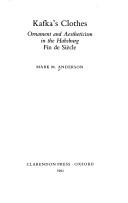
Kafka's Clothes
Ornament and Aestheticism in the Habsburg Fin De Siècle
Oxford University Press · Print & ebook · April 30, 1999
`One should either be a work of art, or wear one' proclaimed Oscar Wilde at the end of the nineteenth century; `I am made of literature, I am nothing else, and cannot be anything else' Franz Kafka proclaimed a brief decade later.
We earn from qualifying purchases.
- Who it’s for
- Mark Anderson traces continuities between Kafka’s dandyism and his later literary identity.
- Genres
- German Literary Criticism, 20th-Century Literary Criticism
- Published
- Oxford University Press, April 30, 1999
Nearest books
Matched by what the books are about, then ordered by what their readers also loved.
 Aesthetic DilemmasMarlo Burks, Marlo Alexandra Burks64% matchShares German Literary Criticism and 20th-Century Literary Criticism
 Kafka's Jewish LanguagesDavid Suchoff61% matchShares German Literary Criticism and 20th-Century Literary Criticism
 German-jewish Thought and Its AfterlifeVivian Liska58% matchShares German Literary Criticism
 The Soul of Man Under SocialismOscar Wilde55% match
 Aesthetic TheoryTheodor W. Adorno, Robert Hullot-Kentor55% matchShares German Literary Criticism
 Milan Kundera and Feminist CriticismJ. O'Brien, John O'Brien55% matchShares 20th-Century Literary Criticism
 EncounterMilan Kundera55% match
 Modernism: a Very Short IntroductionChristopher Butler55% matchShares 20th-Century Literary Criticism
Start with three books, and this one can be the first.
Members get a new edition every morning: a route out from their books to essays, research and talks, with the reason for each.
Start with this bookAbout this book
`One should either be a work of art, or wear one' proclaimed Oscar Wilde at the end of the nineteenth century; `I am made of literature, I am nothing else, and cannot be anything else' Franz Kafka proclaimed a brief decade later. Between these two claims lies the largely unexplored region in which the European decadent movement turned into the modernist avant-garde.
Continue reading
In this original historical study, Mark Anderson explores Kafka's early dandyism, his interest in fashion, literary decadence and the `superficial' spectacle of modern urban life, as well as his subsequent repudiation of these phenomena in forging a literary identity as the isolated, otherworldly `poet' of modern alienation. Rather than posit a break between these two personae, Anderson charts the historical continuities between the young Kafka and the author of The Metamorphosis and The Trial. The book demonstrates how clothing functions as a semi-private code of meaning in his literary works and the extent to which the aestheticist notion of becoming the work of art haunts Kafka's conception of writing throughout his life. The result is a startlingly unconventional portrait of Kafka and Prague at the turn of the century, involving such issues as Jugendstil aesthetics, Otto Weininger's `egoless' woman, the Viennese critique of architectural ornament, the clothing-reform movement, anti-Semitism, and the question of Jewish-German writing.
Kafka and Clothing
Mark Anderson traces continuities between Kafka’s dandyism and his later literary identity.
Come here for
- Kafka’s early dandyism, fashion interests, and literary decadence
- Clothing as a semi-private code in his literary works
Expect
- A study of Prague at the turn of the century
- Discussion of Jugendstil, clothing reform, anti-Semitism, and Jewish-German writing
Where it sits
| German Literary Criticism | 75% |
|---|---|
| 20th-Century Literary Criticism | 71% |
Percentages are BookFrontier’s reading of the book.
Publisher categories
- Literary Criticism
- Authors
- Mark M. Anderson
- Publisher
- Oxford University Press
- Published
- April 30, 1999
- Format
- Print & ebook
- Reading lane
- Literary Criticism